Physics and Applications of Andreev Spin Qubits by Prof Valla Fatemi
IAS Frontiers Seminars: Quantum Horizons, Seminar #5
On 12 January 2026, Prof Valla Fatemi from Cornell University presented his talk titled “Physics and Applications of Andreev Spin Qubits”. The compact and insightful talk gave audiences an idea of how quantum bit (qubit) states can be ingeniously engineered from delicate experimental setups. His engaging presentation was delivered with great clarity and captivated audiences across all levels, ranging from postgraduate students to renowned experts in their respective fields.
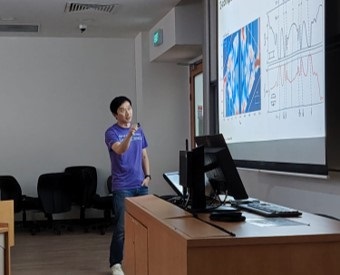
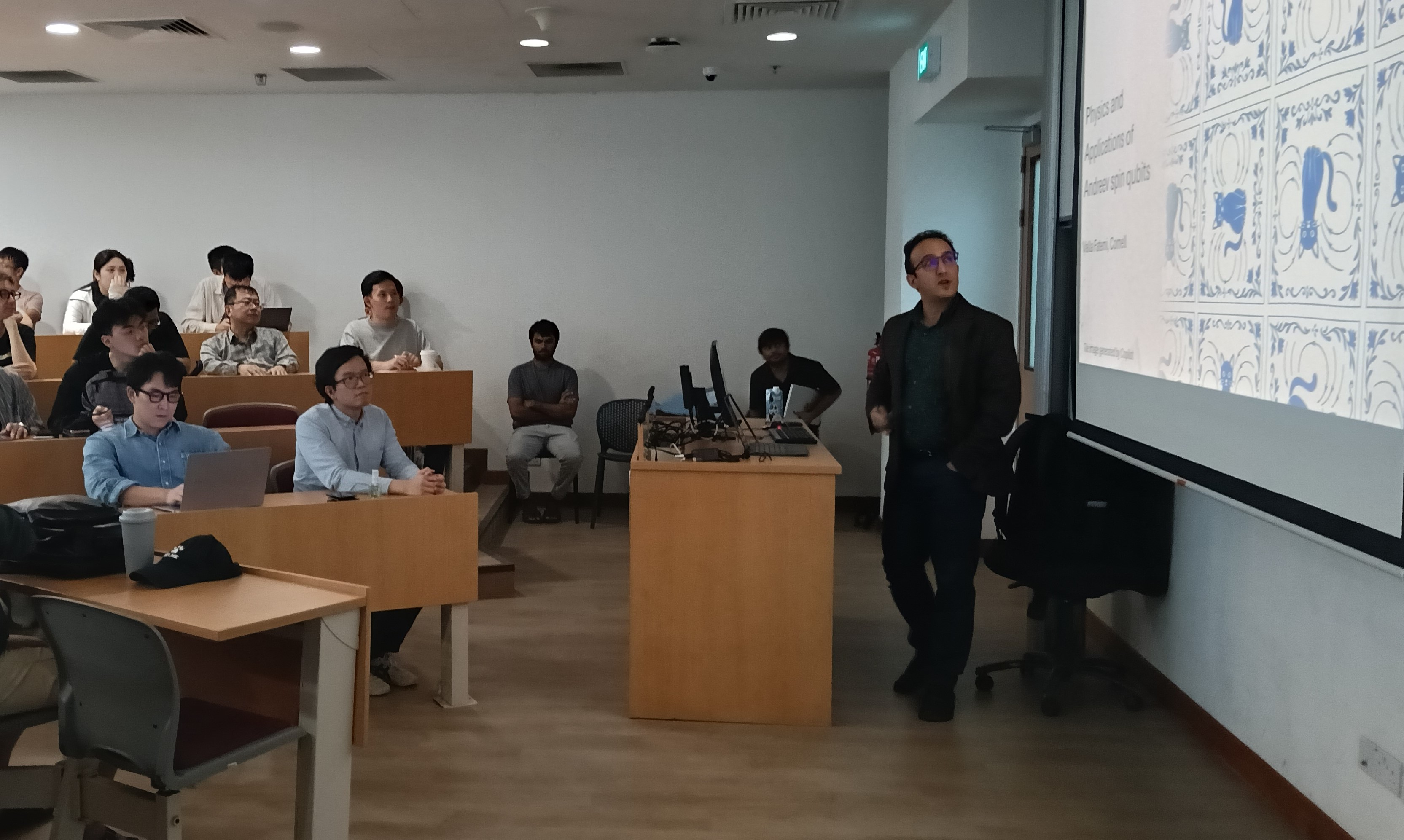 From bits to qubits, Prof Valla Fatemi explores quantum devices unlocking unprecedented computational power.
Prof Fatemi began his presentation by outlining the history and development of quantum physics over the past century, before identifying and connecting relevant subfields to his current work: building devices that could harness the vast potential of quantum mechanics beyond the simple semiconductor technologies widely used in modern-day electronics. In essence, the conventional way to store data is by expressing it as strings of information, each representing a two-state system. While many such implementations exist, the most common method relies on transistors that control electronic states, giving rise to what is known as a “bit”. A qubit, on the other hand, exploits the principles of quantum mechanics and ideally serves as a bit with the added advantage of quantum superposition, offering potentially unparalleled computational power and scalability.
After laying down the conceptual foundations, Prof Fatemi swiftly delved into more advanced topics surrounding his pursuit of creating a qubit with desirable properties, such as long coherence times with reasonable parity and dephasing timescales. These properties can be achieved through confinement using superconductors, which host localised energy levels that mediate macroscopic supercurrents. Such a hybrid spin–flux qubit is known as an Andreev Spin Qubit (ASQ), where the supercurrent depends on the spin degree of freedom due to spin–orbit coupling. Using the ASQ as a central concept, Prof Fatemi introduced his experimental setup consisting of a heterostructure between aluminium and indium arsenide, serving as the superconductor and semiconductor components respectively. This junction effectively functions as an Andreev “vacuum tube” with strong spin–orbit interaction and an enhanced g-factor. He then reported optical absorption measurements of this heterostructure, revealing a rich phase diagram relating superconducting phase and excitation energy.
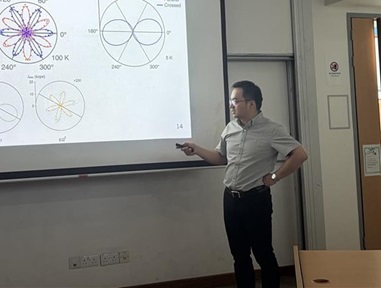
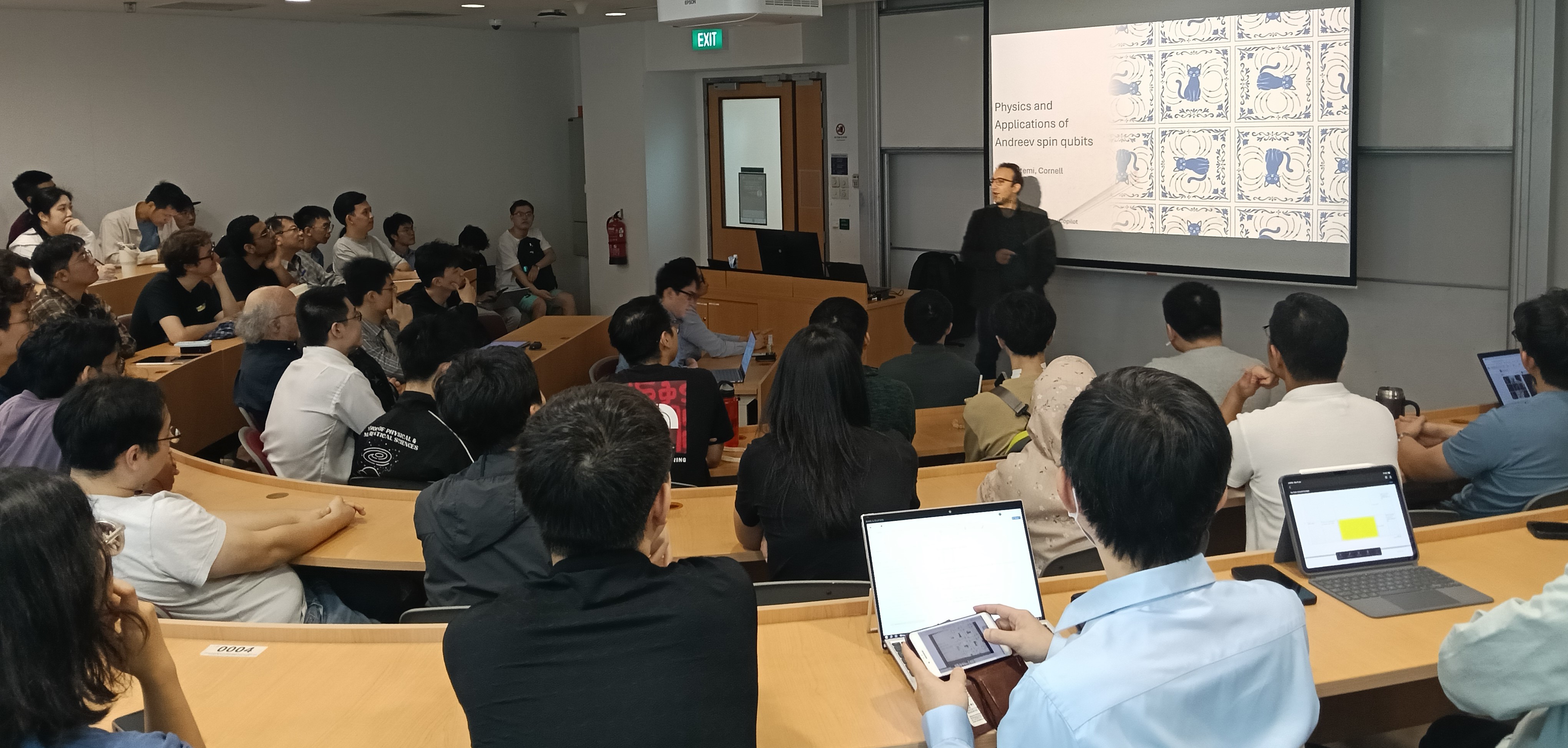 Prof Valla Fatemi presents Andreev spin qubits, revealing noise-free split resonances and long-lived quantum states in engineered superconducting heterostructures.
The phase diagram observed by Prof Fatemi showed promising features, including well-defined auxiliary states and a qubit basis in which individual transitions could be selectively addressed, with degeneracies occurring only at zero and 180 degrees of phase. Subsequent time-domain measurements revealed spin and fermion-parity lifetimes on the microsecond scale, while the dephasing timescale was found to be on the nanosecond scale. Since experiments involving such delicate systems are highly susceptible to interference, Prof Fatemi also explored error-reduction strategies by minimizing quasiparticle “poisoning” (unwanted excitations) through gap engineering.
With the ASQ effectively serving as a spin-dependent inductor, he designed a superconducting circuit capable of resolving energy relaxation processes and quasiparticle poisoning events. The reflectance of the junction was measured across varying incident frequencies and amplitudes as a function of the superconducting phase, revealing meandering and split resonance frequencies within a specific phase regime. Notably, this splitting of states was free from significant noise, with two clear and distinct states observed which is an unprecedented result for the system under investigation.
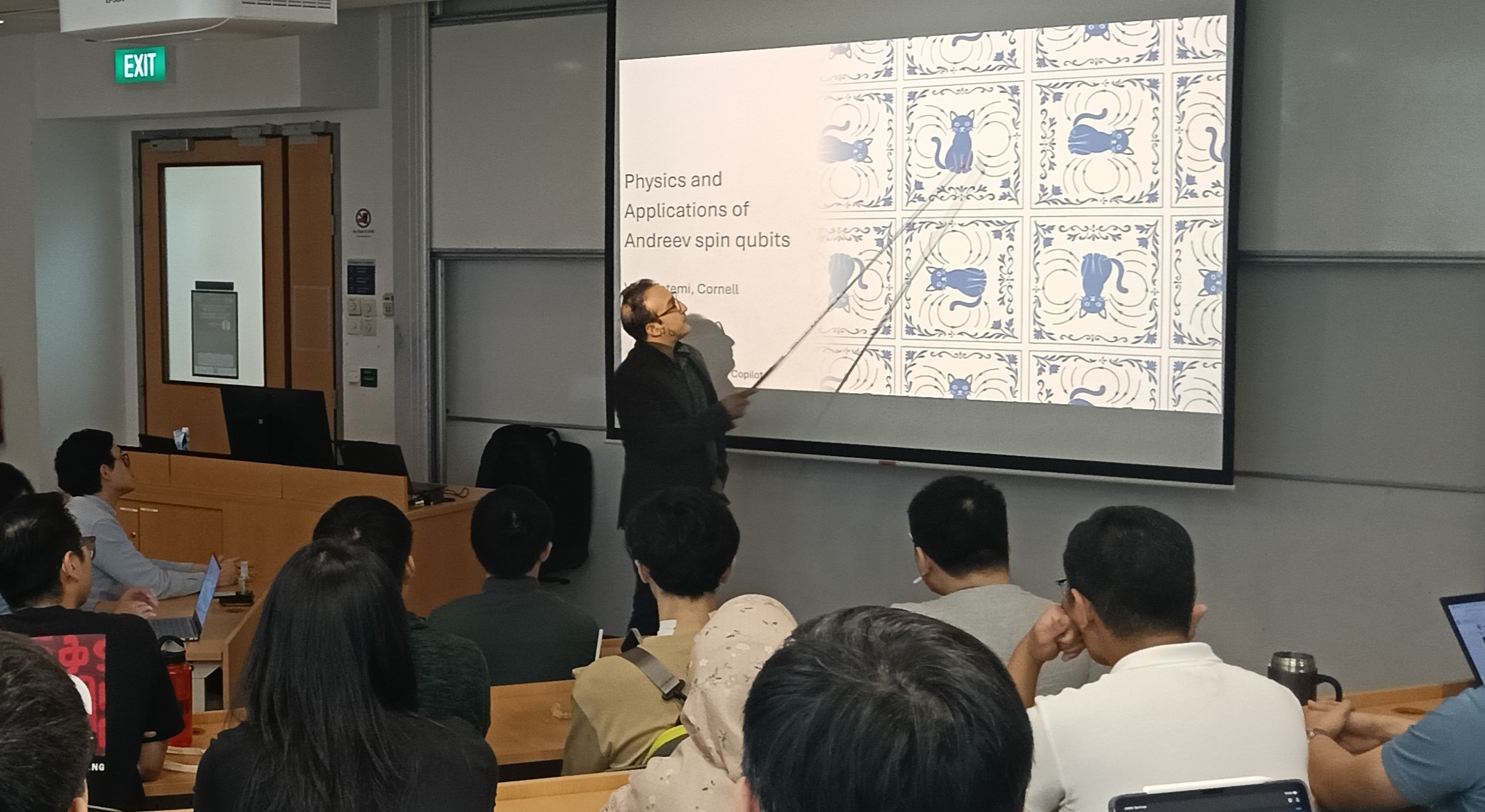 Exploring how fermionic symmetries and repetition-based error correction protect quantum information, suppress dephasing, and advance coherent quantum systems.
Finally, Prof Fatemi discussed methods for protecting quantum information, aimed at preserving state integrity through repetition-based error correction schemes. As the system under study is fermionic, Kramers’ theorem implies that at certain symmetry points, the Hamiltonian cannot contain terms with an odd number of Pauli matrices. This property can be exploited using singlet states to suppress dephasing effects. Prof Fatemi concluded by taking thought-provoking and technical questions from the audience, engaging in concise yet insightful discussions with experts, and highlighting several challenges, limitations, and plausible future extensions of his work. His talk was met with overwhelmingly positive feedback and greatly enriched the learning environment for all attendees.
This seminar is part of the ongoing IAS Frontiers Seminars: Quantum Horizons series. Find out more about the upcoming seminars and register here.
Written by John Tan| NTU School of Physical and Mathematical Sciences
“I enjoyed how he introduced AQS and how he implemented it to his set up achieving reliable quantum info. ” - John Tan (PhD Student, SPMS)
"His perspective on the application of Andreev Spin for quantum technology application and its future" - Qiu Kai Wei (PhD Student, SPMS)
“The professor introduced the quantum circuit and materials from the beginning to the deep concepts. Additionally, he interacted and answered questions from attendees very well.” - Chiu Kuan-Fu (Masters Student, SPMS)