Probing 2D Magnetic Materials with Magnetotransport by Prof Alberto Morpurgo
IAS Frontiers Seminars: Quantum Horizons, Seminar #4
Held on 1 December 2025, the seminar featured Prof Alberto Morpurgo (University of Geneva), who presented how magnetotransport in 2D magnetic materials uncovers rich magnetic phase behaviour down to the ultimate limit of individual monolayers. Specifically, he explained the underlying concepts and the latest experimental insights on probing magnetism in atomically thin layers and how new functionalities can emerge.
The seminar gave undergraduates, graduate students and faculty the opportunity to hear from a highly respected condensed matter physicist whose influential work has significantly shaped current research on the electronic properties on 2D materials and heterostructures.
Prof Morpurgo began by categorising a broad family of 2D magnetic semiconductors according to whether they exhibit ferromagnetic or antiferromagnetic ground states. Materials with ferromagnetic order are experimentally easier to study because they possess a non-zero net magnetisation. However, probing the magnetic response of atomically thin monolayers remains highly challenging. Therefore, transport measurements are essential, as they provide a powerful way to detect and investigate magnetic phase transitions in these ultrathin systems.
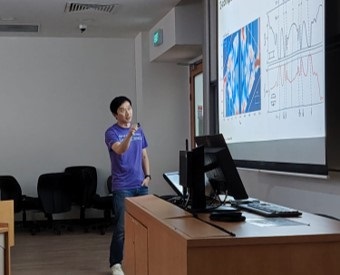
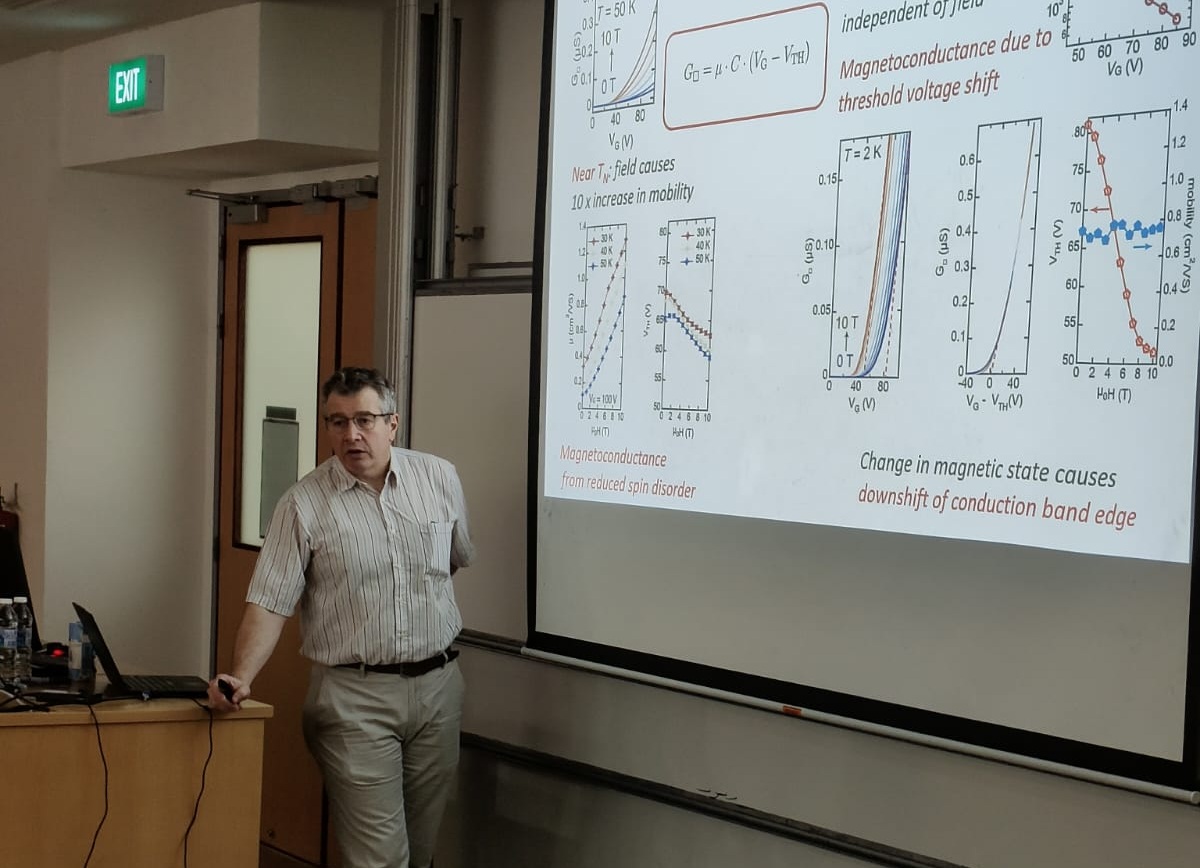 Prof Morpurgo explains how transport measurements reveal magnetic behaviour and phase transitions in ultrathin 2D materials.
Prof Morpurgo then introduced two types of transport measurements that his group employs to investigate the magnetic properties of these materials. Both approaches rely on fabricating transistors using compounds such as chromium(III) bromide and chromium(III) iodide, which are then brought into contact with the magnetic semiconductors. A doped silicon substrate serves as the gate to accumulate charge, enabling the measurement of charge transfer. Selecting an appropriate material for the transistor is difficult, as the bandwidth must not be too small, otherwise the charge can become easily localised.
The material he selected for the transistor was CrPS₄, which has a relatively large bandwidth (around 1 eV, according to ab-initio calculations). In addition, CrPS₄ is a weakly anisotropic layered antiferromagnet, making it well suited for these studies. He then demonstrated the types of magnetic responses that emerge when a magnetic field is applied at low temperatures. In particular, the magnetisation of individual layers can switch orientation, giving rise to either spin-flip or spin-flop transitions, depending on how the spins realign. For instance, chromium(III) iodide exhibits spin-flip transitions, whereas MnPS₃ undergoes spin-flop transitions.
With this setup, the magneto-conductance of the materials can be measured by varying both the magnetic field and the temperature. By examining how the magneto-conductance evolves under an applied magnetic field, one can identify the corresponding magnetic state (whether it is a spin-flip or spin-flop configuration). Moreover, because the magnetic state is temperature dependent, there exists a critical temperature at which the system undergoes a transition between these states. This spin-phase transition is particularly intriguing, as it leads to a downward shift of the conduction-band edge.
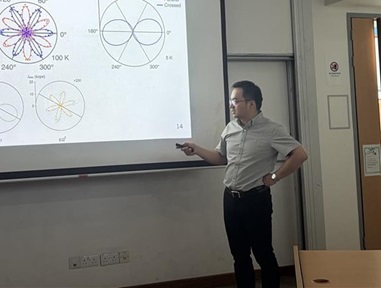
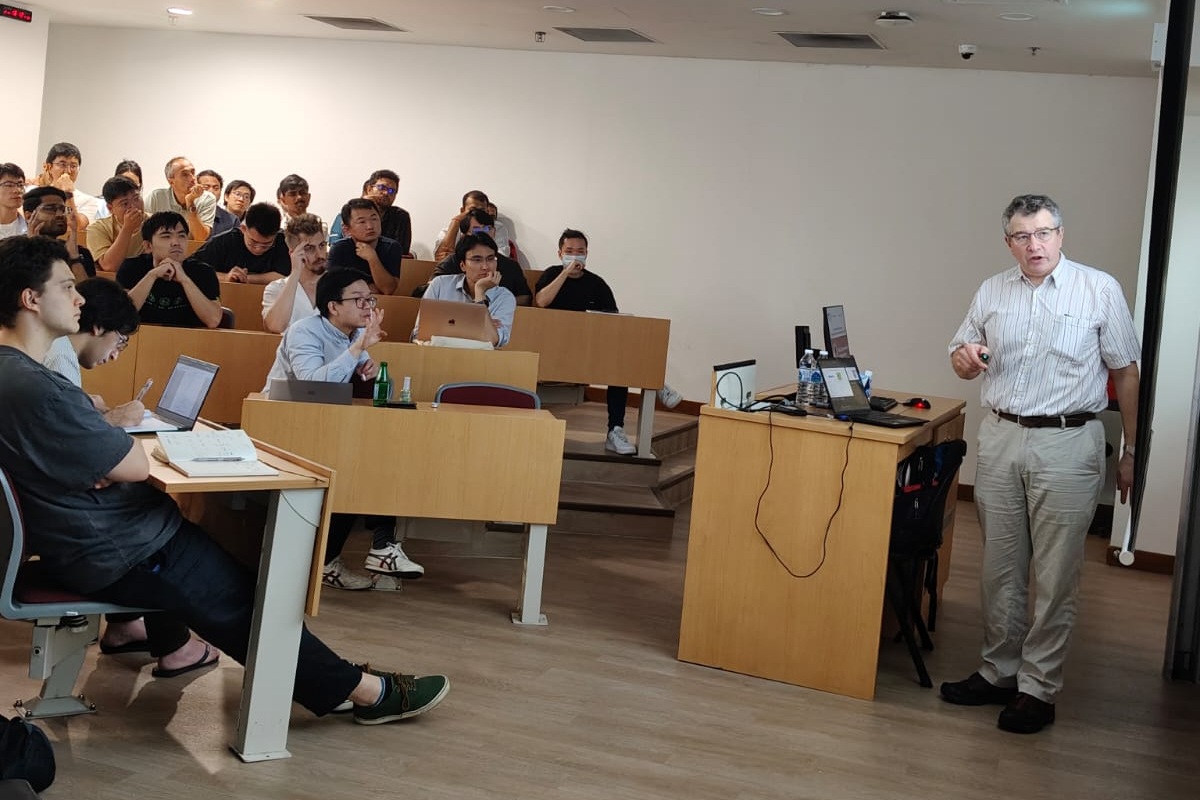 Prof Morpurgo presents transistor-based transport measurements to reveal spin-flip and spin-flop magnetic behaviours.
The seminar then explored the case in which a finite displacement field is applied. Depending on the direction of electric field, and in the presence of magnetic field, the energy of the system will be different. Magneto-conductance was measured under different orientations of the magnetic field: when the field is applied out of plane, a clear hysteresis can be observed, whereas no hysteresis is observed for an in-plane magnetic field.
Prof Morpurgo further explained that a perpendicular electric field breaks inversion symmetry, which in turn induces spin polarisation in the conduction band. In systems with sufficiently high electron density, this mechanism allows the magnetic state to be tuned, shifting the anisotropy from out-of-plane to in-plane. This tunability highlights how electric fields can serve as an efficient control knob for manipulating magnetic order in ultrathin materials. He emphasised that such electric-field control is particularly promising for device applications, as it enables reversible switching without relying solely on large magnetic fields.
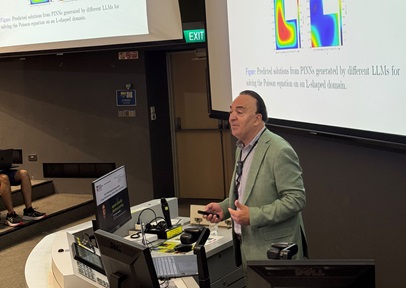
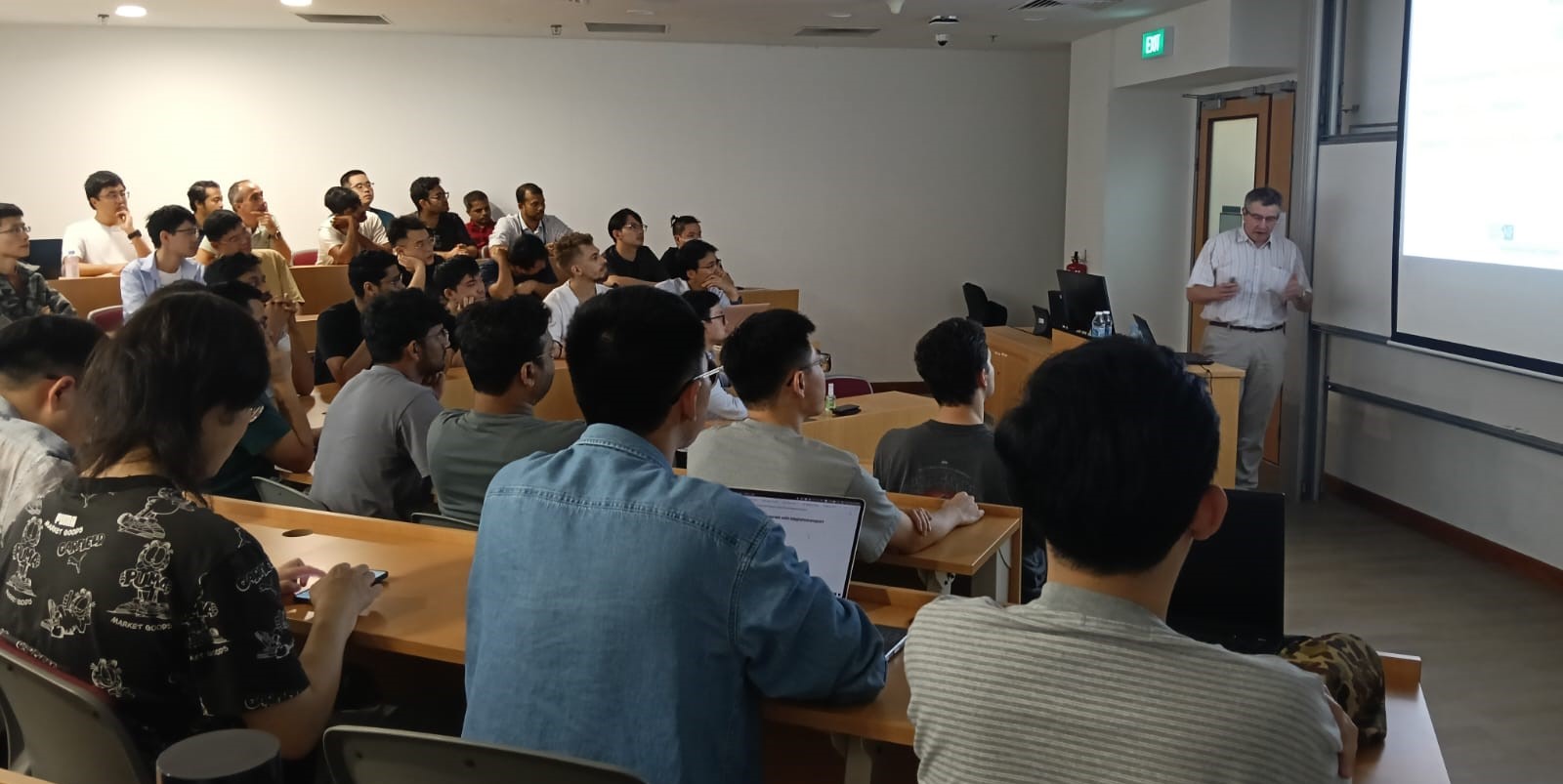 Discussions highlight electric-field-driven tuning of magnetic anisotropy, with hysteresis changing under varied field orientations.
The seminar concluded with an engaging Q&A session, with questions ranging from other possible magnetic responses to the subtleties of the measurement techniques. Prof Morpurgo’s talk highlighted how thoughtful experimental design, paired with a deep understanding of fundamental physics, can reveal phenomena that would otherwise remain inaccessible. His work underscores the rapidly growing potential of 2D magnetic systems as a platform for discovering new states of matter. The session left the audience with a clearer sense of both the conceptual challenges and the exciting opportunities that lie ahead in this field.
This seminar is part of the ongoing IAS Frontiers Seminars: Quantum Horizons series. Find out more about the upcoming seminars and register here.
Written by Tan Fei | NTU School of Physical and Mathematical Sciences
“I really enjoyed his explanation on the physics of the materials” - Wong Xuan Kai (PhD Student, SPMS)
“Prof Morpurgo was very articulate in introducing two mechanisms, spin flip and spin flop” - John Tan (PhD Student, SPMS)
"The talk started with a general introduction and several questions, which is much easier for people not professionals in materials." - Chiu Kuan-Fu (Masters Student, SPMS)