Lee Kong Chian Distinguished Professor Public Lecture by Prof Duncan Haldane
Written by Shivam Mahajan | Research Fellow, SPMS
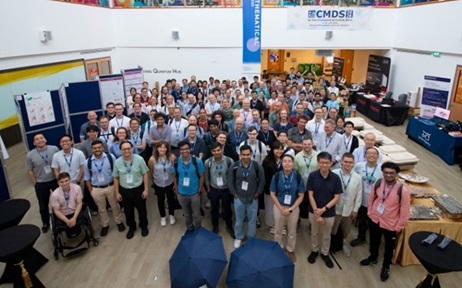
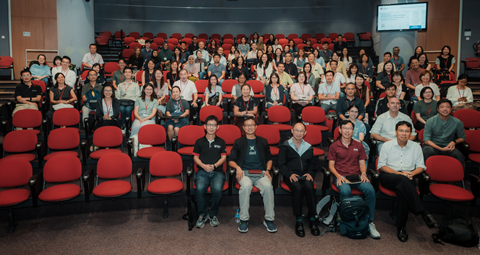
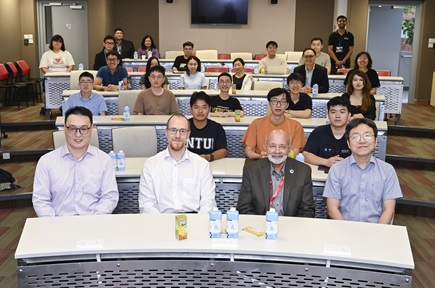
On 14January 2026, the Institute of Advanced Studies (IAS) at Nanyang Technological University hosted the IAS Lee Kong Chian Distinguished Professor Public Lecture by Prof Duncan Haldane, Nobel Laureate in Physics (2016), at the Stephen Riady Auditorium in Singapore’s city centre. Sponsored by the Lee Foundation, the lecture brought together students, researchers, and members of the public for an engaging evening exploring how quantum mechanics—a theory developed over a century ago—continues to shape modern science and emerging technologies.
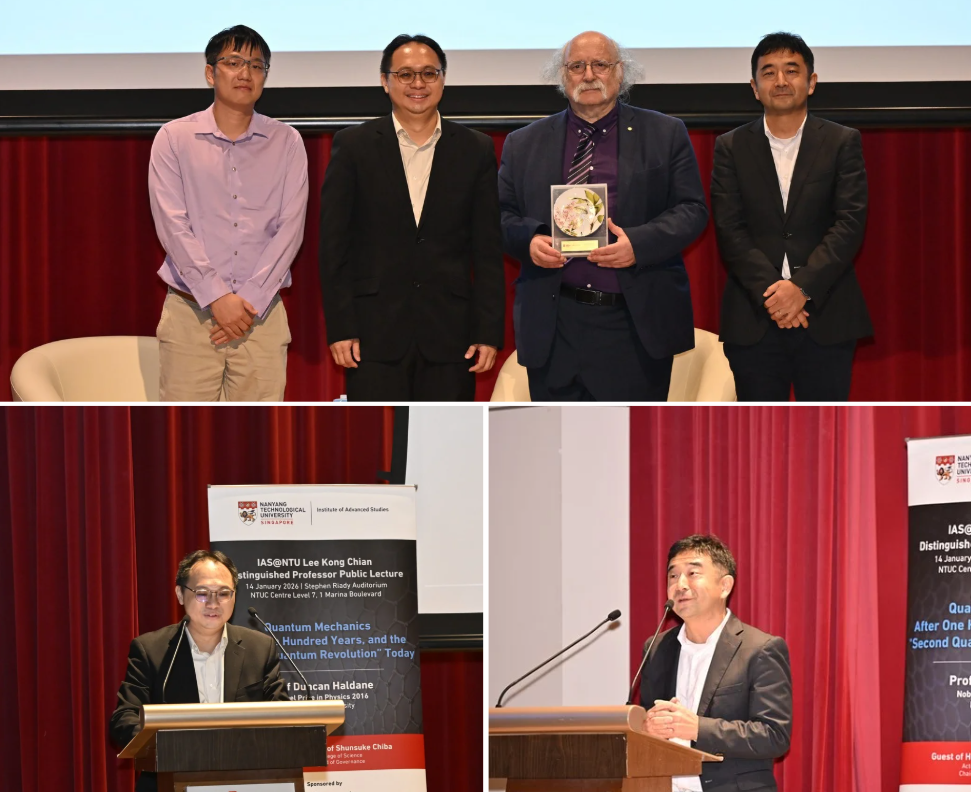
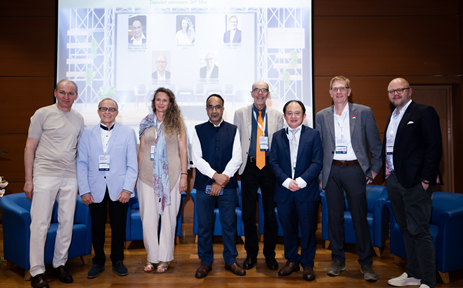
[Top, from left to right] Assoc Prof Yang Bo (SPMS, NTU), Prof Sum Tze Chien (Director, IAS), Prof Duncan Haldane and Prof Shunsuke Chiba (Acting Dean, College of Science, NTU); [Bottom] Opening addresses by Prof Sum Tze Chien and Guest-of-Honour Prof Shunsuke Chiba.
In his lecture, “Quantum Mechanics after One Hundred Years, and the ‘Second Quantum Revolution’ Today,” Prof Haldane guided the audience through the evolution of quantum theory, showing how ideas that once seemed abstract or paradoxical are now driving powerful new technologies. For much of the twentieth century, quantum mechanics was popularly associated with principles such as Heisenberg’s uncertainty principle. Only in recent decades has another phenomenon—quantum entanglement—emerged as a central concept, enabling advances in quantum information, communication, and cryptography.
Prof Haldane began by revisiting the early models of atoms. He recalled Niels Bohr’s hydrogen atom, in which a negatively charged electron orbits a positively charged nucleus, and explained how Schrödinger’s wave mechanics later reimagined electrons as occupying quantum states called “orbitals.” He highlighted the Pauli exclusion principle, which prevents two identical electrons from occupying the same quantum state unless their intrinsic spins point in opposite directions. Far from being merely theoretical, this principle explains why matter has structure and solidity, governs chemical bonding, and underpins the stability of the world around us.
 Prof Haldane traces quantum ideas shaping matter, entanglement, and today’s second quantum revolution.
This naturally led to entanglement, a phenomenon Einstein famously dismissed as “spooky action at a distance,” in which particles remain linked so that the state of one cannot be described independently of the other, even over large distances. Later theoretical work by John Stewart Bell provided a way to test whether these correlations could be explained classically, and experiments led by Alain Aspect in the early 1980s confirmed Bell’s predictions using entangled photons. Today, entanglement can be generated over continents and even via satellites, firmly establishing it as a real and measurable property of nature.
Prof Haldane noted that generating and sustaining long-range entanglement is challenging, a difficulty that spurred discoveries in condensed-matter physics from the late 1970s onward. Klaus von Klitzing’s discovery of the quantum Hall effect in 1980, along with unusual magnetic states in quantum spin chains (now associated with the Haldane gap), revealed entirely new phases of matter. These so-called “topological” states are defined by global quantum properties rather than conventional order, making them remarkably robust to imperfections. Professor Haldane illustrated how this understanding has led to the discovery of fractional quantum Hall states and inspired renewed exploration of moiré materials, such as twisted bilayer graphene, where strong interactions produce novel quantum phenomena without external magnetic fields.
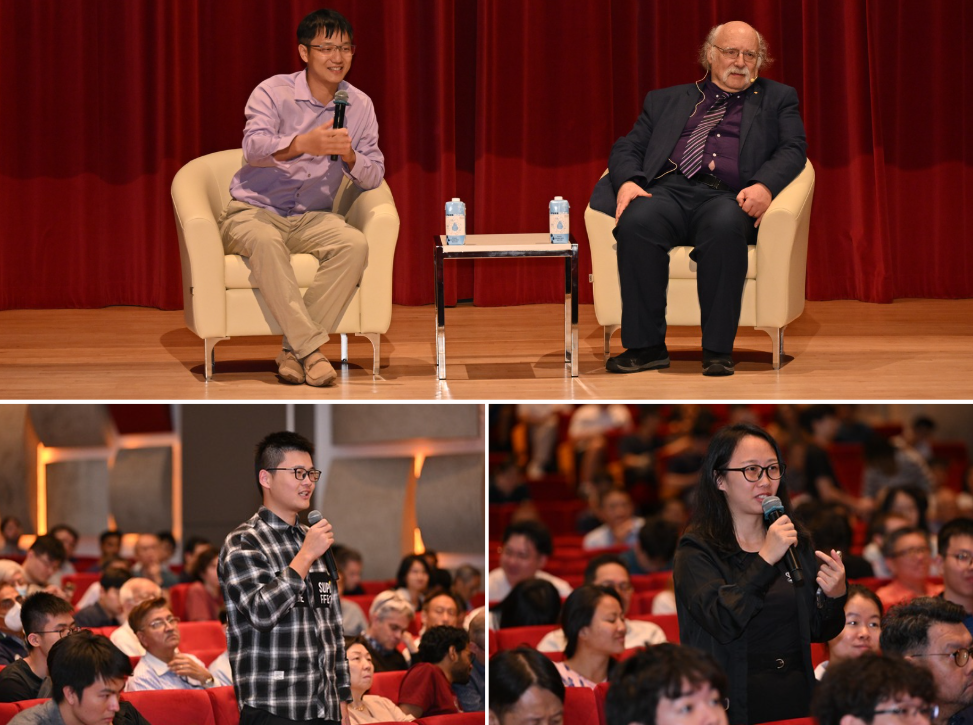
Looking ahead, Prof Haldane discussed how certain exotic quantum states—drawing on ideas from Ettore Majorana in the 1930s—can store information in a highly protected, non-local way. By encoding information in collective properties rather than individual particles, these systems offer exciting opportunities for more resilient quantum technologies, including secure quantum communication and teleportation protocols.
Throughout the lecture, Prof Haldane highlighted how the century-old framework of quantum mechanics continues to reveal new layers of insight. What once seemed like philosophical puzzles are now practical tools, and entanglement, once doubted by even the theory’s founders, has become a driving force in the ongoing second quantum revolution, shaping both fundamental research and emerging applications in science and technology.
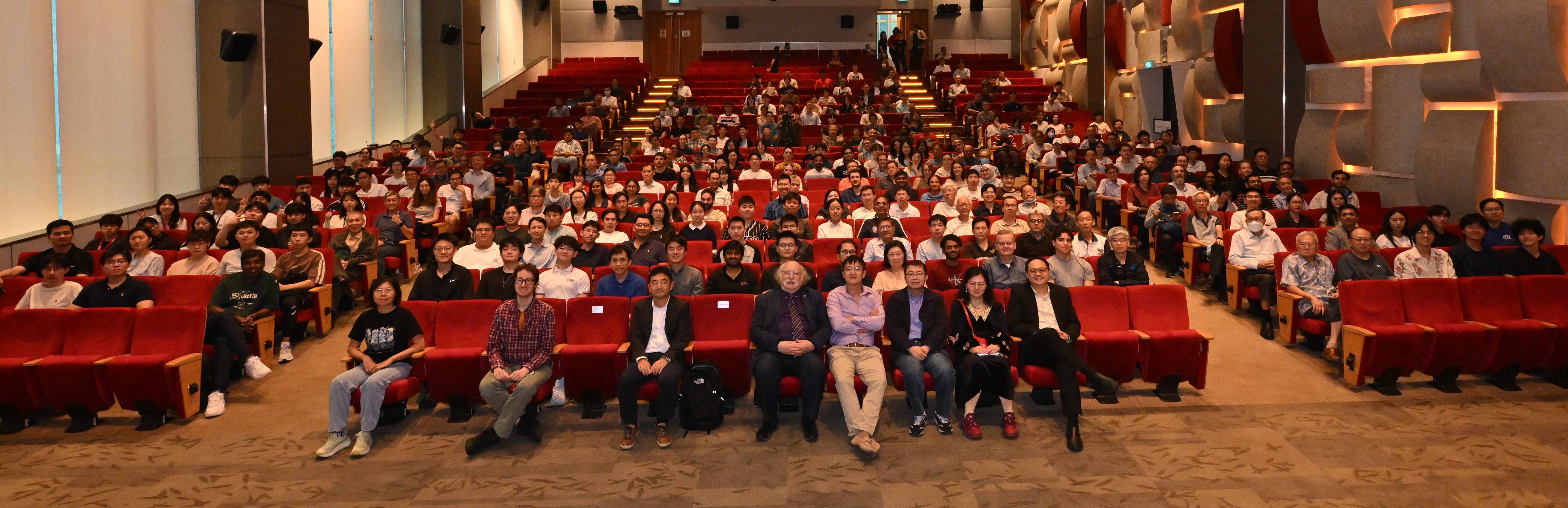
"I particularly enjoyed Prof Haldane's clear explanation of topological quantum matter, and the iceberg analogy made complex concepts much easier to understand." - Zhang Shuhan (Undergraduate student, MAE)
"The public lecture is a chance to gain exposure to quantum mechanics." - Dong Luojie (Phd student, NIE)
"I was pleasantly surprised that it had both intuitive and basic knowledge, and also frontier developments and more technical aspects covered." - Liu Shuyu (Public attendee)
"I enjoyed the depth of discussion and the attempt at making a very esoteric subject more accessible using analogies." - Fang Yao (Public attendee)