Lee Kong Chian Distinguished Professor Public Lecture by Prof Jack Dongarra
Written by Luqman Alka| PhD student, College of Computing and Data Science (CCDS, NTU)
On 8 July 2025, the Institute of Advanced Studies (IAS) at NTU hosted an inspiring afternoon with the public lecture, “Bright Light: Computing Then, Now, and To Be,” delivered by Prof Jack Dongarra, the 2021 ACM Turing Award recipient and IAS Lee Kong Chian Distinguished Professor.
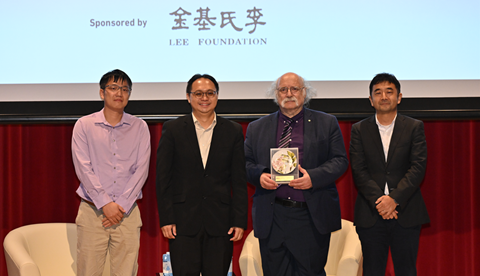
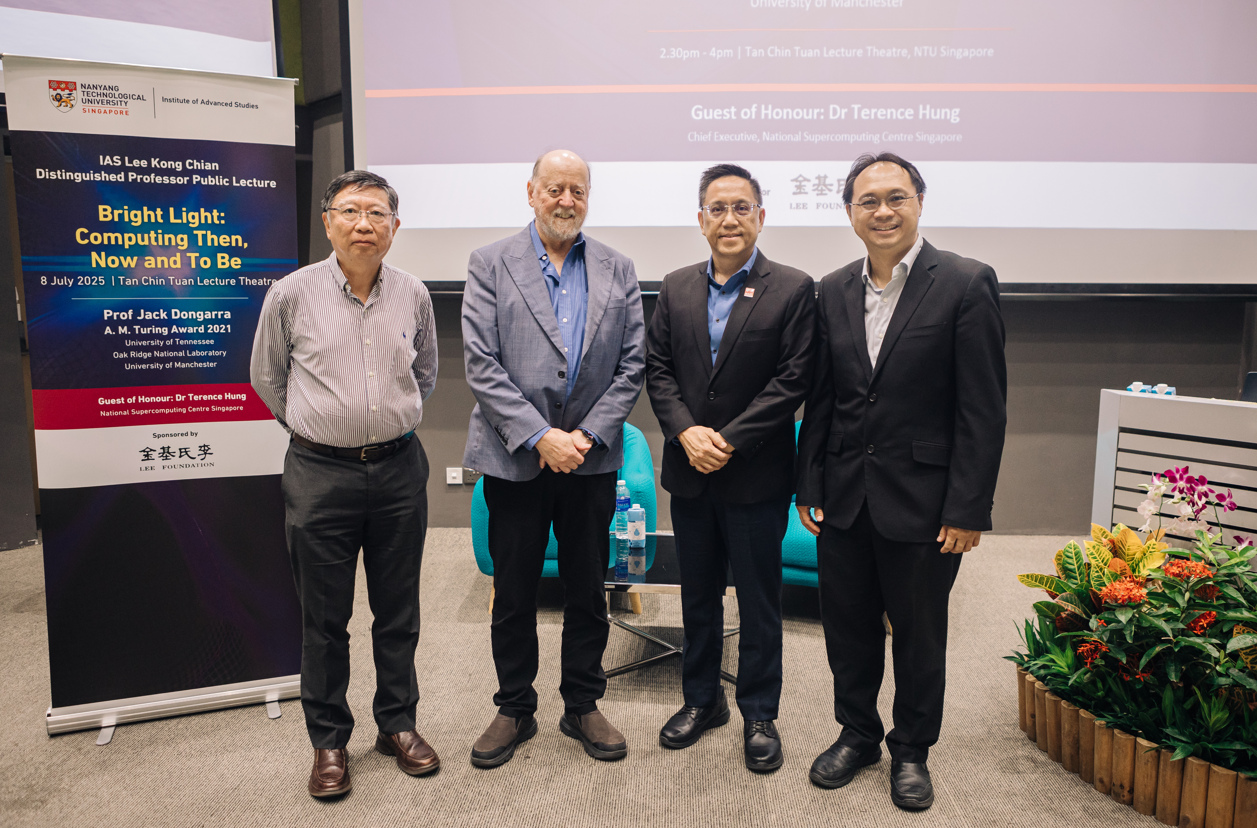 [From left to right]: Prof Cai Wentong (CCDS, NTU), Prof Jack Dongarra, Dr Terence Hung (National Supercomputing Center Singapore), and Prof Sum Tze Chien (Director, IAS).
The lecture began with a welcome address by Prof Sum Tze Chien, Director of IAS, followed by remarks from the Guest-of-Honour Dr Terence Hung, Chief Scientist at the National Supercomputing Centre (NSCC) Singapore. Both speakers highlighted the importance of High-Performance Computing (HPC) in driving research and innovation, and how openly available HPC infrastructure helps position Singapore as an active contributor to the global supercomputing ecosystem.
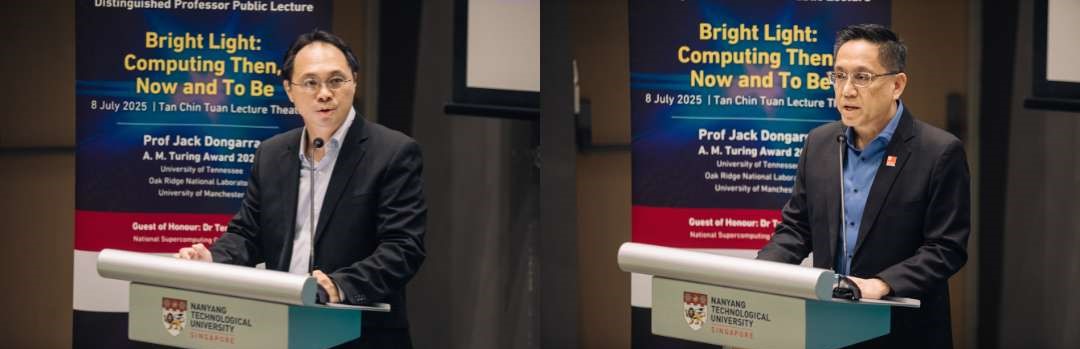
Prof Sum Tze Chien (left) and Guest-of-Honour Dr Terence Hung (right) delivering their opening remarks, highlight HPC’s role in advancing research and Singapore’s global supercomputing presence.
Prof Dongarra’s lecture traced the evolution of HPC through both a technical and deeply personal lens. He began by reflecting on his family history, sharing a candid story of his grandfather’s journey to the United States by ship, and how his family has influenced his own career path. This set the tone for a talk that balanced technology’s human side with its impactful trajectory.
A key focus of Prof Dongarra’s lecture was the TOP500 project, a benchmark he co-developed in 1993 to rank the world’s most powerful supercomputers. He noted that the system ranked #1 on the original list in the early 1990s would today be comparable to a standard laptop, a striking illustration of how rapidly computing power has scaled over the years. Today, the benchmark remains a vital reference point for global HPC efforts, with key contributors from USA, China, Germany, Italy. He highlighted China’s meteoric rise through the rankings over the past years but also noted that the country has ceased submitting performance data in recent years, raising broader questions about openness, international competition, and transparency.
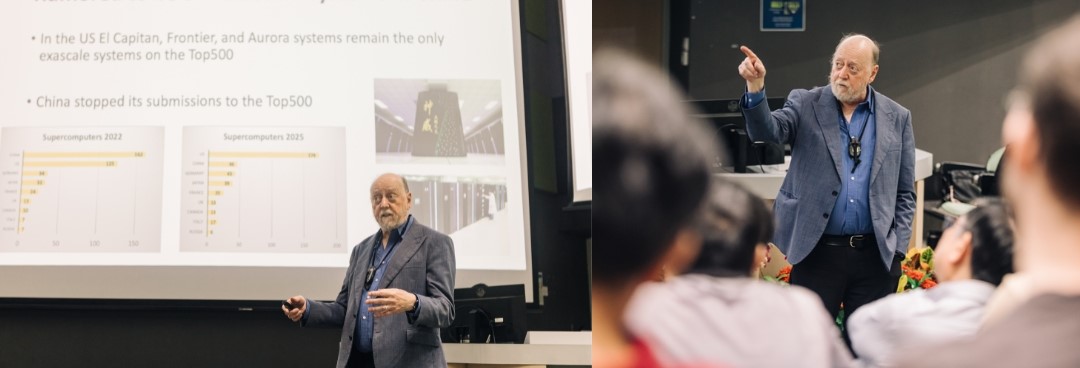 Prof Dongarra reflects on the TOP500 list and China’s shifting HPC transparency.
Turning his attention to Singapore, Prof Dongarra referenced the most recent June 2025 TOP500 list, where NSCC Singapore’s highest-ranked system placed at 108, with a total of three systems listed. He underscored that participation itself marks Singapore as an important player in the HPC arena. Prof Dongarra also addressed the changing paradigms in computing precision, speed and accuracy. Historically, HPC systems have emphasised high numerical precision to support rigorous scientific computation. In contrast, modern AI systems often operate with lower precision, trading exactness for speed and scale. Prof Dongarra suggested that the future lies in a thoughtful balance between these approaches, optimising precision based on the specific demands of the application. This hybrid approach reflects a broader shift in scientific computing, where boundaries between disciplines and technologies are increasingly fluid.
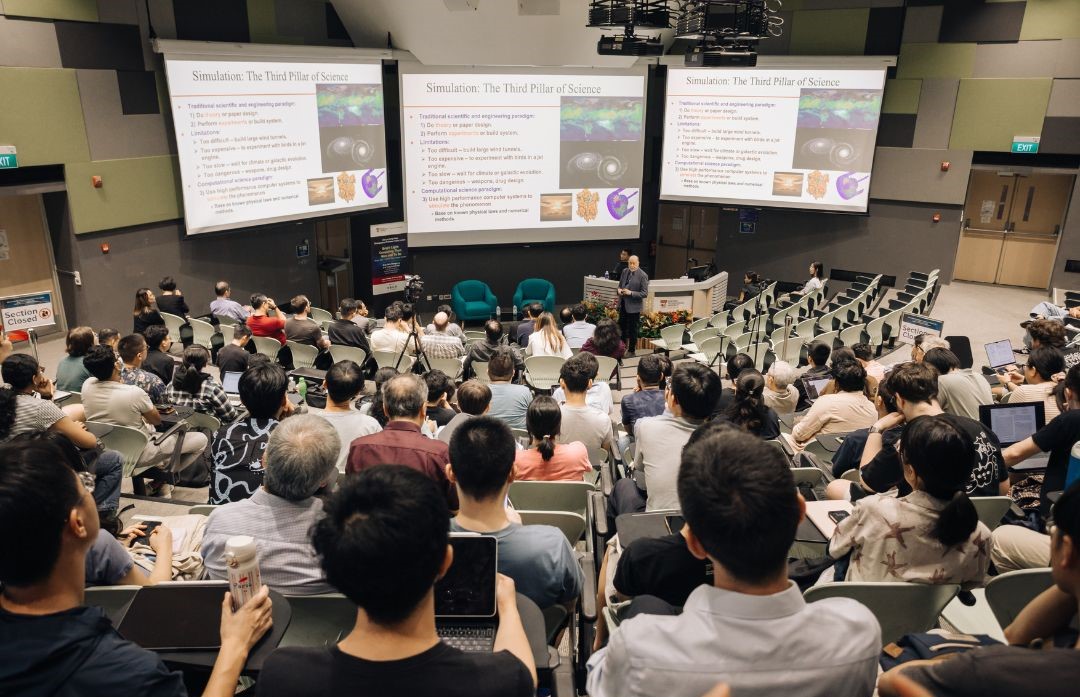 Prof Dongarra highlighting quantum computing’s promise, while acknowledging the technical challenges ahead.
Throughout his talk, Prof Dongarra contextualised emerging trends, including the potential of quantum computing, neuromorphic computing, and optical systems. While optimistic about long-term innovations, he cautioned against hype, especially in the quantum space, noting that quantum computing is still in its infancy, with only a few viable algorithms and many technical barriers at this point. Nevertheless, he emphasised that it remains an important research frontier, deserving of attention and investment over the next few decades.
.jpg?sfvrsn=5df9f93_1)
Prof Cai Wentong (right) moderating a vibrant Q&A as Prof Dongarra shares his perspectives on HPC and computing’s future.
The lecture concluded with a lively Q&A session moderated by Professor Cai Wentong, Associate Dean (Faculty) from NTU’s College of Computing and Data Science. Audience members engaged Prof Dongarra on topics such as the future of high-performance computing and ethical considerations in AI and automation. The exchange was robust and insightful, with Prof Dongarra candidly addressing various aspects of computing’s trajectory. The lecture marked not only a celebration of a pioneering figure in computing but also a meaningful moment for the NTU research community to reflect on its own role in advancing science through computation.
After his public lecture, IAS held an afternoon tea with Prof Jack Dongarra, giving selected students and researchers the chance to engage in stimulating discussions with a leading authority in high-performance computing. Read more about the tea session here.
"Learning about the architecture of supercomputers was particularly interesting." - Gagan Chandra (Undergraduate student, CCEB)
"I enjoyed Prof Dongarra's jokes, accessible teaching approaches and the general integration of the lecture with modern topics." - Daniil Kargin (Undergraduate student, CCEB)
"Prof was engaging and shared useful details about High-Performance Computing." - Undergraduate student, CCDS