
IAS Frontiers Conference on Geometry, Dynamics, and Learning (GDL2026)
Welcome to the IAS Frontiers Conference on Geometry, Dynamics, and Learning
The IAS Frontiers Conference on Geometry, Dynamics, and Learning will bring together an international cohort of leading researchers, early-career investigators, and promising graduate students working at the interface of geometric analysis, dynamical systems, and machine learning. Over the past decade, a convergence of ideas from pure mathematics, data science, and theoretical computer science has catalysed a new research frontier in which tools from differential geometry and dynamical systems theory inform the design, analysis, and interpretability of modern learning algorithms, and, conversely, insights from learning are reshaping foundational questions in geometry and dynamics.
The primary goals of this workshop are to (1) cultivate new intellectual bridges between geometry, dynamical systems, and learning theory; (2) identify shared research challenges and unify disparate methodological frameworks; and (3) accelerate collaborative projects that leverage mathematical rigor to address practical problems in data-driven science and engineering.
Researchers who may be interested in delivering a 30-minute talk at the conference should send the title and abstract of their proposed talk together with a brief biography to cyrussam.mostajeran@ntu.edu.sg.
Conference Themes:
- Geometric optimization
- Geometric and topological data analysis
- Geometric deep learning
- Shape analysis
- Information geometry
- Optimal transport
- Dissipative dynamics
- Geometric and variational integration
- Geometric methods in dynamical systems
- Infinite-dimensional dynamical systems
- Quantum mechanics and quantum information theory
.png?sfvrsn=40859d2d_1 "Keynote Speakers (1)")

Organising Committee:
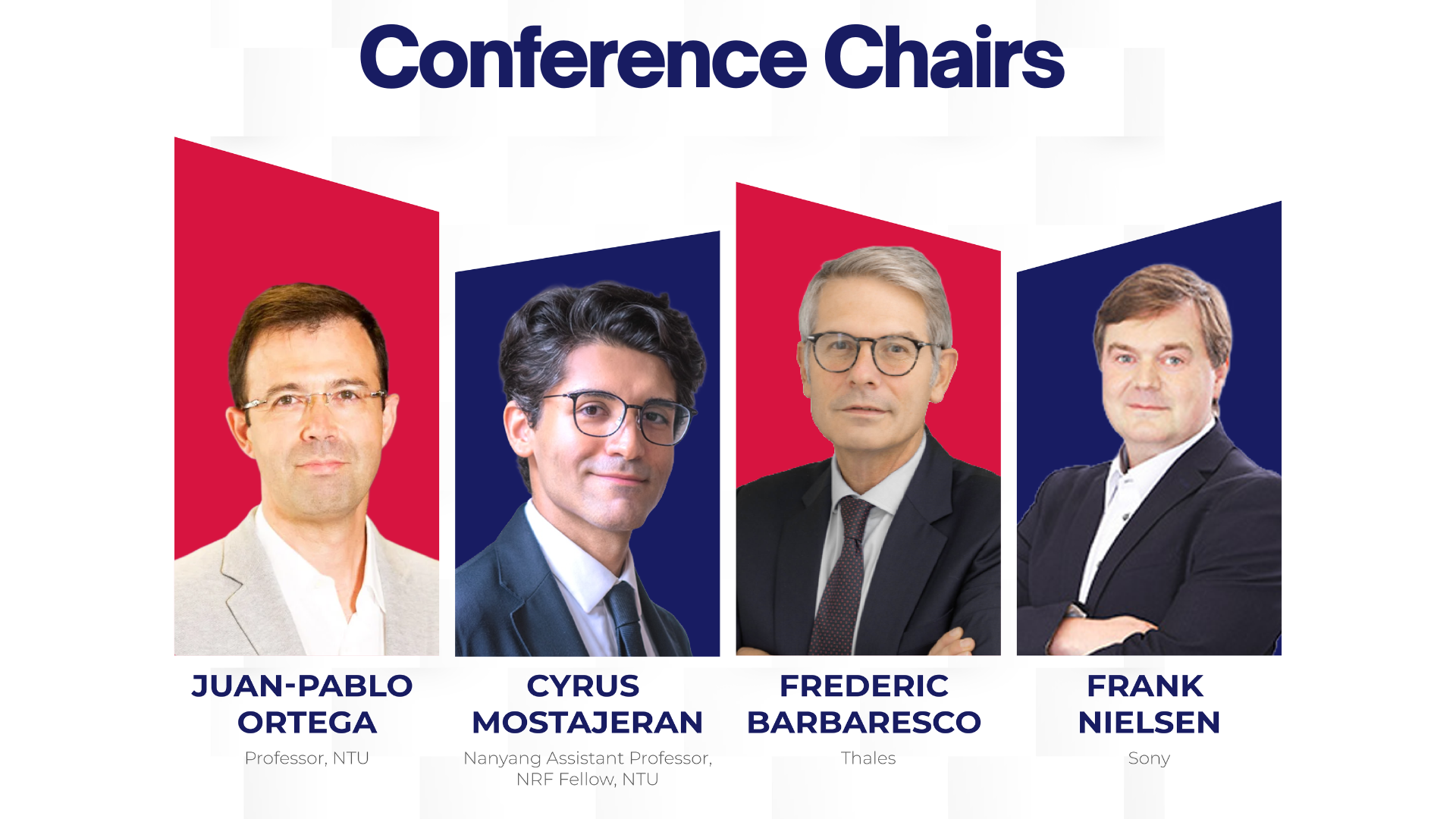
- Cyrus Mostajeran (NTU)
- Juan-Pablo Ortega (NTU)
- Frank Nielsen (Sony)
- Frederic Barbaresco (Thales)
- Kelin Xia (NTU)
- Francois Gay-Balmaz (NTU)
- Florian Rossmannek (NTU)
- Jeremie Houssineau (NTU)
GDL 2026 Presentation List
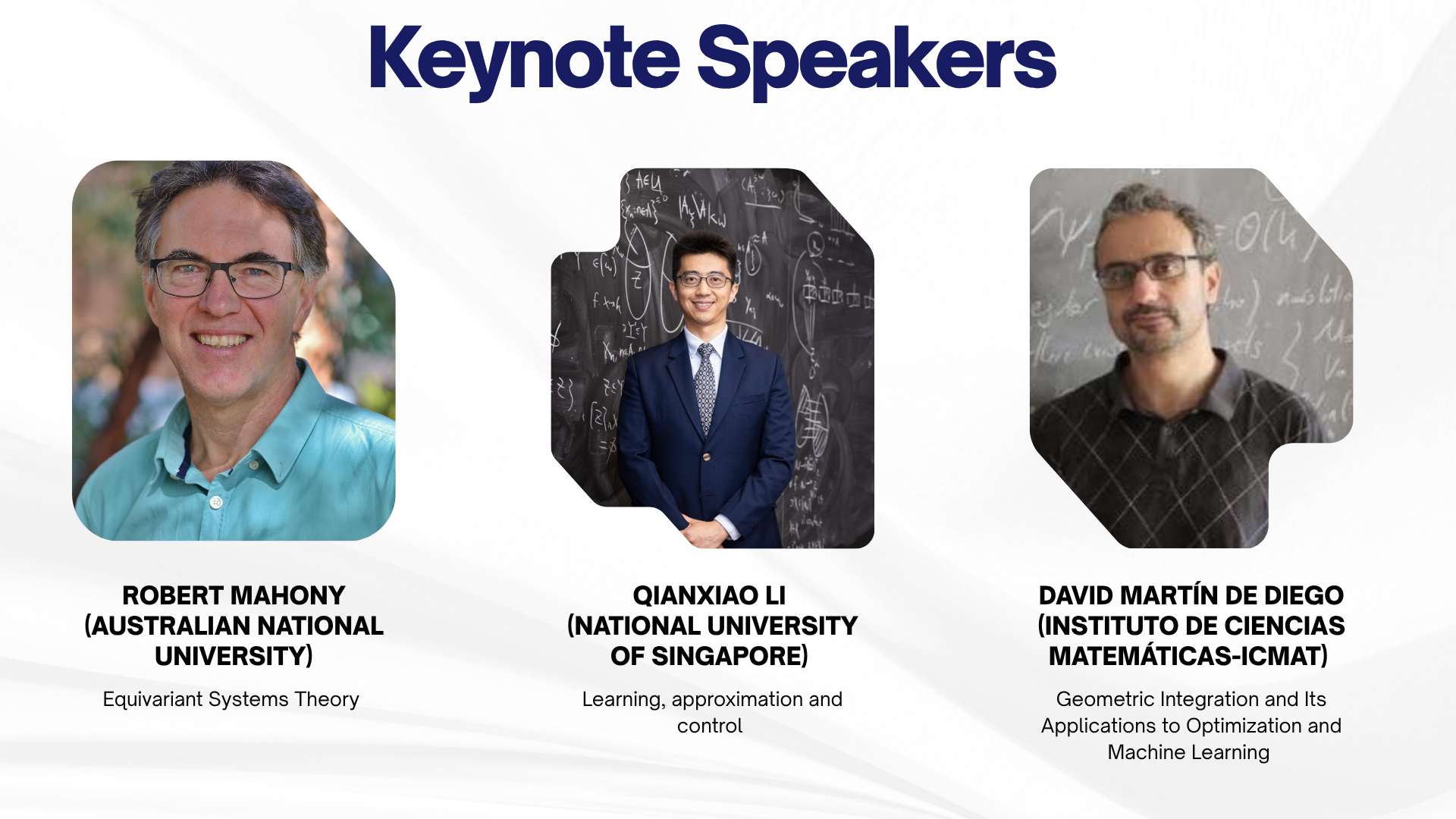
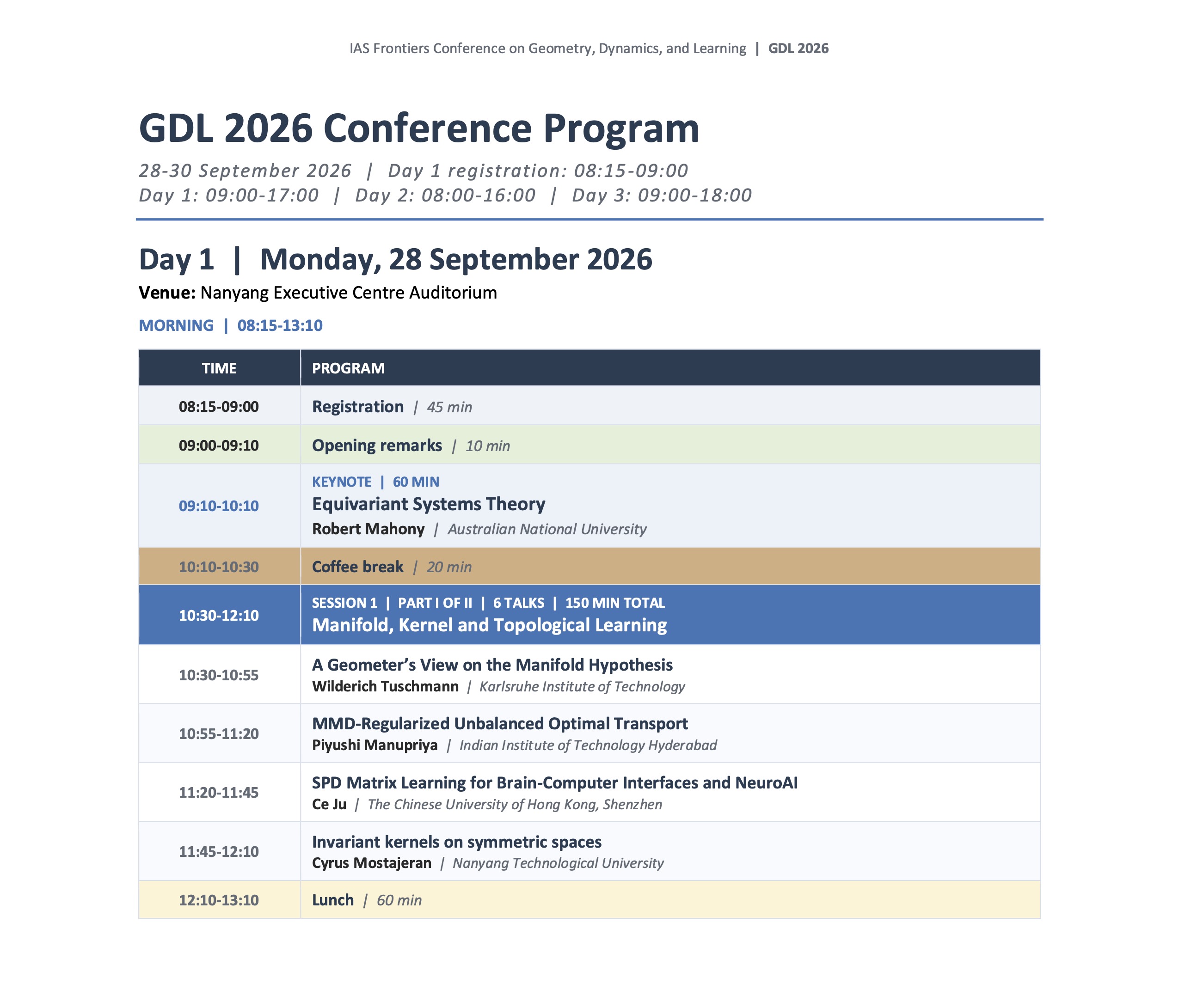
- Robert Mahony | Australian National University | Equivariant Systems Theory
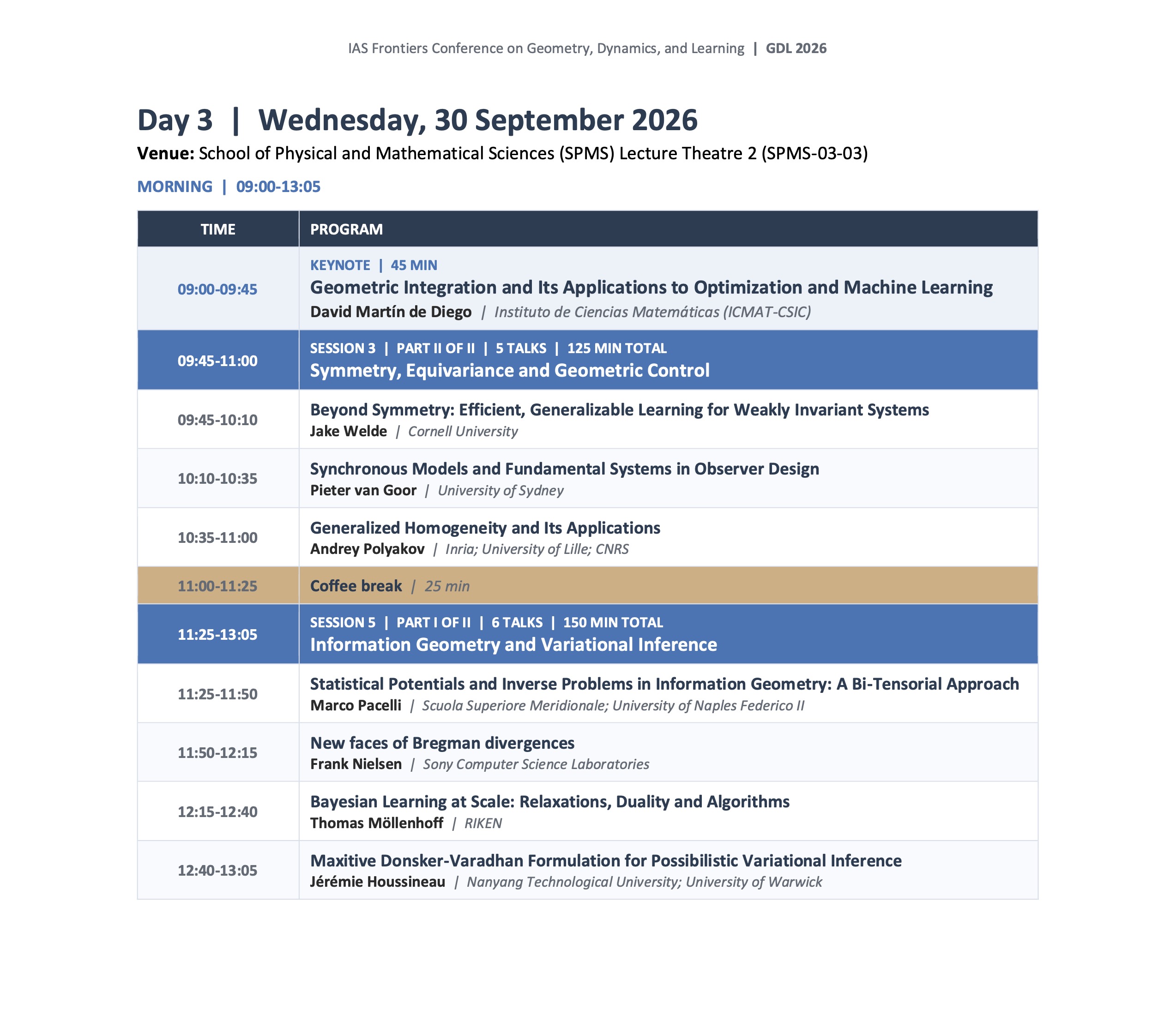
- Pieter van Goor | University of Sydney | Synchronous Models and Fundamental Systems in Observer Design
- Ravi N. Banavar | Indian Institute of Technology Bombay | Convolution, equivariance, and invariance in Dynamical Systems
- Jake Welde | Cornell University | Beyond Symmetry: Efficient, Generalizable Learning for Weakly Invariant Systems
- Qiao Huang | Southeast University | Invariant connections in geometric mechanics: reduction and curvature-induced memory
- Andrey Polyakov | Inria; University of Lille; CNRS | Generalized Homogeneity and Its Applications
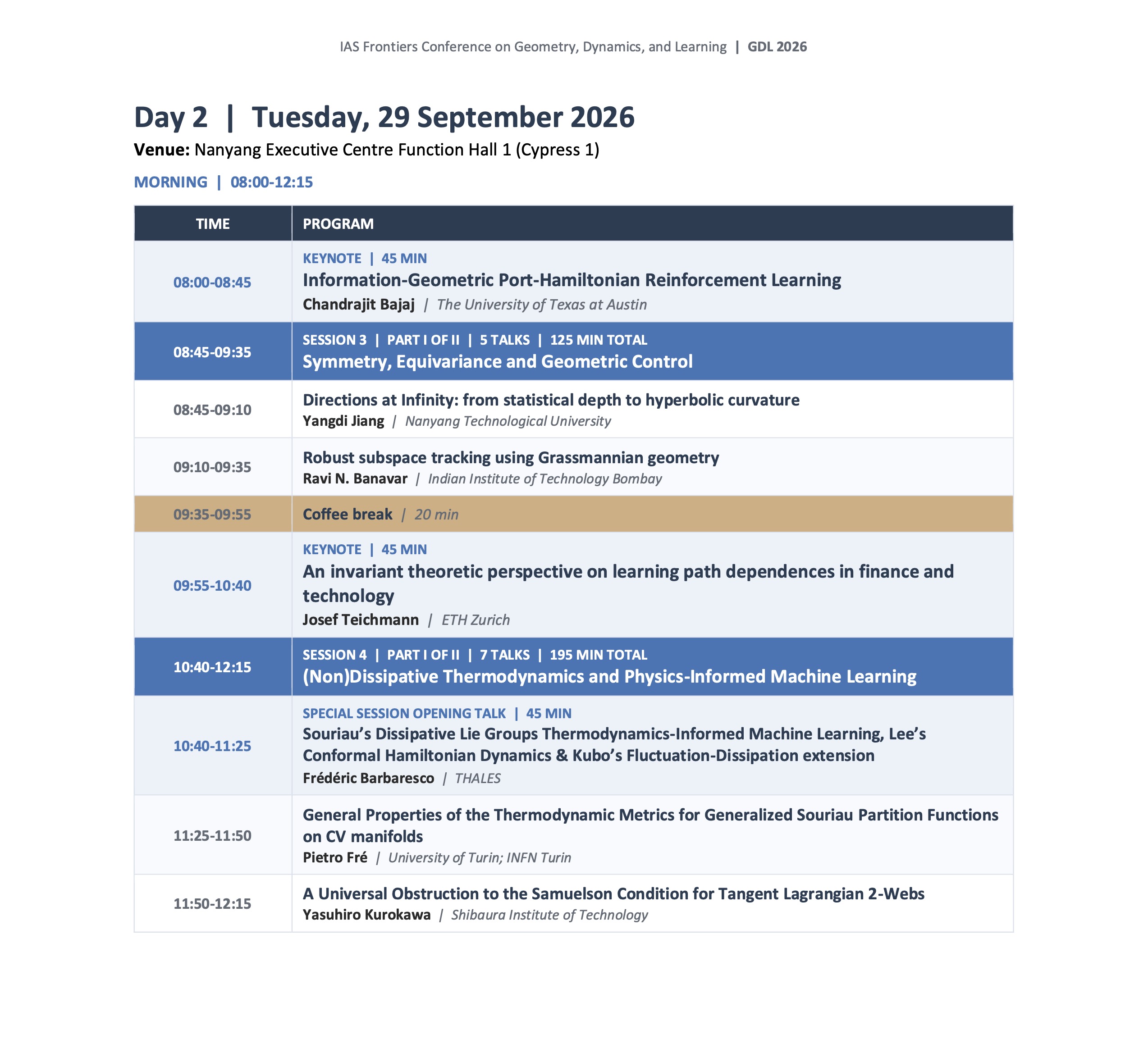
- Josef Teichmann | ETH Zurich | An invariant theoretic perspective on learning path dependences in finance and technology
- David Martín de Diego | Instituto de Ciencias Matemáticas (ICMAT-CSIC) | Geometric Integration and Its Applications to Optimization and Machine Learning
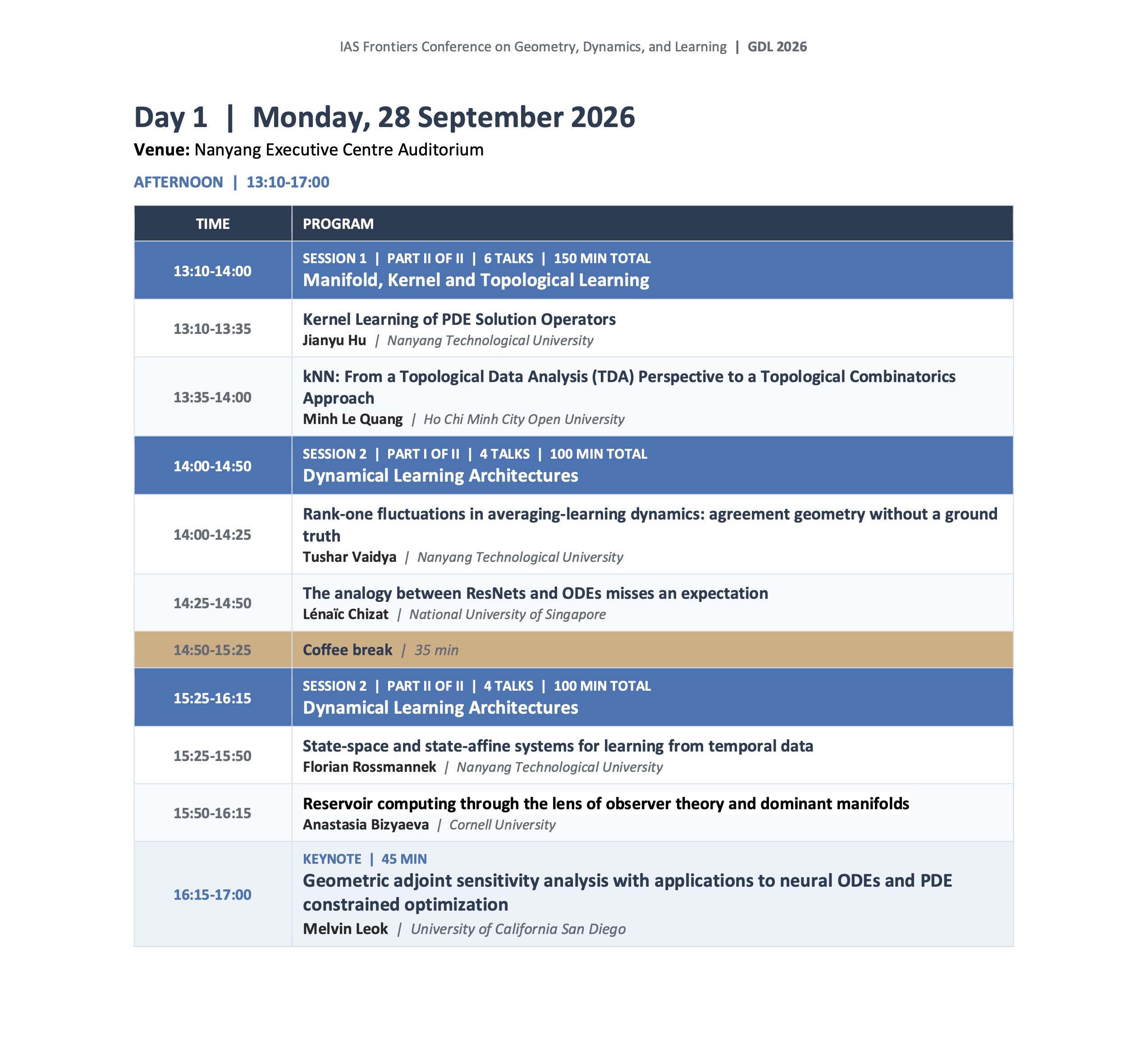
- Melvin Leok | University of California San Diego | Geometric adjoint sensitivity analysis with applications to neural ODEs and PDE constrained optimization
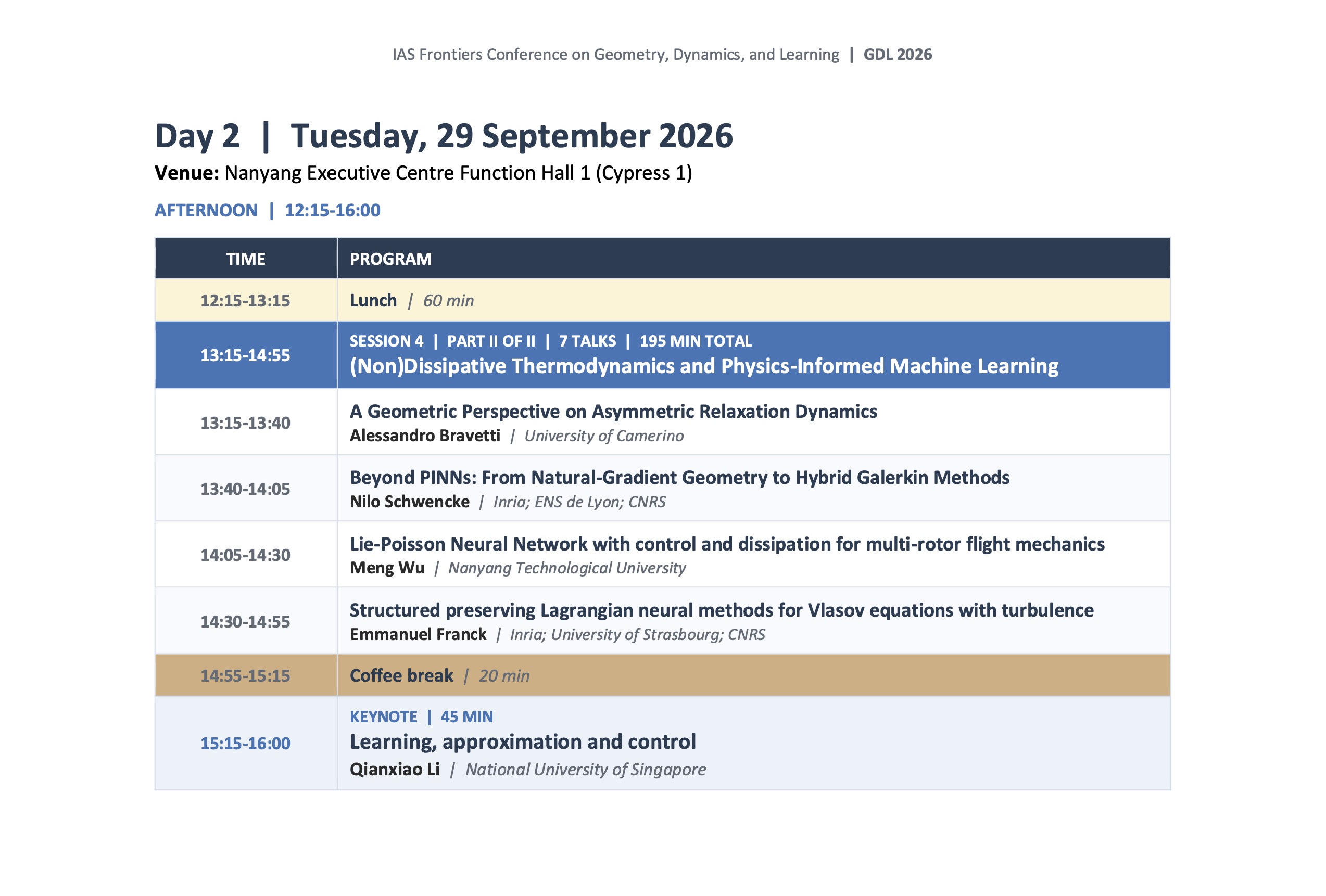
- Qianxiao Li | National University of Singapore | Learning, approximation and control
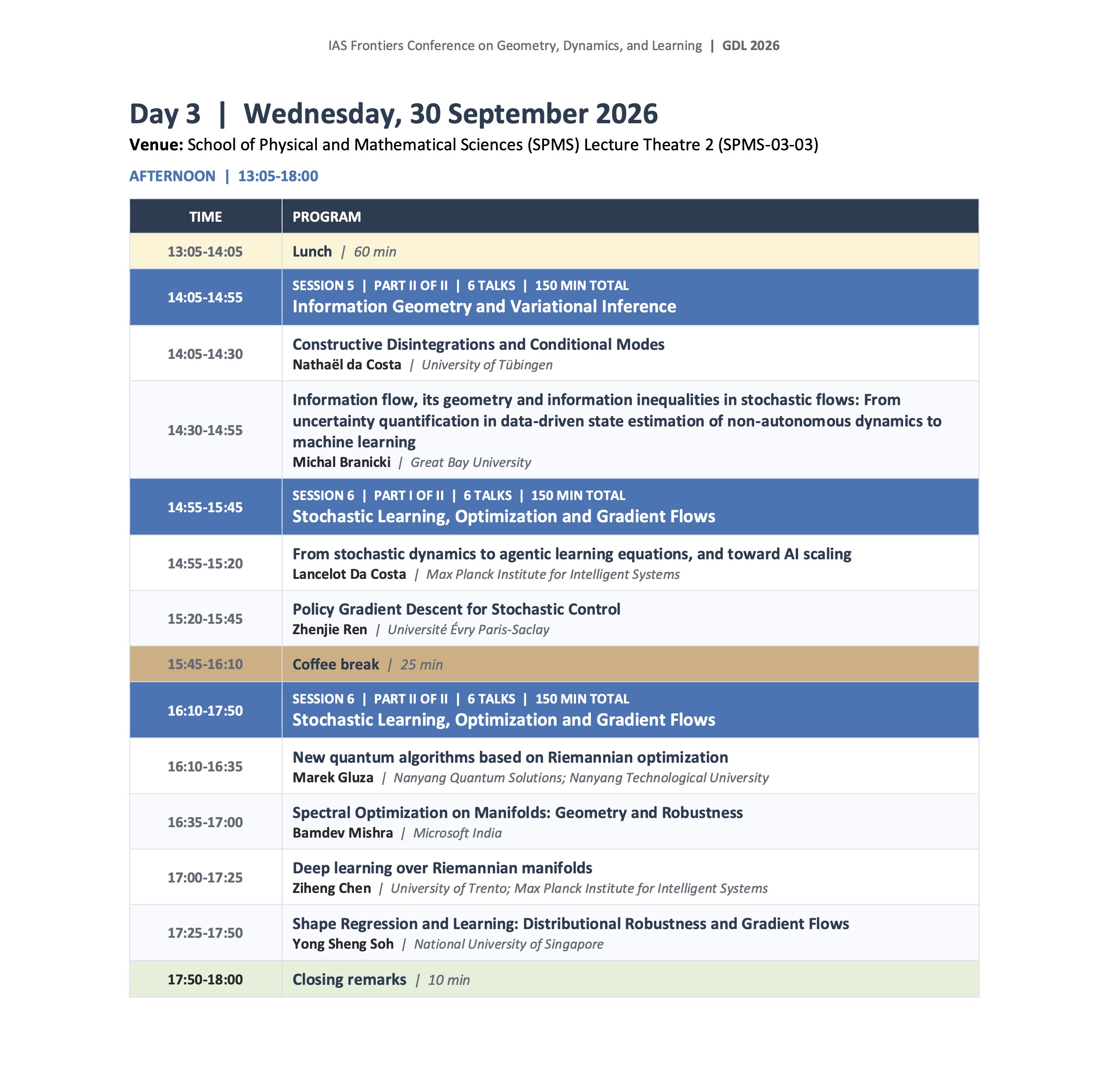
- Zhenjie Ren | Université Évry Paris-Saclay | Policy Gradient Descent for Stochastic Control
- Marek Gluza | Nanyang Quantum Solutions; Nanyang Technological University | New quantum algorithms based on Riemannian optimization
- Frédéric Barbaresco | THALES | Souriau’s Dissipative Lie Groups Thermodynamics-Informed Machine Learning, Lee’s Conformal Hamiltonian Dynamics & Kubo’s Fluctuation-Dissipation extension
- Pietro Fré | University of Turin; INFN Turin | General Properties of the Thermodynamic Metrics for Generalized Souriau Partition Functions on CV manifolds
- Yasuhiro Kurokawa | Shibaura Institute of Technology | A Universal Obstruction to the Samuelson Condition for Tangent Lagrangian 2-Webs
- Alessandro Bravetti | University of Camerino | A Geometric Perspective on Asymmetric Relaxation Dynamics
- Nilo Schwencke | Inria; ENS de Lyon; CNRS | Beyond PINNs: From Natural-Gradient Geometry to Hybrid Galerkin Methods
- Meng Wu | Nanyang Technological University | Lie-Poisson Neural Network with control and dissipation for multi-rotor flight mechanics
- Emmanuel Franck | Inria; University of Strasbourg; CNRS | Structured preserving Lagrangian neural methods for Vlasov equations with turbulence
- Marco Pacelli | Scuola Superiore Meridionale; University of Naples Federico II | Statistical Potentials and Inverse Problems in Information Geometry: A Bi-Tensorial Approach
- Frank Nielsen | Sony Computer Science Laboratories | New faces of Bregman divergences
- Chandrajit Bajaj | The University of Texas at Austin | Information-Geometric Port-Hamiltonian Reinforcement Learning
- Thomas Möllenhoff | RIKEN | Bayesian Learning at Scale: Relaxations, Duality and Algorithms
- Nathaël da Costa | University of Tübingen | Constructive Disintegrations and Conditional Modes
- Jérémie Houssineau | Nanyang Technological University| Maxitive Donsker-Varadhan Formulation for Possibilistic Variational Inference
- Michal Branicki | Great Bay University | Information flow, its geometry and information inequalities in stochastic flows: From uncertainty quantification in data-driven state estimation of non-autonomous dynamics to machine learning
- Jinqiao Duan | Great Bay University | Geometric Methods for Stochastic Dynamical Systems: A Concise Introduction
- Lancelot Da Costa | Max Planck Institute for Intelligent Systems | From stochastic dynamics to agentic learning equations, and toward AI scaling
- Wilderich Tuschmann | Karlsruhe Institute of Technology | A Geometer’s View on the Manifold Hypothesis
- Ziheng Chen | University of Trento; Max Planck Institute for Intelligent Systems | Deep learning over Riemannian manifolds
- Ce Ju | The Chinese University of Hong Kong, Shenzhen | SPD Matrix Learning for Brain-Computer Interfaces and NeuroAI
- Cyrus Mostajeran | Nanyang Technological University | Invariant kernels on symmetric spaces
- Jianyu Hu | Nanyang Technological University | Kernel Learning of PDE Solution Operators
- Piyushi Manupriya | Indian Institute of Technology Hyderabad | MMD-Regularized Unbalanced Optimal Transport
- Yong Sheng Soh | National University of Singapore | Shape Regression and Learning: Distributional Robustness and Gradient Flows
- Minh Le Quang | Ho Chi Minh City Open University | kNN: From a Topological Data Analysis Perspective to a Topological Combinatorics Approach
- Lénaïc Chizat | National University of Singapore | The analogy between ResNets and ODEs misses an expectation
- Florian Rossmannek | Nanyang Technological University | State-space and state-affine systems for learning from temporal data
- Anastasia Bizyaeva | Cornell University | Timescale effects and dominant manifolds in reservoir computing networks
- Tom Chaffey | University of Sydney | Computing gradients in analog circuits
*The organisers may adjust the programme or reschedule talks without prior notice. We thank you for your understanding.
Funding and Sponsorship | |||
 |  |  |  |