Helping artificial intelligence become truly intelligent
In his public lecture at NTU, Turing Award Laureate Prof Yann LeCun shares his insights on how AI can make sense of the physical world.
“Intelligence is what you use when you don’t know what to do,” said philosopher and psychologist Jean Piaget.
Unlike animals and humans who understand the physical world, current AI models are trained on a large number of examples to predict outcomes based on probability. As a result, AI may struggle to handle novel situations and accomplish new tasks.
In the age of agentic AI, how then can we develop the next generation of machines that truly understand the real world and not just process large amounts of data?
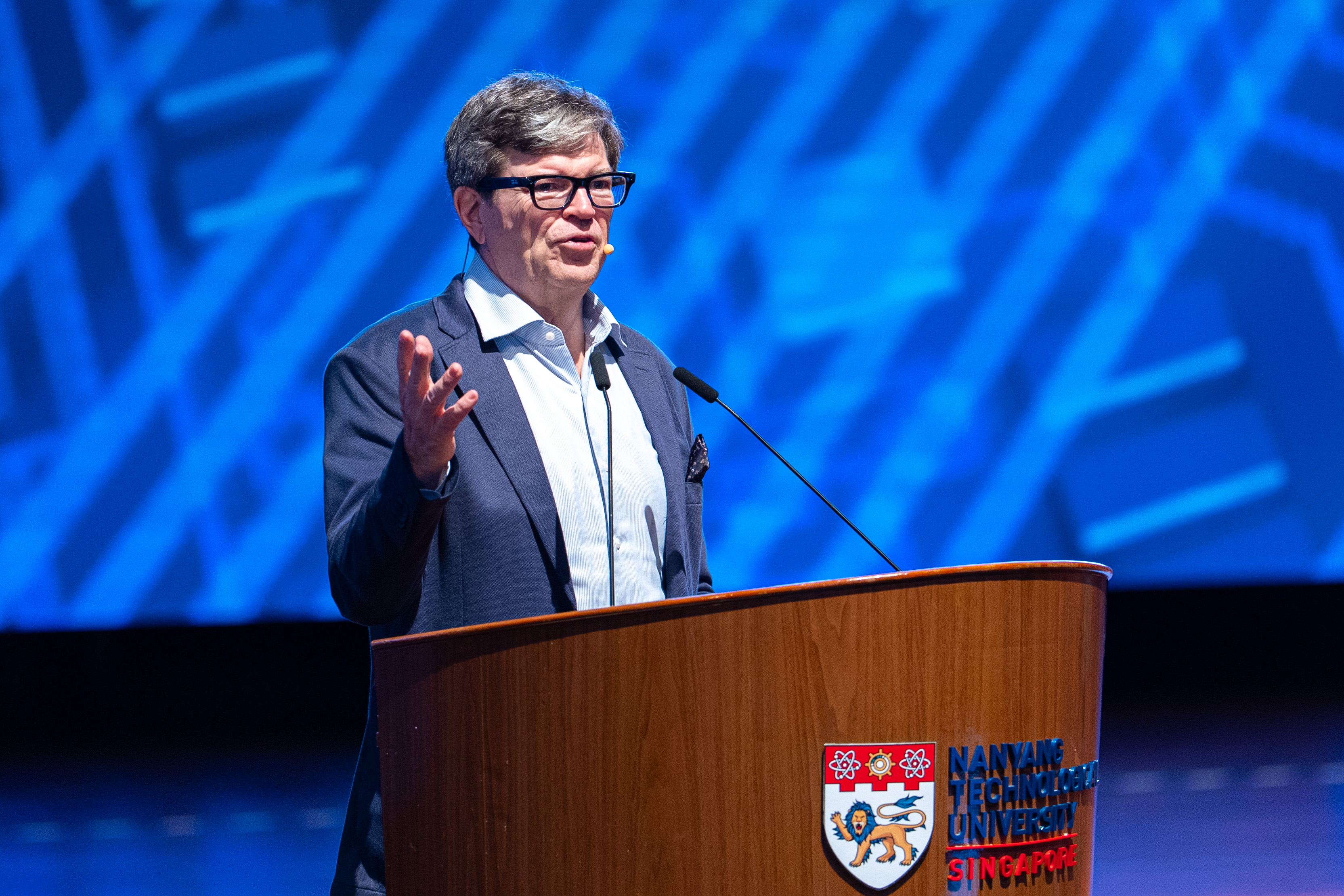
This was the topic that Prof Yann LeCun discussed in the CCDS Distinguished Speaker & IAS@NTU Lee Kong Chian Distinguished Professor Public Lecture.
The event was organised jointly by the College of Computing and Data Science (CCDS) and Institute of Advanced Studies, with support from the Lee Foundation and the Infocomm Media Development Authority.
Widely considered one of the three godfathers of AI, Prof LeCun is the 2018 ACM A.M. Turing Award Laureate, Jacob T. Schwartz Professor at New York University and Executive Chairman of Advanced Machine Intelligence Labs. He was also formerly Chief AI Scientist at Meta.
Building AI that understands the world
In his lecture "World Models: Enabling the Next AI Revolution", Prof LeCun explored how a new generation of AI systems may hold the key to enabling machines to understand, reason and plan, with little to no task-specific training.
Prof LeCun, who had suggested that no AI system today is as smart as a house cat, highlighted how AI falls short at accomplishing new tasks with minimal training, unlike animals and humans. This is because current AI systems are trained only on text, instead of sensory data.
On the other hand, true machine intelligence requires an understanding of the physical world.
Citing examples from how humans learn by making mental maps of the world, Prof LeCun said that AI can also learn in a similar way. He pioneered a framework called Joint-Embedding Predictive Architecture (JEPA) that learns an internal model of the world by predicting abstract representations from sensory observations.
Counter to generative models used today that predict every single detail, world models like JEPA anticipate future states at a deeper semantic level while disregarding information that is irrelevant or cannot be reliably estimated. This helps autonomous systems develop common sense, reason under uncertainty and predict the outcomes of possible actions.
The session ended with a fireside chat moderated by Prof Bo An, Head of the Division of Artificial Intelligence at CCDS. During the discussion, Prof LeCun emphasised that while AI tools can accelerate research, human judgement remains at the centre of breakthroughs and discoveries.
Watch the lecture here: https://www.youtube.com/watch?v=LYZCbAyssgw.