Detecting plant stress in real time
NTU researchers apply machine learning to assess plant health and boost crop yields.
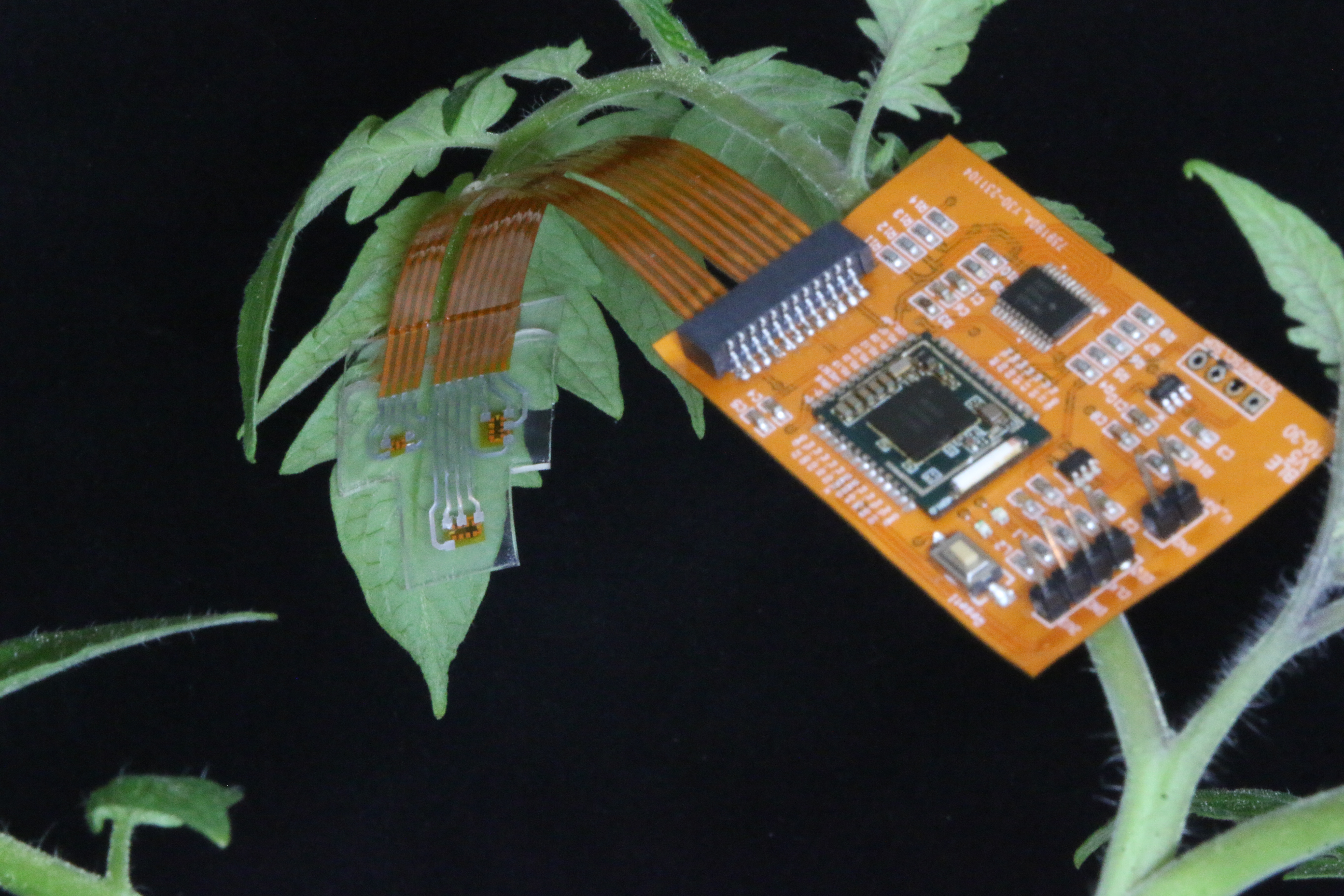
By enabling farmers to detect and treat plant stress early, the innovation may boost crop yields. Credit: Huazhong University of Science and Technology and NTU.
Plants are exposed to stresses that can affect their growth. Identifying plant stress and rectifying it in real time can improve crop yields and help meet the world’s growing demand for food.
Leveraging machine learning, researchers co-led by Prof Chen Xiaodong of NTU’s School of Materials Science & Engineering have invented a system to diagnose and treat various plant stresses in tomato plants early.
The system uses soft sensors attached to the plant leaves. One type of sensor detects changes in leaf colour due to nutrient deficiencies and mite attacks, while another identifies heat and moisture-related stress by measuring the rate of transpiration – the process by which plants release water vapour through their leaves. A machine learning model then analyses the collected data and makes diagnoses in real time.
Compared with computer vision methods, the system is more sensitive and can detect plant stress before noticeable symptoms appear, giving farmers a wider window to restore plant health. It is also non-invasive, unlike conventional methods of evaluating plant health.
Tomato grafting, where the fruit-producing part of one tomato plant is combined with the robust root system of another to create a stronger plant, is used in agriculture to enhance disease resistance, improve stress tolerance and boost crop yields. Using the system, the scientists could also assess the health of grafted tomatoes and evaluate the suitability of various grafting combinations.
The scientists are now expanding the use of the system to more plant species.
Find out more about the innovation in “A machine-learning-powered spectral-dominant multimodal soft wearable system for long-term and early-stage diagnosis of plant stresses” in Science Advances (2025), DOI: 10.1126/sciadv.adw7279.
The article appeared first in NTU's research & innovation magazine Pushing Frontiers (issue #26, May 2026).