
NTU researchers build AI that designs decision-making software in about an hour
New AI system, LACE, could potentially cut the design of algorithms for complex scheduling, routing and resource-allocation from months to about an hour.
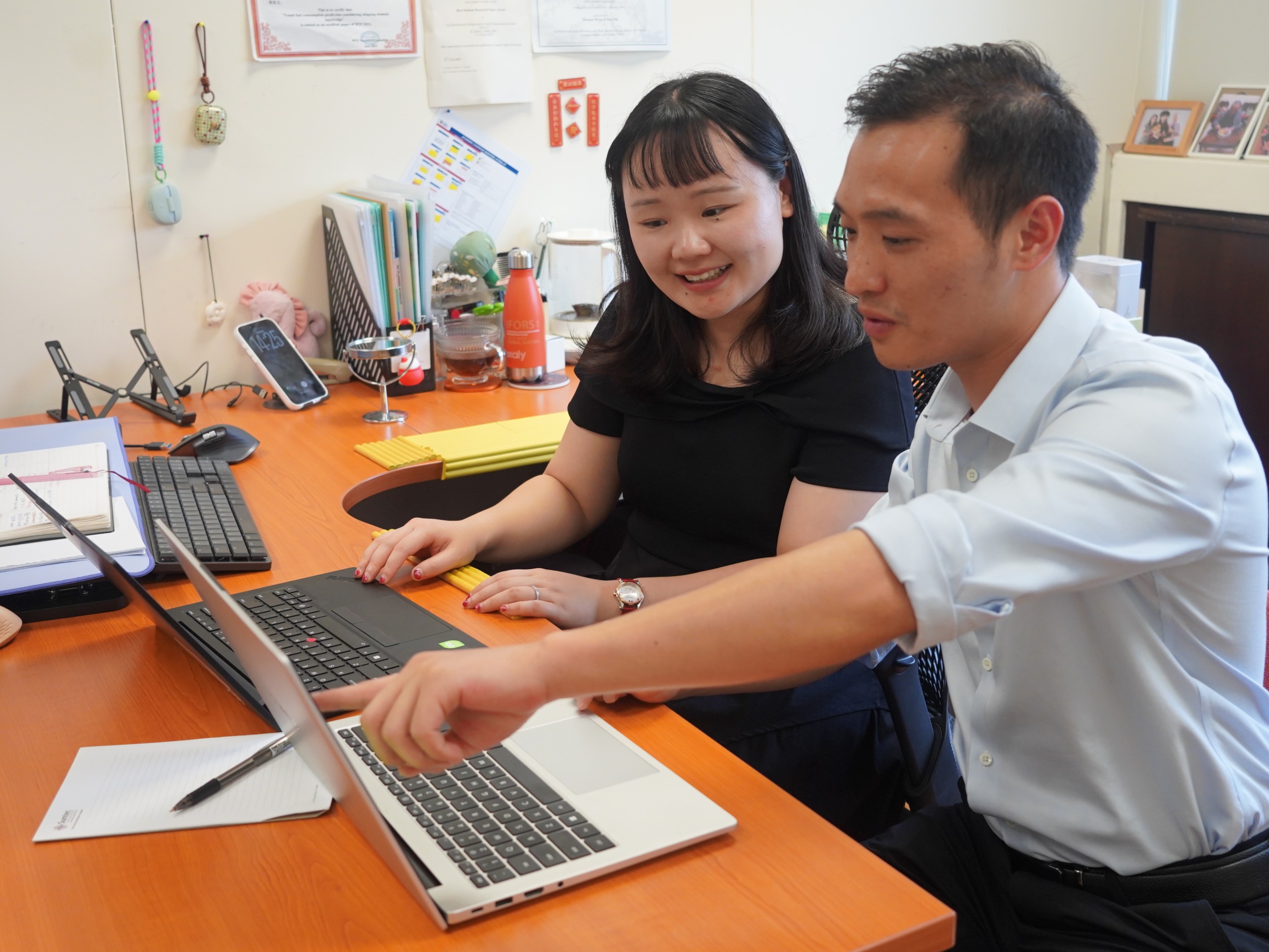 Asst Prof Yan Ran (L) and Research Fellow Dr Gong Huatian discussing the LACE model they developed. Credit: NTU Singapore
Nanyang Technological University, Singapore (NTU Singapore) researchers have developed an advanced Artificial Intelligence (AI) framework that automates the creation of complex decision-making software, cutting development time from months of specialised engineering to about an hour.
Named Large Language Model (LLM)-driven Algorithm Construction via Complementary Evolution or LACE, the system allows non-specialist users to input complex operational problems in plain language. LACE then automatically constructs, evaluates, and refines a dedicated “portfolio” of specialised algorithm heuristics tailored to solve the problem efficiently.
LACE was put to the tests on four new maritime problems, and it achieved scores of 97 to 99 per cent against the best result obtained by any method tested. In addition, LACE was able to design a solution in around an hour for about US$10 (S$12.70).
Published in Nature Machine Intelligence this month, the study was led by NTU’s School of Civil and Environmental Engineering (CEE) Asst Prof Yan Ran and Research Fellow Dr Gong Huatian.
Outperforming existing AI frameworks and solution-finding software programs
Combinatorial optimisation (CO) is a subfield of computer science that focuses on finding the most optimal solution from a set of massive possible solutions. It underpins critical global operations including maritime port berth scheduling, hospital operating room allocations, supply chain routing, and power grid management.
To solve CO’s complex problems, systems engineers often rely on modular contracts, or clear rules, to split the problems into smaller pieces. They then use specialist heuristics, or smart short cuts, to solve each piece of problem quickly.
Traditionally, tailoring algorithms to new operational constraints required months of painstaking trial-and-error by domain experts. While LLMs can write computer code, existing AI methods routinely fail when tasked with building complete solvers for novel, real-world logistical problems in a single attempt.
LACE overcomes this bottleneck through a two-stage architecture. First, it breaks down the problem into modular contracts, and then iteratively evolving a team of complementary specialist heuristics.
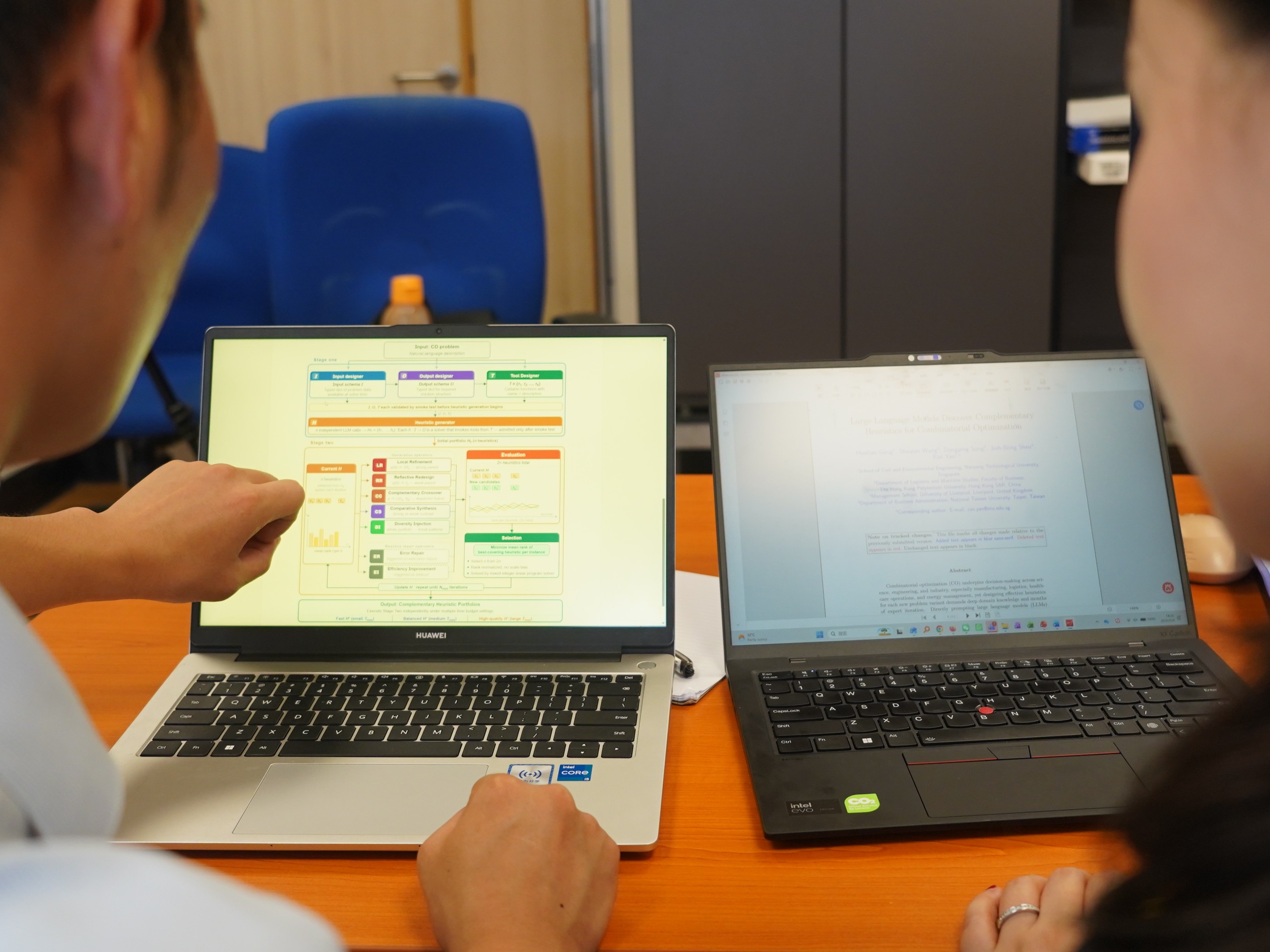 Research Fellow Dr Gong Huatian (L) and Asst Prof Yan Ran highlighting the LACE model they created. Credit: NTU Singapore
Lead author Asst Prof Yan said: “Designing custom software for real-world operations has historically been a major bottleneck across industries like port management, healthcare, and energy. With LACE, we demonstrate that clever design of an AI framework, rather than just building larger AI models, can bridge this gap. By turning months of manual coding into a roughly one-hour automated process, we are making high-performance operational optimisation accessible to organisations of all sizes.”
Democratising high-performance algorithm discoveries
When tested on four entirely new, complex container terminal and tugboat routing problems designed to reflect modern maritime challenges, LACE achieved scores of 97 to 99 per cent against the best result obtained by any method tested. Competing LLM-based AI systems, including Google’s FunSearch, failed completely to produce feasible algorithms or software capable of meeting operational constraints.
In fact, LACE completed its execution in about an hour for each problem and at a cost of under US$10 in computation fees per problem.
Dr Gong said: “Whether re-routing tugboats in a busy port during unexpected congestion or, in future applications, reallocating hospital beds during a surge, operational conditions shift rapidly. LACE allows decision-makers to generate validated, highly effective solution strategies on demand in about an hour. By comparison, traditional software designs can take months and costs hundreds of thousands.”
By dramatically reducing both time and computational costs, the NTU research team believes LACE can democratise high-performance algorithm discoveries to build solutions software for smaller research teams, regional logistics hubs, public healthcare institutions, and utility providers who lack multi-million-dollar algorithm engineering budgets.
The paper titled “Large Language Models Discover Complementary Heuristics for Combinatorial Optimization”, was first published online in Nature Machine Intelligence on 1 October 2026. DOI: 10.1038/s42256-026-01307-8.
Please visit here for more information about the study.





.tmb-listing.jpg?sfvrsn=462ec612_2)