NTU scientists develop non-toxic ‘light-activated’ compound for safer 3D printing and advanced biomaterials
New family of light-activated compounds could replace traditional ones that are toxic to humans.
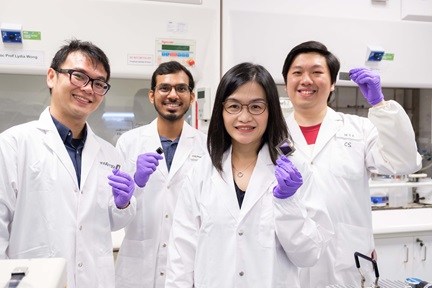
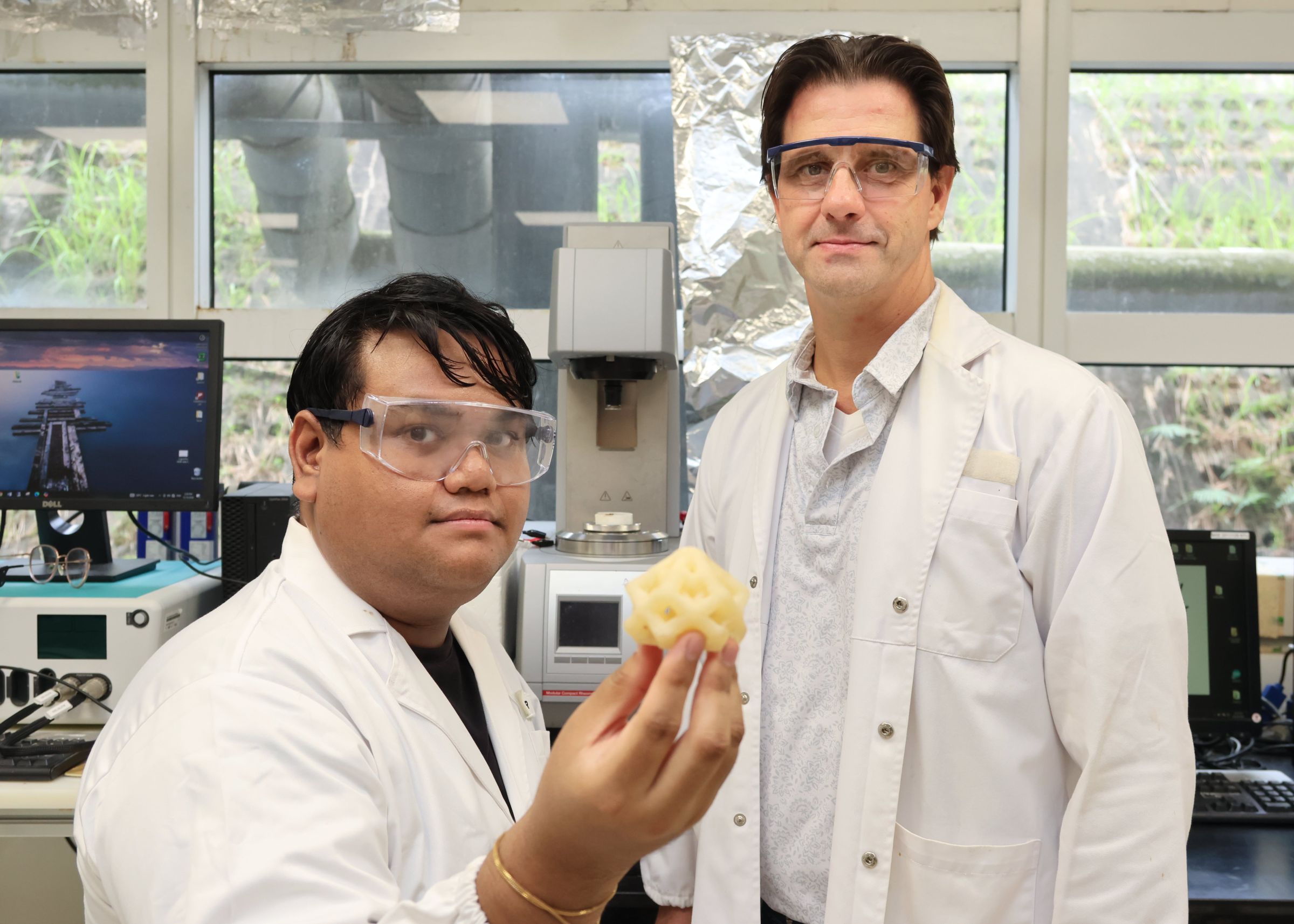 PhD student Naziruddin Ali (left) and Assoc Prof Terry Steele posing with a 3D printed model made using the aryl diazirine photoinitiators they developed. Credit: NTU Singapore.
Scientists from Nanyang Technological University, Singapore (NTU Singapore) have developed a new class of light-activated compounds that could lead to safer and more versatile applications in 3D printing, cosmetics, and medicine.
These compounds, known as aryl diazirine photoinitiators, are used to solidify liquid resins into hard plastics with speed and precision using light. The current industry-standard photoinitiators often face issues of toxicity and poor solubility in water.
The NTU study, published in NPG Asia Materials this month, demonstrates that the new aryl diazirine photoinitiators are not only non-toxic to human cells but also offer superior performance, including reduced material shrinkage and compatibility with water-based sustainable resins.
A safer, greener alternative
Photoinitiators are a key ingredient in everything from the adhesives that seal electronics to the biocompatible hydrogels used in tissue engineering. When exposed to light, they kickstart a chemical reaction called polymerisation, which turns liquid materials solid in seconds.
However, the most common photoinitiators, such as diphenyl(2,4,6-trimethylbenzoyl)phosphine oxide (TPO) and phenylbis(2,4,6-trimethylbenzoyl)phosphine oxide (BAPO), have been identified as reproductive toxins, creating an urgent need for safer alternatives. In fact, both TPO and BAPO are being banned in some regions, such as European Union (EU), due to health concerns. The ban has disrupted the gel-nail sector, which relied on TPO for fast and reliable curing.
The NTU team, led by Assoc Prof Terry W. J. Steele from the School of Materials Science and Engineering, found that aryl diazirines are a highly effective and biocompatible replacement.
Assoc Prof Steele said: “The industry is facing a major challenge as the most effective and widely used photoinitiators are being regulated out of existence due to toxicity. Our goal was to develop a new 'activator' that is not only safe and biocompatible but also improves on the performance of existing materials. We have created a solution that addresses the toxicity problem head-on while opening new possibilities for innovation.”
Overcoming key technical hurdles
One of the significant findings of the study is the new photoinitiators’ ability to reduce the shrinkage that typically occurs when a liquid resin hardens. The aryl diazirines release nitrogen gas during the curing process, a feature that can be tuned to counteract this contraction, leading to more stable and reliable finished products.
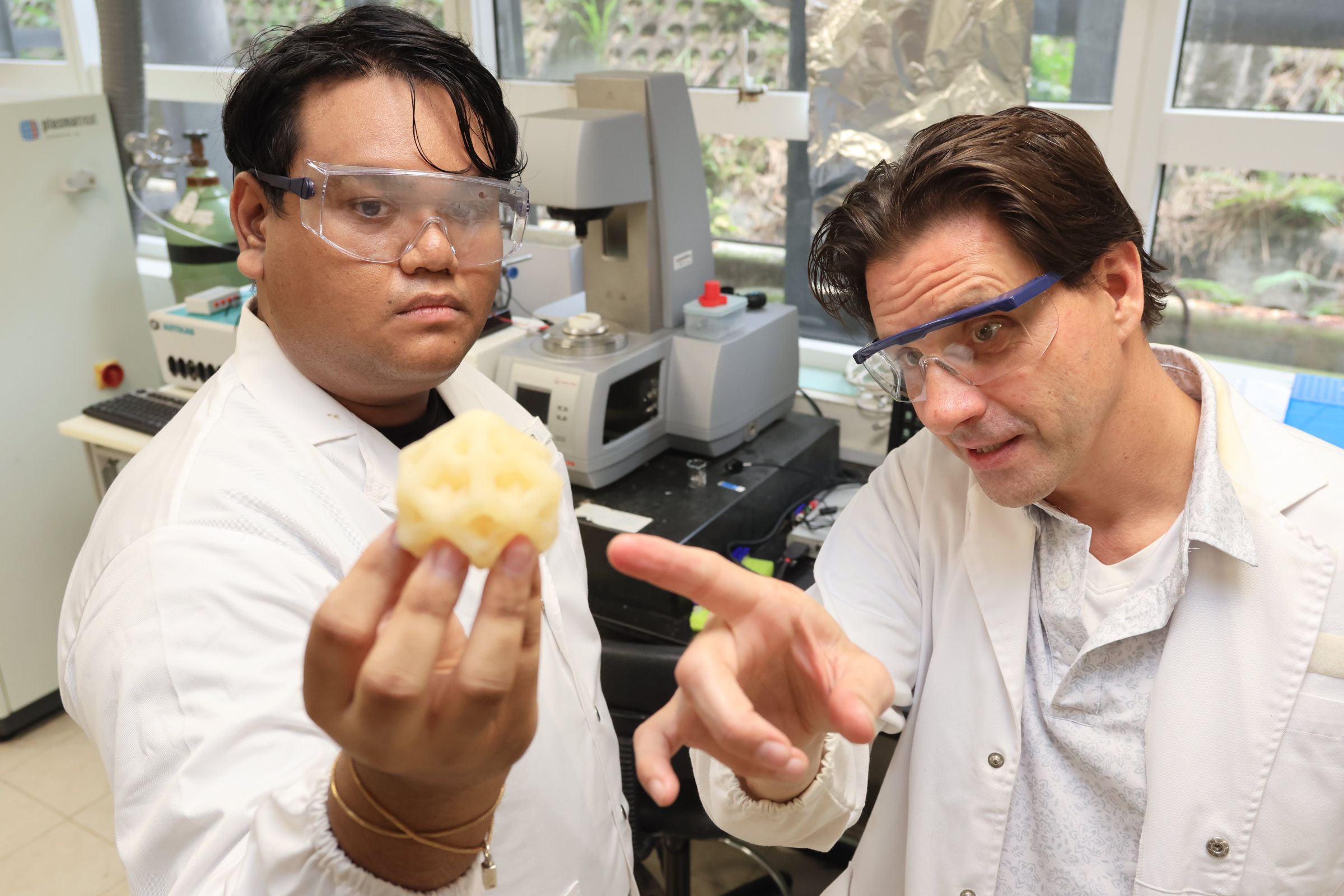 PhD student Naziruddin Ali (left) and Assoc Prof Terry Steele discussing a 3D printed model made using the aryl diazirine photoinitiators they developed. Credit: NTU Singapore.
Furthermore, several of these new compounds are soluble in water and liquid at room temperature. This behaviour simplifies handling and allows them to be used in “greener” manufacturing and sensitive biomedical applications where organic solvents are avoided.
“What truly sets our new photoinitiators apart is their unique combination of benefits. Not only are they non-toxic, but they also solve the long-standing problem of material shrinkage that is a critical issue in high-precision fields like 3D printing and dentistry. Their liquid form and water-solubility make them incredibly easy to work with and integrate into sustainable, water-based systems, which is a huge advantage for the industry,” said Assoc Prof Steele.
Future applications in manufacturing and medicine
The NTU researchers have demonstrated the new technology across several real-world uses. They have produced water-tight “form-in-place” seals and 3D-printed microfluidic channels from a sustainable, soybean-oil-based resin. The team notes the new compounds are also promising for live-cell encapsulation and food packaging.
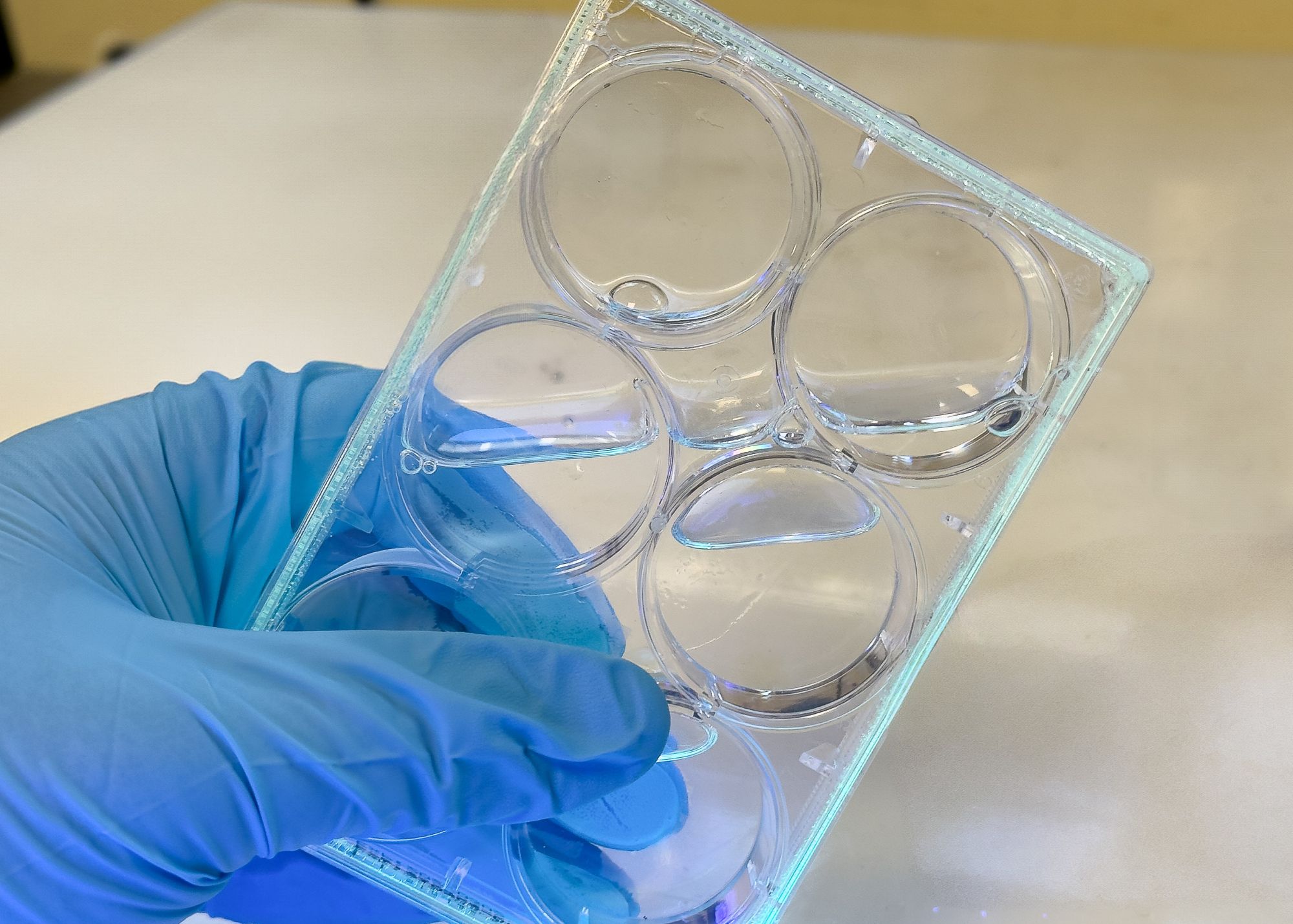 A form-in-place gasket is cured instantly with a handheld UV light to create a water-tight seal, showcasing the material's utility for custom sealants and biomedical devices. Credit: NTU Singapore.
They also created a stretchy skin bioadhesive that can extend to more than three-and-a-half times its length without damaging the underlying skin. It also acts as a protective barrier for long-term medical catheters.
Their findings pave the way for a new generation of light-curable materials for use in advanced manufacturing, biomaterials, and even wearable electronics, where safety and performance are paramount.
“Our next step is to bridge the gap between our laboratory findings and industrial-scale manufacturing, ensuring these safe activators can be easily adopted by global partners,” said lead author Naziruddin Ali.
The paper titled “Non-toxic aryl diazirine photoinitiators”, was first published online in NPG Asia Materials on 16 October 2026. DOI: 10.1038/s41427-026-00680-5.