WiRE2025: Women in Renewable Energy
Written by Quadeer Rehman | Energy Research Institute@NTU
The fifth Women in Renewable Energy (WiRE) supported by the IAS Frontiers Workshop series and a satellite event of the International Conference on Materials for Advanced Technologies (ICMAT), was held on 4 July 2025 in Singapore at the NTUC Centre, One Marina Boulevard. Gathering researchers and students from across disciplines, the workshop celebrated the achievements of women in renewable energy while openly addressing the challenges they continue to face. The aim was to provide better support for the next generation of scientists. The one-day programme combined invited talks, a poster session over lunch, and a closing discussion on actions the community can take moving forward.
The accessible city-center location and the scenic setting was especially well-suited for the poster session and networking activities. The atmosphere encouraged both scientific exchange and community-building, ensuring that participants could engage meaningfully with one another.
Programme highlights spanned cutting-edge science and translational topics across solar energy, advanced materials, storage, and sustainability. Presentations explored subjects such as halide-perovskite crystallisation dynamics, recombination losses and passivation, device stability roadmaps, and emerging approaches that couple artificial intelligence with materials discovery.
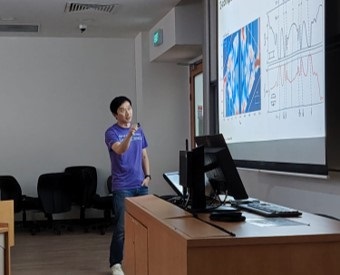
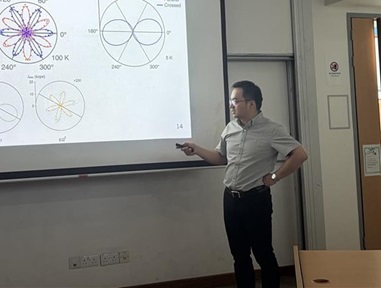
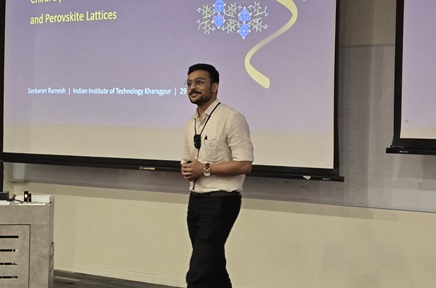
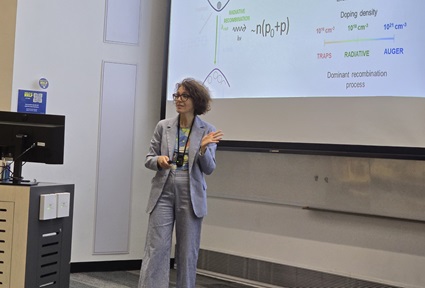
.jpg?sfvrsn=a8d940e9_1) Presentations by Profs Maria Antonietta Loi (left) and Yeng Ming Lam (right).
Presentations by Profs Maria Antonietta Loi (left) and Yeng Ming Lam (right).
The morning plenary block opened with talks by Ying Shirley Meng, Mirjana Dimitrievska, and Liu Bin; before participants continued their discussions over a coffee break. The mid-morning to noon sessions featured presentations by Hongxia Wang, Maria Antonietta Loi, and Yeng Ming Lam, which seamlessly led into the lunch and poster session. The poster session over lunch created a vibrant space for dialogue, connecting early-career researchers with senior academics and industry colleagues. Conversations during the session ranged widely, from device physics and characterisation techniques to manufacturability and field stability. Many participants found common ground, with several research teams already exploring opportunities for collaborative follow-ups.
In the afternoon, the Royal Society spotlight brought attention to talks by Francesca Brunetti and Nakita Noel, and was followed by an open discussion during the tea break. The closing sessions featured Huiqiong Zhou and Marina Freitag, with the workshop culminating in reflections led by Professors Paola Vivo and Mónica Morales Masis.
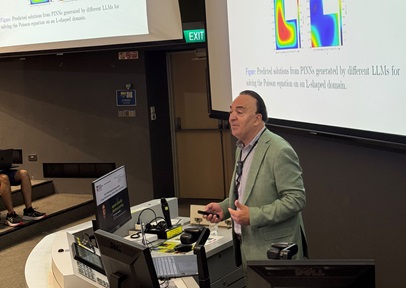
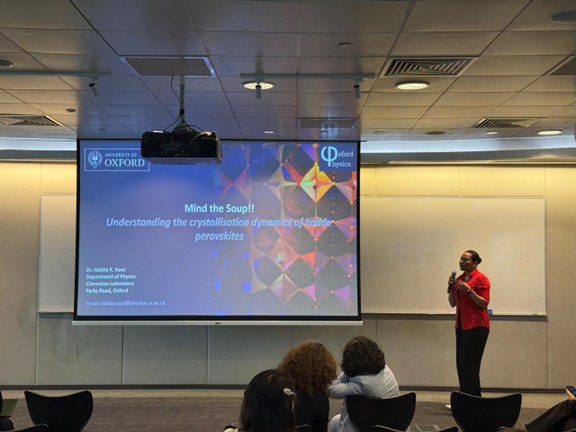 Dr Nakita Noel delivers her engaging talk, Mind the Soup! Understanding the Crystallisation Dynamics of Halide Perovskites.
Several key themes emerged from the day’s presentations and discussions. Crystallisation and film formation were examined in depth, with new insights on controlling intermediate phases and processing windows to deliver uniform, defect-lean perovskite films. Recombination and passivation strategies were also a major focus, with analyses of radiative versus non-radiative pathways—such as TRPL-derived rate constants—and interface strategies to suppress losses.
The workshop also emphasised stability by design, highlighting the role of ink chemistry, morphology, encapsulation, and device architecture in prolonging operational lifetimes of renewable energy devices. Beyond photovoltaics, speakers and participants addressed opportunities in energy storage materials, sensors and wearables, as well as circular-economy approaches that broaden the impact of renewable technologies. The integration of artificial intelligence into renewable energy research was another exciting theme, with discussions on how data-driven models can accelerate discovery and process optimisation while maintaining sustainability as a central guiding principle.
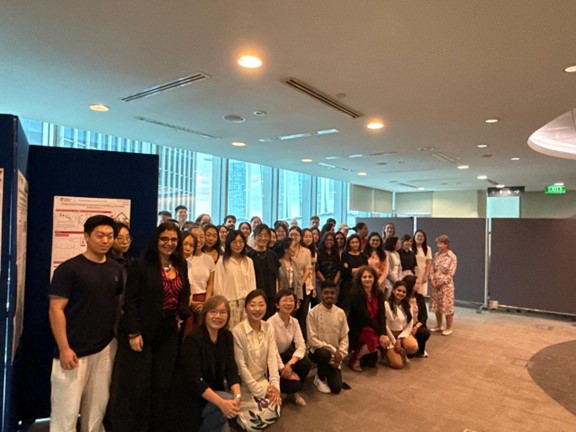 Group photo of the participants at WiRE2025.
Beyond the scientific content, the community and inclusion dimension of the workshop stood out. There were frank and open conversations about mentorship, the importance of role models, and the structural changes needed to retain and elevate women in energy research. These reflections underscored the importance of creating an ecosystem where talent can thrive without barriers.
WiRE2025 was chaired by Prof Zakya H. Kafafi, with co-chairs Prof Natalie Stingelin and Prof Quyen Nguyen, and local chairs Prof Liu Bin and Prof Annalisa Bruno. The organisers expressed their gratitude to all speakers, poster presenters, volunteers, and partners who contributed to making the event a success. The workshop not only advanced knowledge in renewable energy but also strengthened the community dedicated to building a more inclusive and sustainable future.