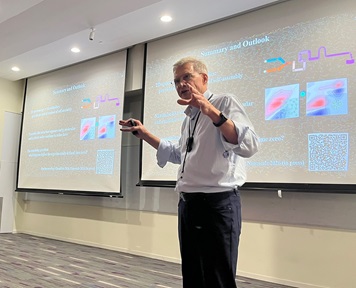
Shaping the Code of Tomorrow: An Interview with Turing Laureate Prof Jack Dongarra
An Interview Jointly Organised with the Graduate Students' Club of CCDS
When Prof Jack Dongarra speaks about computing, you quickly realise you’re in the presence of someone who hasn’t just witnessed the evolution of computer science but he’s helped shape it. Widely recognised as one of the architects of high-performance computing (HPC), Prof Dongarra has authored foundational software libraries, pioneered algorithmic innovations, and shaped the direction of computational science globally. In this candid interview on 8 July 2025, the 2021 Turing Award winner shares his reflections on software, open science, the AI revolution, and what the next decades might hold for computing.
 Prof Jack Dongarra reflects on shaping high-performance computing, open science, and AI’s future in this candid interview.
Scientific Openness and Real-World Impact
Prof Dongarra began his research career with a simple but profound motivation: to make software faster and more accurate. His early work focused on implementing numerical algorithms, especially for linear algebra, in ways that could scale across architectures and deliver robust, portable performance. His software, including widely used packages like LINPACK and LAPACK, has become the invisible backbone of countless applications, from scientific simulations to AI libraries like SciPy and R. A major factor in its longevity? Open access and community involvement.
Prof Dongarra views open-source licensing not just as a matter of convenience, but as a commitment to scientific progress. Developed with public funding, he believes the software should be available to those who need it, no strings attached.
But with openness comes a challenge- sustainability. Maintaining and documenting complex scientific software takes time and resources, resources that grants often fail to cover. This tension between innovation and sustainability is a recurring theme in scientific computing. Prof Dongarra believes that while open source plays a critical role in keeping scientific tools transparent and accessible, the broader ecosystem still needs to reckon with how it funds long-term software maintenance.
Navigating the Future of High-Performance Computing
As computing technologies evolve, what excites one of the field’s pioneers? For Prof Dongarra, the future lies in diversifying beyond CPUs and GPUs. Looking ahead, he speculated that future HPC systems might integrate not only traditional processors but also cutting-edge technologies like optical computing, neuromorphic systems, and quantum computing.
Of these, optical computing, where data is encoded in light and manipulated at the speed of light, shows promise in terms of performance. Neuromorphic computing, which mimics the structure and functioning of the human brain, also holds potential for energy-efficient computation. But when it comes to quantum computing, Prof Dongarra remains cautiously skeptical. He warned that overhyping quantum risks creating a “quantum winter”, a period of disillusionment, similar to what AI experienced in its early days since there are only a few algorithms that really work well, and the hardware is still error-prone and unstable. Still, he sees it as a vital research frontier to solve certain classes of problems.
The rise of AI has created an interesting contrast with traditional HPC. While scientific computing demands high precision, AI models can often work with low-precision data to achieve faster inference. “There’s a divergence in precision needs,” Prof Dongarra explained. “AI is pushing hardware to be optimised for low precision, which might leave scientific computing underserved.” Yet the intersection is full of promise. AI is already accelerating simulations and predictions where previously only brute-force numerical methods applied. Prof Dongarra encourages researchers to apply new algorithmic approaches that combine low-precision speed with high-precision corrections, in order to take advantage of AI-era hardware without sacrificing accuracy. He encouraged researchers to stay flexible by making fundamental research relevant in the current funding climate. The key is to ask how your work connects to the major trends, whether that’s AI, climate science, or energy.
A Message for Students: Tools, Mentors, and Mindsets
Prof Dongarra emphasised the growing importance of generative AI tools in academic research and learning. He encouraged students and researchers to become proficient in using large language models, framing them as valuable resources that have largely replaced traditional search engines such as Google. He shared how he personally uses ChatGPT to quickly summarise complex academic papers, compare research findings, and extract relevant insights, which significantly reduces the time and effort required in scholarly work. However, he also cautioned users to remain critical of the output, acknowledging that AI tools sometimes produce inaccurate or incomplete information.
Prof Dongarra stressed that mastering the use of AI tools, including crafting effective prompts, is becoming an essential skill for students aiming to stay competitive and productive in today’s rapidly evolving research landscape.
Prof Dongarra also highlighted the crucial role of mentorship throughout his career, describing it as a foundational element in both personal and professional growth. He reflected on the patience and guidance he received from his mentors, which helped shape his research path and encouraged him to overcome challenges. He stressed the importance of networking and collaboration, encouraging young researchers to openly share their work and challenges with peers and mentors. This exchange not only helps to gain fresh perspectives and solutions but also fosters a supportive community where ideas can grow.
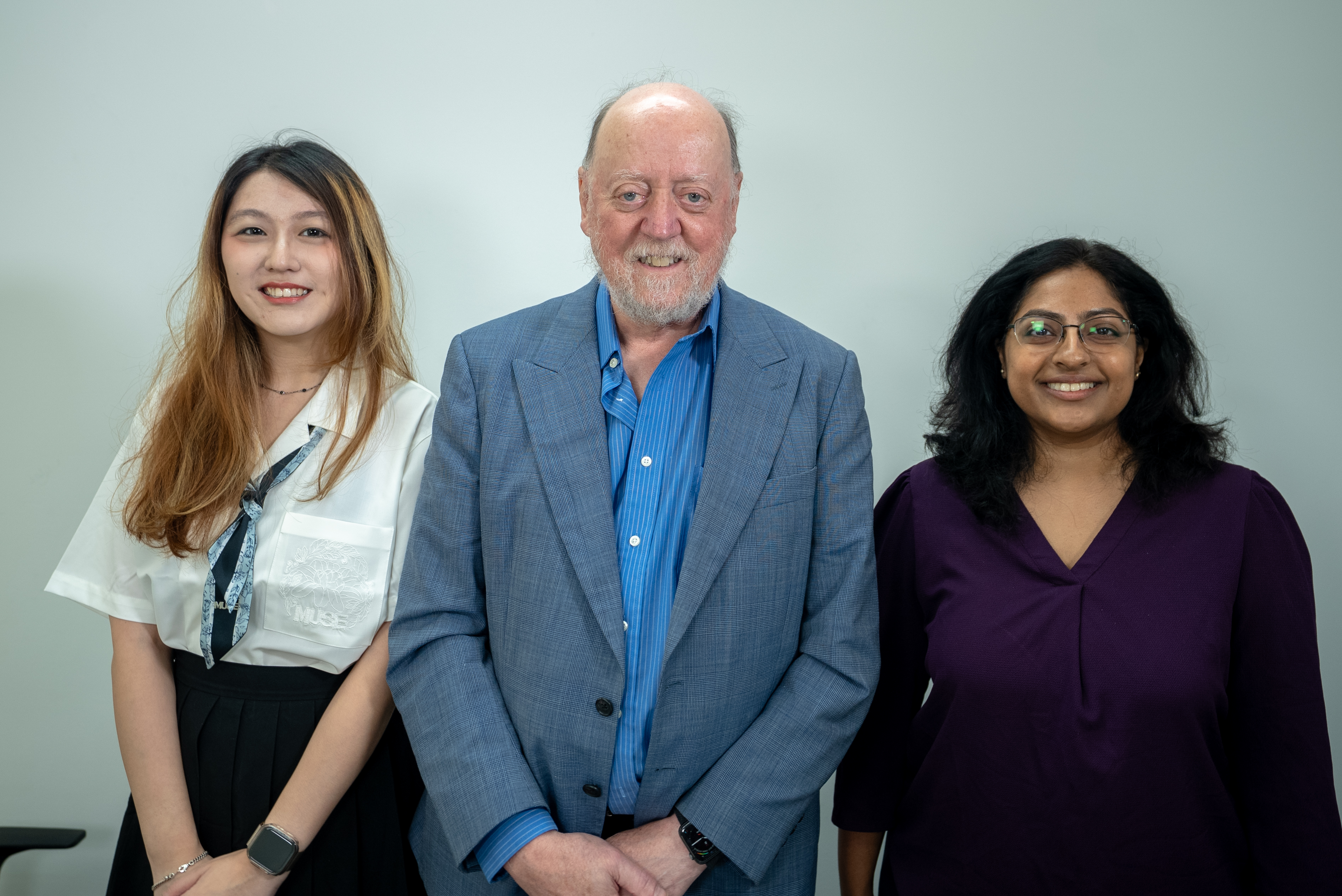 [From left to right] Goh Si Qi (PhD student, CCDS NTU), Prof Jack Dongarra, and Luqman Alka (PhD student, CCDS NTU).
“Expect to fail. That’s part of research. Aim high. Don’t just go for the low-hanging fruit,” he advised. “And most importantly- network. Engage with others. Share your challenges. You’ll be surprised how much you grow from that.”
In his message to the NTU research community, particularly young scholars and faculty, Prof Dongarra stressed the central role of passion in academic success. He explained that pursuing a PhD means becoming an expert in a very specific area, so it is crucial to select a topic that genuinely interests and motivates the student. Passion fuels the perseverance needed to tackle difficult problems over the long term. Tackling ambitious questions helps researchers develop stronger skills and produces work that can make a meaningful difference in their field.
Prof Dongarra’s appointment as the IAS Lee Kong Chian Distinguished Professor symbolises a commitment to fostering a vibrant research culture that blends cutting-edge computational science with mentorship and community building. His advice to students and faculty alike is to follow their curiosity with dedication, maintain an ambitious outlook, and remain resilient in the face of inevitable setbacks.
Written by: Luqman Alka | Graduate Students' Club of the College of Computing and Data Science (CCDS)
Watch the full interview here: