Quantum Field Theory: A Universal Language by Prof Đàm Thanh Sơn
IAS@NTU STEM Graduate Colloquium Jointly Organised with the Graduate Students' Clubs
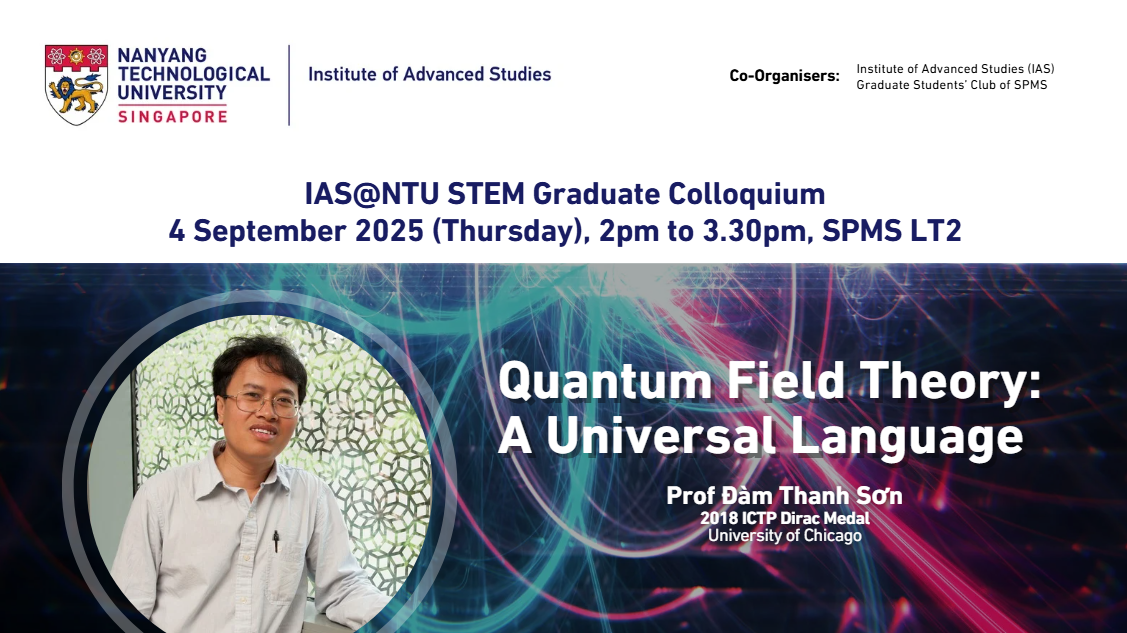
On 4 September 2025, the IAS@NTU STEM Graduate Colloquium, organised in collaboration with the School of Physical and Mathematical Sciences (SPMS) and the Graduate Students’ Clubs of SPMS, featured an insightful talk by Prof Đàm Thanh Sơn from the University of Chicago. His talk, Quantum Field Theory: A Universal Language, demonstrates the ubiquity of Quantum field theory as the fundamental language for describing the physical phenomena - in elementary particle physics to complex condensed matter systems.
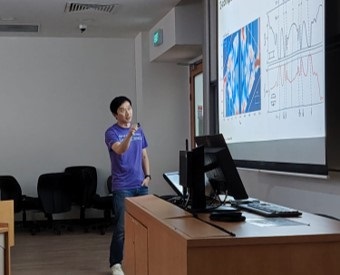
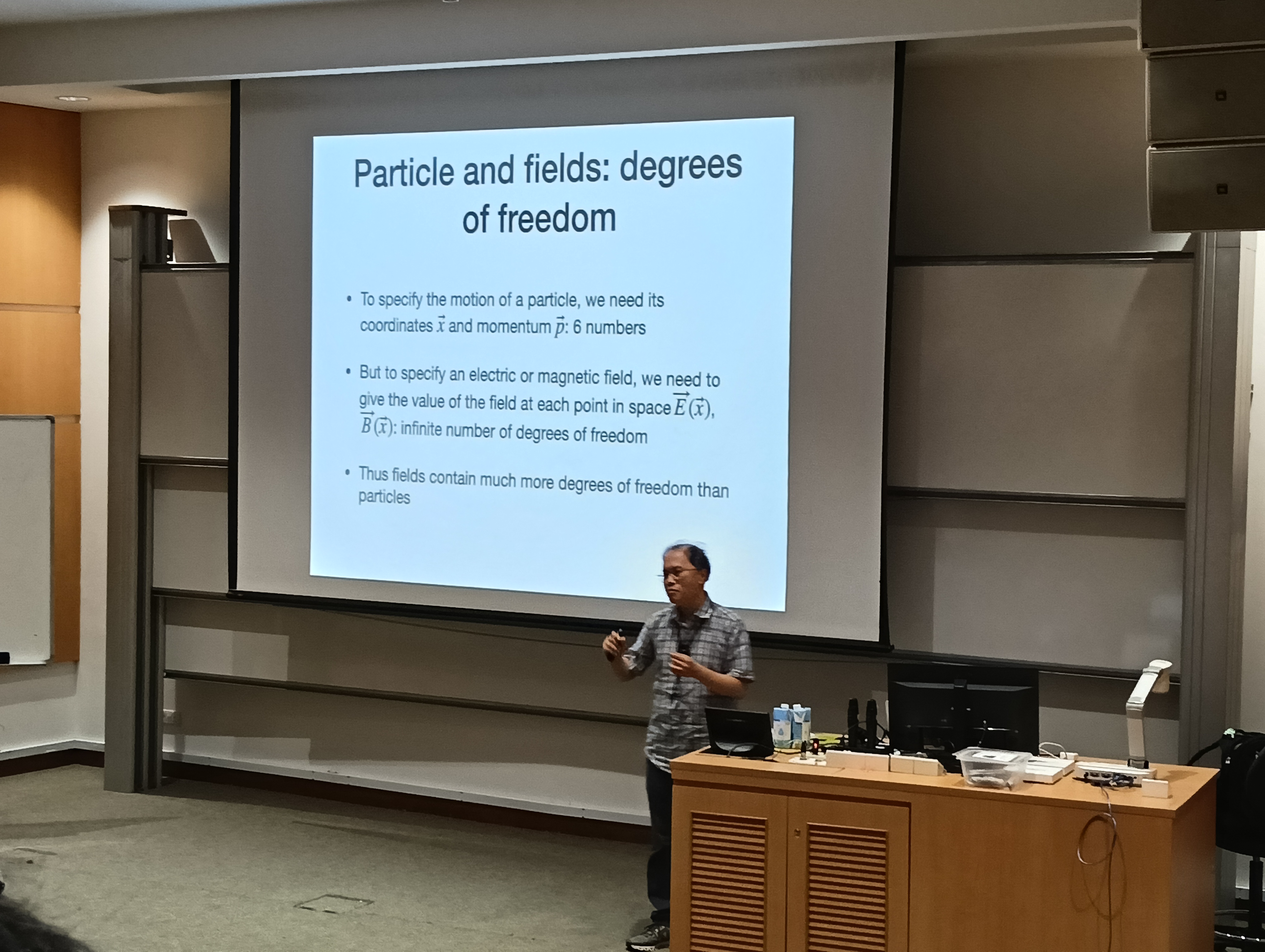 Prof Đàm presents on the evolution from classical physics to quantum field theory’s revolutionary insights.
By the end of the 19th century, physics rested on two great pillars: Newton’s laws of motion, which described dynamics of particles, and Maxwell’s equations of electromagnetism, which governed fields. Classically, particles and fields were distinct categories with finite and infinite degrees of freedom, respectively. The early 20th century brought quantum mechanics, with Schrodinger’s equation, Heisenberg’s uncertainty principle, de Broglie’s waves of matter and Einstein’s particles of light blurring this distinction. Still, some processes, like the emission of photons by atoms, demanded more than what quantum mechanics could provide. To explain them, one had to quantise not only the electron’s motion but also the electromagnetic field itself. This hybrid picture was the first glimpse of quantum field theory (QFT). The full leap came in 1928, when Paul Dirac wrote his relativistic version of Schrodinger equation, showing that electrons themselves must be treated as quantum fields—an insight that predicted the existence of antiparticles, a striking yet unusual new feature of nature, at that time.
QFT thus emerged as the fundamental framework for particle physics. Unlike ordinary quantum mechanics, which can only describe fixed numbers of particles, QFT naturally incorporates the creation and annihilation of particles, vacuum fluctuations, and relativistic causality. It is the universal language for the Standard Model, the field theory that has explained every particle physics experiment to date with extraordinary precision. But QFT’s reach extends far beyond high-energy physics: the same principles illuminate phenomena across condensed matter and statistical mechanics. Whether in phonons in solids, critical points in phase transitions, or exotic quantum Hall states, QFT offers a language flexible enough to describe collective excitations and emergent particles that no simpler framework can capture.
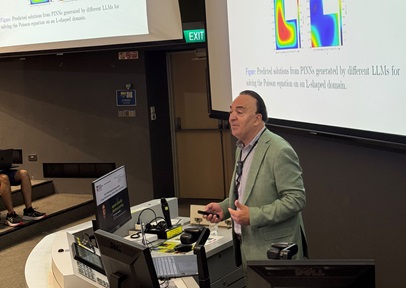
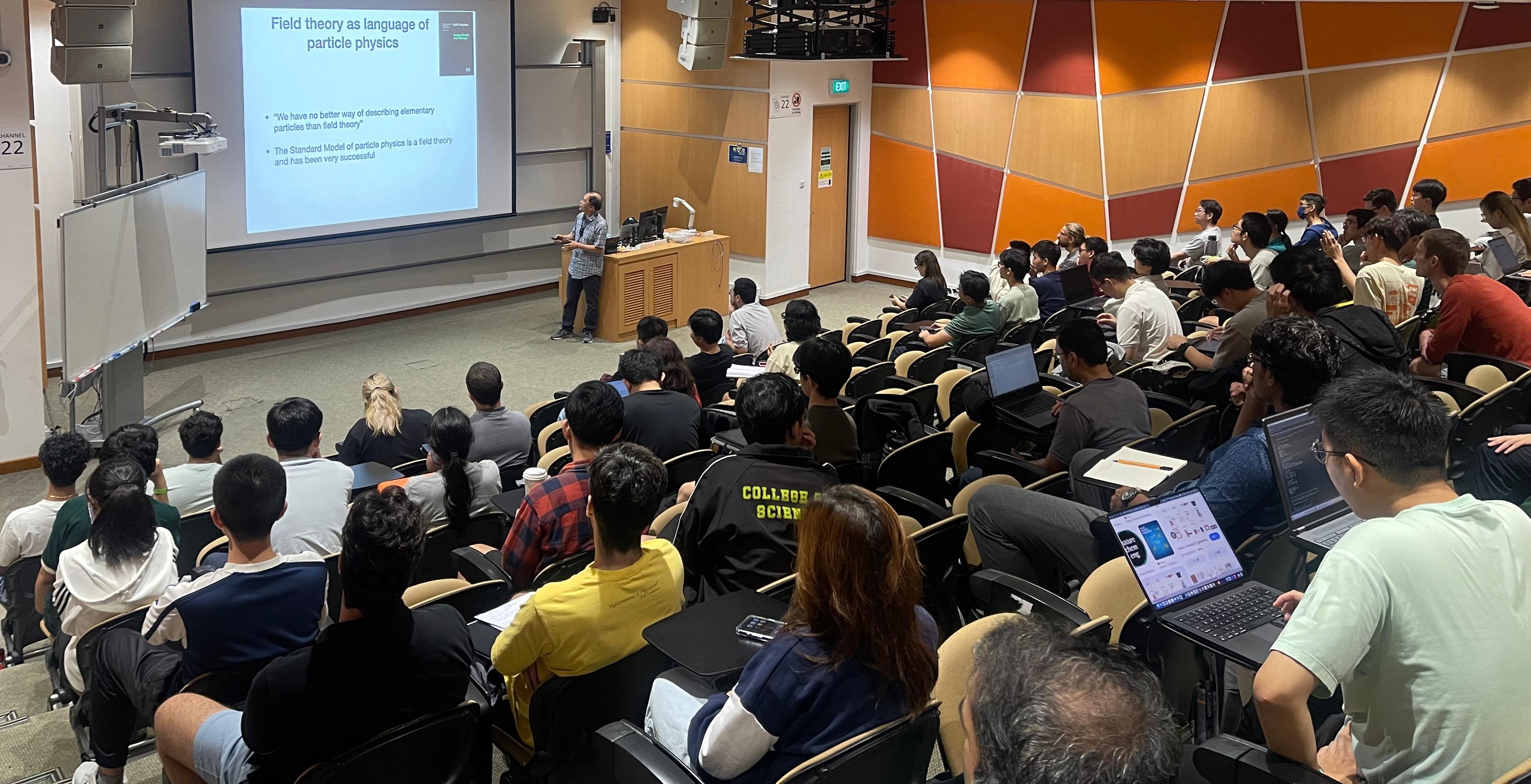 Prof Đàm captivates a packed lecture theatre, illustrating condensed matter physics with elegant, concrete examples.
Prof Đàm gave elegant and concrete examples from condensed matter physics to illustrate these ideas. The first was phonons - the quantised vibrations of atoms in a solid. When a piece of solid is struck, the sound waves produced can be quantised into quasiparticles. Their field-theoretic description arises from the continuous displacement field of atoms in a discrete lattice. Crucially, a solid spontaneously breaks continuous translational symmetry, and QFT tells us that such spontaneous symmetry breaking must give rise to Nambu–Goldstone bosons: massless excitations whose energy vanishes at zero momentum. Phonons are precisely such modes in a solid. Prof Đàm emphasised how QFT provides the most natural language for capturing the physics of phonons and other continuous symmetry-broken modes, because it can easily handle processes involving arbitrary numbers of these quasiparticles.
A second example focused on critical phenomena and the role of the renormalisation group (RG). The phase transition of water boiling into its vapour terminates at a certain critical point, which marks the beginning of a continuous phase transition. Early theories by Landau theorised the critical exponents at this critical point by a square root law. However, experiments in two and three dimensions did not support these results. The resolution for this puzzle came from Kenneth Wilson’s renormalisation group, first developed in the context of quantum electrodynamics and later applied to statistical mechanics. Here Prof Đàm highlights how second-order phase transitions can be described by special kinds of QFTs - conformal field theories - with remarkable predictive power, yielding exponents in excellent agreement with experiment. His own work has contributed to the modern application of QFT and duality ideas to strongly correlated systems near criticality.
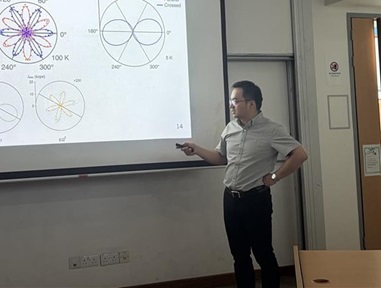
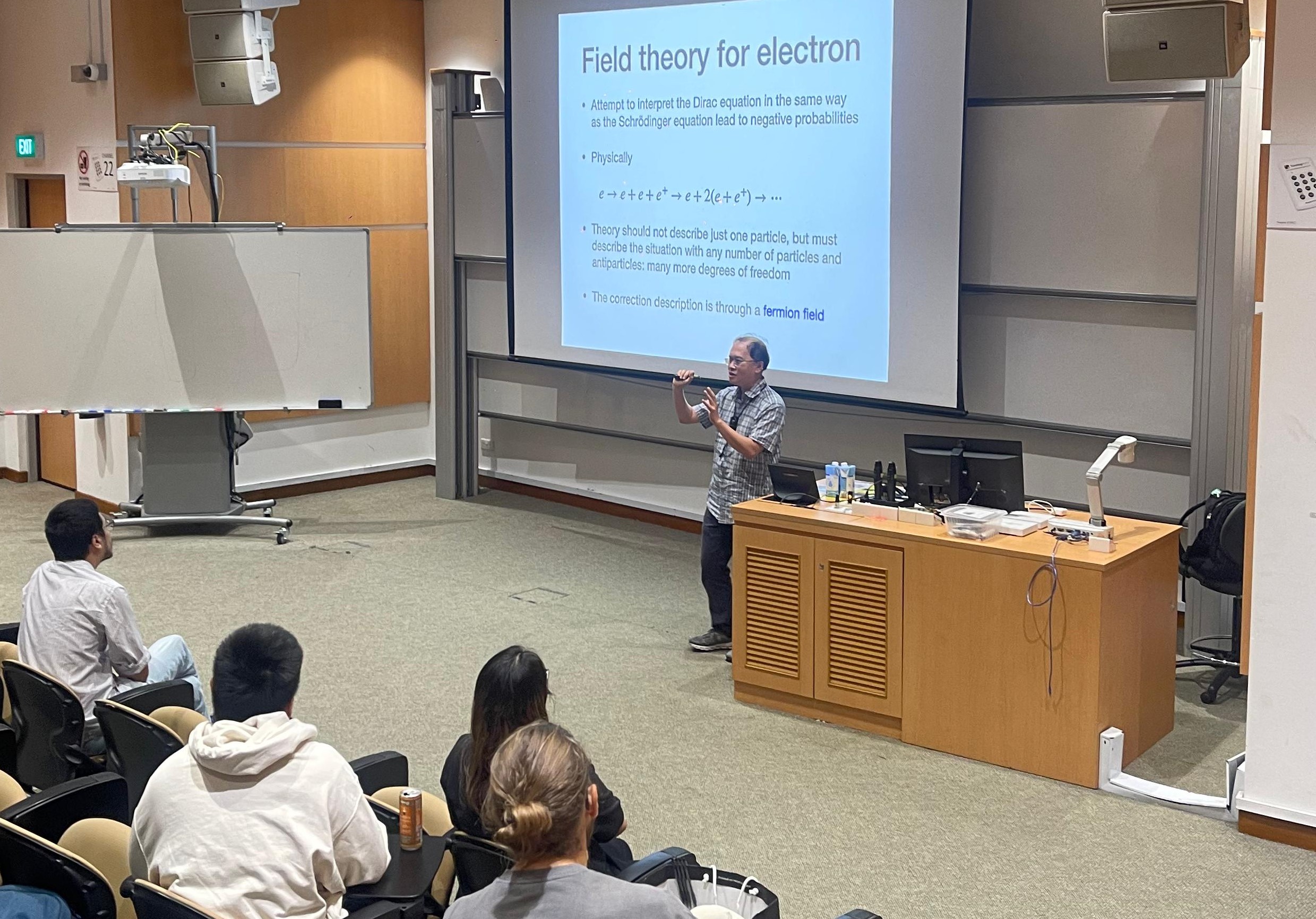 Prof Đàm highlights how modern theories explain critical phase transitions with remarkable accuracy.
Graphene offers a third striking example. This two-dimensional sheet of carbon atoms, arranged in a hexagonal lattice, is a semimetal with low-energy excitations behaving like relativistic Dirac fermions. The key difference is that their “speed of light” is about 300 times smaller than the real speed of light, making them accessible in tabletop experiments. Moreover, graphene realises a peculiar form of mixed-dimension QFT, where the electrons live in two dimensions, while the photons they interact with propagate in three. This interplay has made graphene a remarkable laboratory for testing ideas drawn from relativistic field theory in a condensed-matter setting.
Finally, Prof Đàm discussed one of the very deep and nontrivial problem in condensed matter physics - the nature of the half-filled Landau level (𝛎 = 1/2) in fractional quantum Hall effect, one of the landmark contributions by Prof Đàm. Consider electrons in two dimensions under a strong magnetic field - their motion is quantised into discrete energy levels called Landau levels. If a Landau level is completely filled, one observes the integer quantum hall effect, where the Hall resistance is quantised in integer multiples. On the other hand for partially filled Landau levels, strong electron-electron interactions dominate and a new quasiparticle emerges where Hall resistance takes rational fractional values. Now, the case of half filling (𝛎 = 1/2) is rather peculiar - where the Landau level is neither full nor empty.
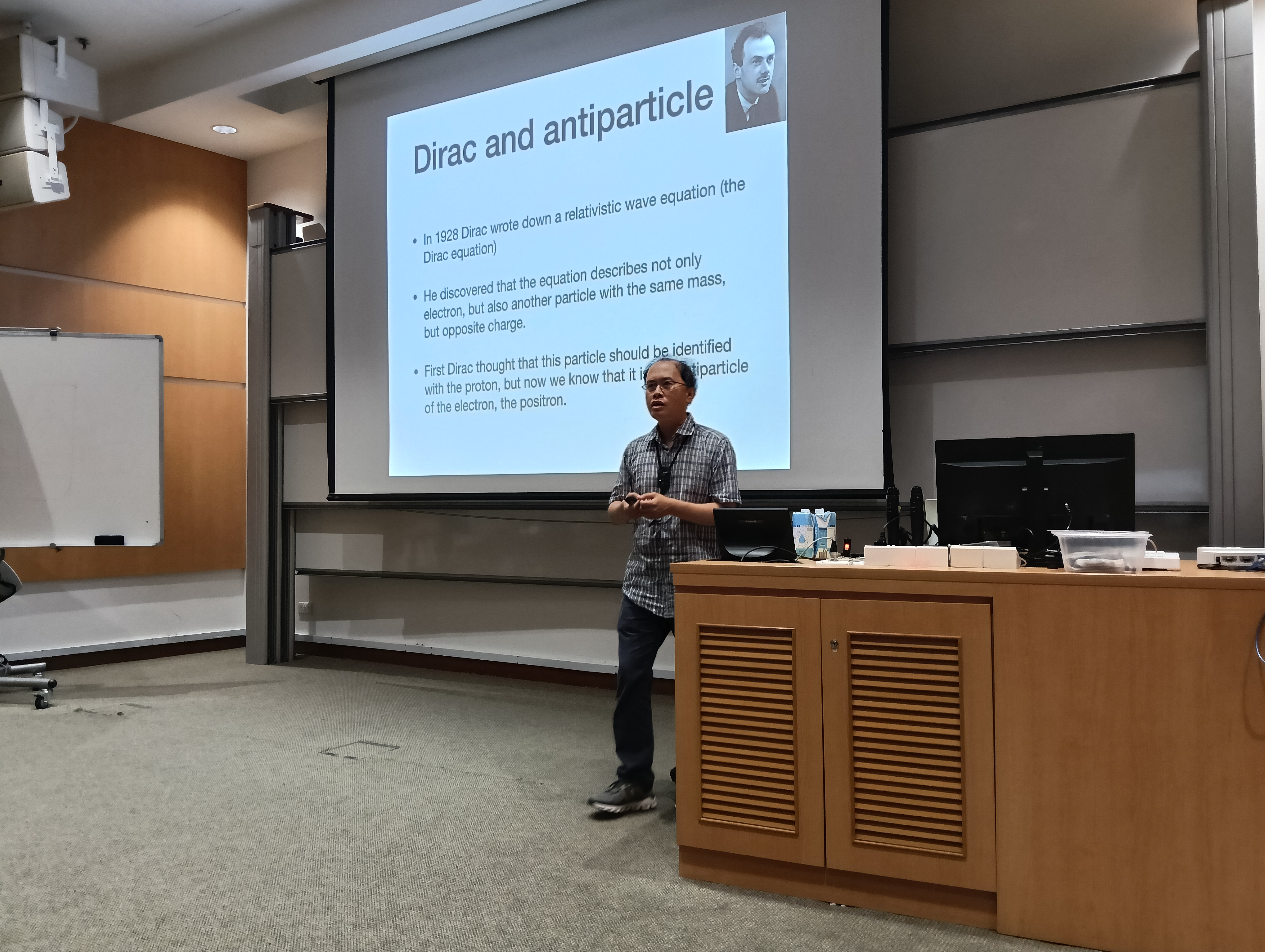 Prof Đàm proposes massless Dirac fermions, reshaping symmetry, duality, and quantum understanding.
Experimentally, a metallic-like transport has been observed, rather than quantised fractional quantum Hall plateaus. The most successful early description was the composite fermion picture proposed by Halperin–Lee–Read (HLR) theory, where each electron is “attached with” two flux quanta of the magnetic field, effectively canceling the external magnetic field at half-filling and forming a Fermi sea - like ordinary electrons in metal. While HLR theory explained many experimental observations, like metallic transport and certain thermodynamic properties, it did not respect particle-hole (PH) symmetry - a fundamental symmetry that half-filled Landau level must obey.
In 2015, Prof Đàm proposed that the correct effective theory at half filling is not non-relativistic composite fermions, but rather massless Dirac fermions (like those in graphene). These Dirac composite fermions carry a Berry phase of π when going around the Fermi surface, which automatically enforces particle–hole symmetry, that HLR theory lacked. This theory also gave new predictions, for example the suppression of backscattering in transport experiments, which matched numerical simulations. It placed the half-filled Landau level inside a broader web of dualities in (2+1)D QFT i.e., mapping a free Dirac fermion in one description to an interacting QED3 gauge theory in another. The important take-away from this example is only QFT has the machinery to describe this phenomenon with emergent gauge fields, Berry phases, particle-hole duality, and quasiparticles that are not adiabatically connected to the original electrons.
.jpg?sfvrsn=205ff034_1) The colloquium ends with applause and a lively Q&A, sparking thoughtful exchanges on theory, symmetry, and quantum phenomena.
The colloquium ends with applause and a lively Q&A, sparking thoughtful exchanges on theory, symmetry, and quantum phenomena.
In conclusion, the colloquium by Prof Đàm highlights how quantum field theory, originally developed as the language of particle physics, has found surprisingly deep and fruitful applications in condensed matter physics. Its ability to capture the collective behavior of vast numbers of particles makes it uniquely suited to some of the most challenging problems in the field. As his examples demonstrated, QFT not only unifies our understanding across different domains of physics but also continues to evolve as a powerful and indispensable tool in modern theoretical research.
.jpg?sfvrsn=c7f2ac4d_1) A memorable audience group photo and snapshot with select fans capture the excitement and admiration for Prof Dam’s visit.
A memorable audience group photo and snapshot with select fans capture the excitement and admiration for Prof Dam’s visit.
Written by Adira Mohitha | NTU School of Physical and Mathematical Sciences Graduate Students’ Club
“I enjoyed the history and introduction of quantum field theory and why it became the theory to describe particle physics” - Qiu Kai Wei (PhD Student, SPMS)
“He introduced a seemingly difficult subject to the mass and demonstrated their applicability and usefulness in a way that is not mathematically intense.” - Lee Gao Yu (PhD Student, CEEE)
Watch the recording here