A New Generation of Ionic-Gated Transistors by Prof Alberto Morpurgo
IAS@NTU STEM Graduate Colloquium Jointly Organised with the Graduate Students' Clubs
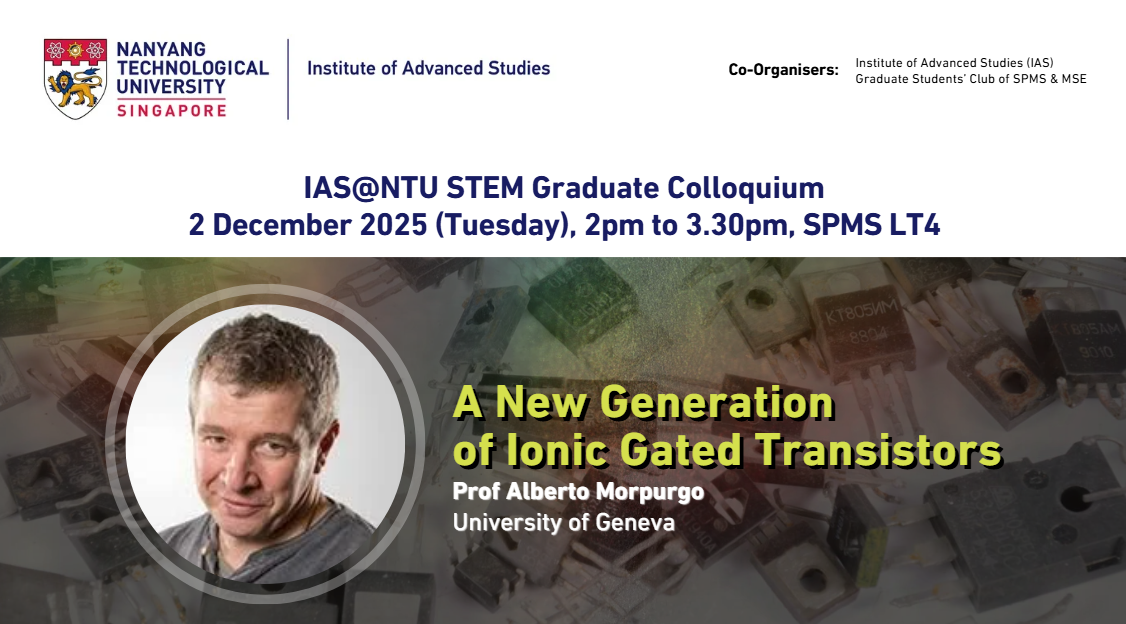
On 2 December 2025, the IAS@NTU STEM Graduate Colloquium Series welcomed Prof Alberto F. Morpurgo, Professor of Experimental Condensed Matter Physics, for a thought-provoking seminar titled “A New Generation of Ionic-Gated Transistors.” Held at SPMS Lecture Theatre, the seminar brought together graduate students, faculty members, and researchers keen to explore how innovative device architectures are reshaping the way scientists probe electronic structure in low-dimensional materials.
The talk examined how ionic-gated transistors, originally developed as high-performance electronic devices, have evolved into powerful experimental platforms capable of accessing extreme electric-field regimes. These devices now enable researchers to quantitatively investigate band gaps, band offsets, and interfacial electronic states in materials systems that challenge conventional measurement techniques.
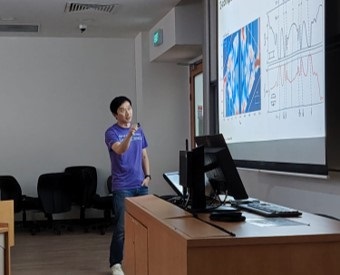
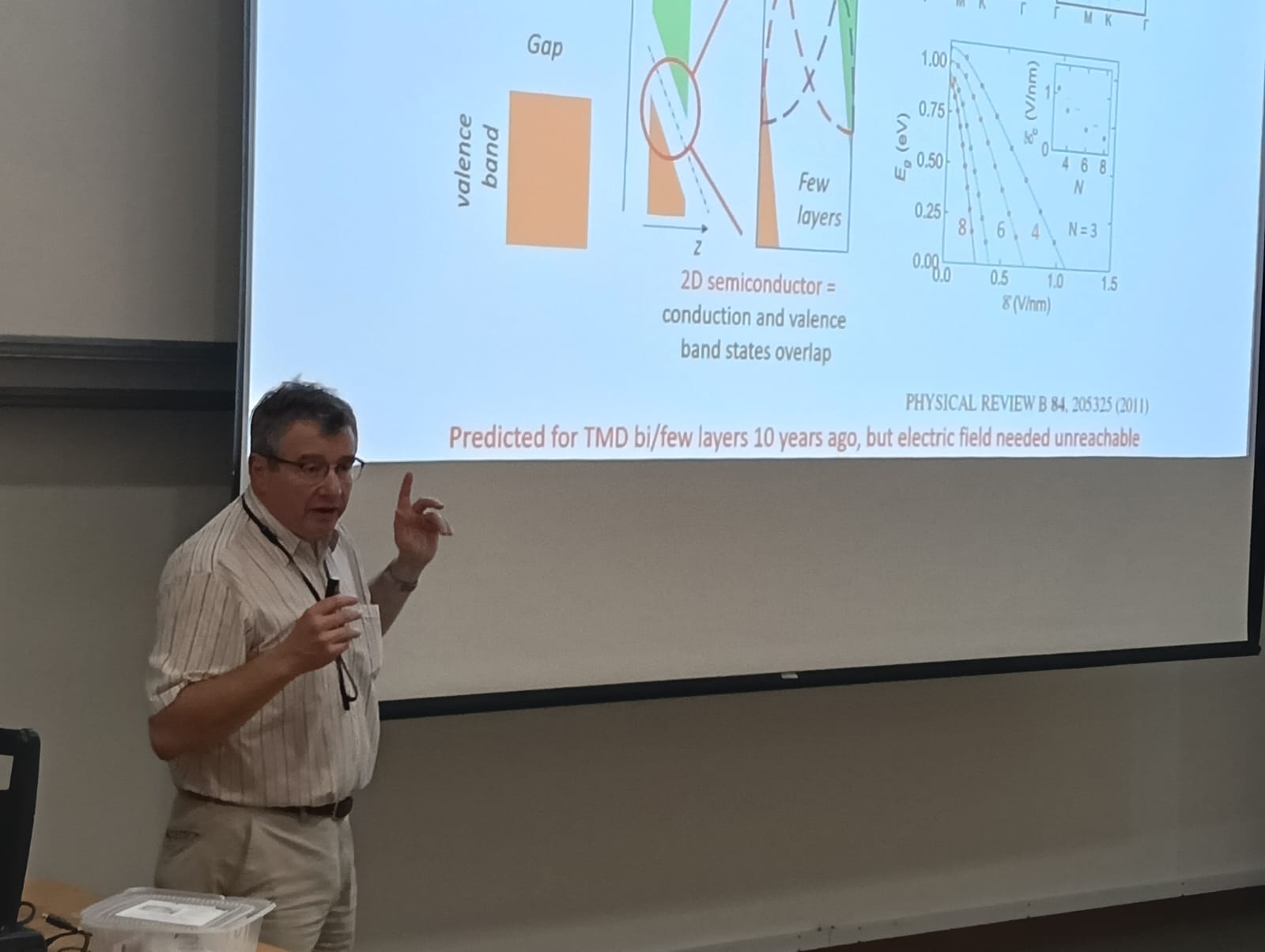 Prof Morpurgo kickstarts his lecture on ionic-gated transistors, revealing new ways to probe low-dimensional electronic materials.
From Conventional Gating to Ionic Control
Prof Morpurgo began by situating the audience within the broader context of modern semiconductor and quantum-materials research. As materials are thinned down to just a few atomic layers, traditional solid-state gate dielectrics increasingly struggle to induce sufficient carrier densities without encountering dielectric breakdown or excessive power dissipation.
Ionic gating offers a radically different approach. By using ionic liquids to form electric double layers at the surface of a material, researchers can generate extremely large interfacial electric fields, far beyond what is achievable with conventional oxide gates. This allows precise tuning of the chemical potential across wide energy ranges, enabling access to electronic regimes that were previously out of reach.
Importantly, Prof Morpurgo emphasised that ionic-gated transistors should not be viewed merely as “stronger” transistors. Instead, they function as experimental probes, capable of revealing fundamental electronic properties with high precision.
Transistors as Spectroscopic Tools
A central message of the seminar was the idea that ionic-gated transistors can be used as quantitative spectroscopy instruments. By carefully tracking how current turns on as a function of gate voltage, researchers can directly extract key electronic parameters such as band gaps, threshold energies, and chemical potential shifts.
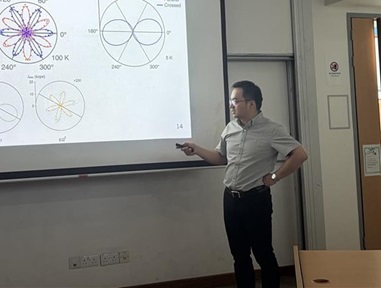
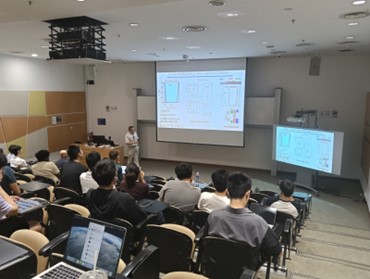 Prof Morpurgo presents experimental data showing exciton binding energy determination and band alignment in TMD materials using ionic-gated transistor platforms.
Using transition metal dichalcogenides as illustrative examples, Prof Morpurgo showed how monolayer and bilayer systems respond differently under strong gating conditions. In monolayers, transport measurements can be correlated with optical data to determine exciton binding energies, revealing how dielectric environment and screening strongly influence electronic interactions.
In bilayer systems, ionic gating enables even richer physics. The ability to independently accumulate electrons and holes on opposite sides of an atomically thin crystal allows researchers to explore regimes where electronic wavefunctions begin to overlap, blurring the distinction between semiconducting and semimetallic behavior.
Probing Interfaces in van der Waals Heterostructures
Moving beyond single materials, Prof Morpurgo highlighted how ionic-gated architectures can be extended to van der Waals heterostructures, where multiple two-dimensional layers are stacked together. In such systems, understanding band alignment at interfaces is critical for designing optoelectronic, spintronic, and quantum devices.
By engineering devices with shared gates and carefully placed contacts, researchers can selectively probe transport through individual layers or across interfaces. Prof Morpurgo demonstrated how this approach allows direct measurement of band offsets and identification of which layer dominates conduction under different gating conditions.
Extreme Electric Fields and Emergent Phenomena
One of the most striking aspects of ionic-gated devices is their ability to access extreme electric-field regimes. When sufficiently strong perpendicular fields are applied to multilayer systems, the electronic structure can undergo dramatic transformations.
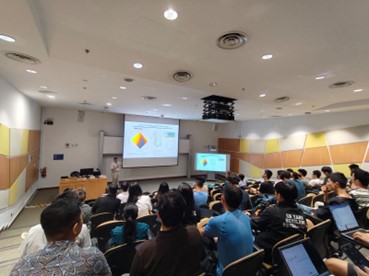
Experimental and theoretical data showing how strong perpendicular electric fields drive the evolution of the band gap in ionic-gated devices.
Under these conditions, band gaps may shrink or collapse entirely, leading to the emergence of unusual semimetallic states. Electronic wavefunctions that are spatially separated at low fields begin to overlap, giving rise to strong Coulomb interactions and highly non-linear transport behavior.
While simplified models offer qualitative insight into these regimes, Prof Morpurgo stressed the importance of ab initio calculations to fully capture the structural deformation and band reconstruction induced by strong fields.
Engaged Discussion and Conclusion
The seminar concluded with a lively Q&A session, reflecting the strong engagement of the audience. Participants raised thoughtful questions about device stability, hysteresis effects associated with ionic liquids, scalability of the technique, and the feasibility of integrating ionic gating into more complex experimental platforms.
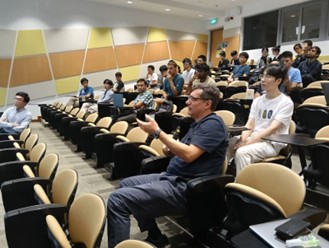
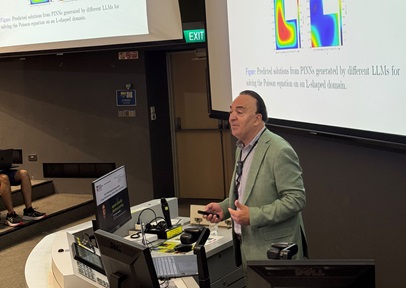
An interactive Q&A session saw attendees discussing device physics, extreme electric fields, and future applications of ionic-gated transistors.
Prof Morpurgo’s seminar offered a compelling perspective on how ionic-gated transistors are redefining experimental access to electronic states in low-dimensional materials. By pushing beyond the limits of conventional gating, this new generation of devices enables quantitative measurements and controlled exploration of electronic regimes that were once inaccessible.
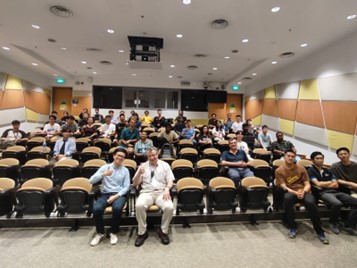
This colloquium is held in conjunction with the ongoing IAS Frontiers Seminars: Quantum Horizons series. Find out more about the upcoming seminars and register here.
Written by: Rohit Duvvuri | NTU School of Physical and Mathematical Sciences Graduate Students' Club
“The seminar gave a very clear picture of how ionic gating can be used as a quantitative spectroscopy tool, not just a transistor technology.” – Nannapaneni Chandra Mouli (PhD student, MSE)
Watch the recording here.