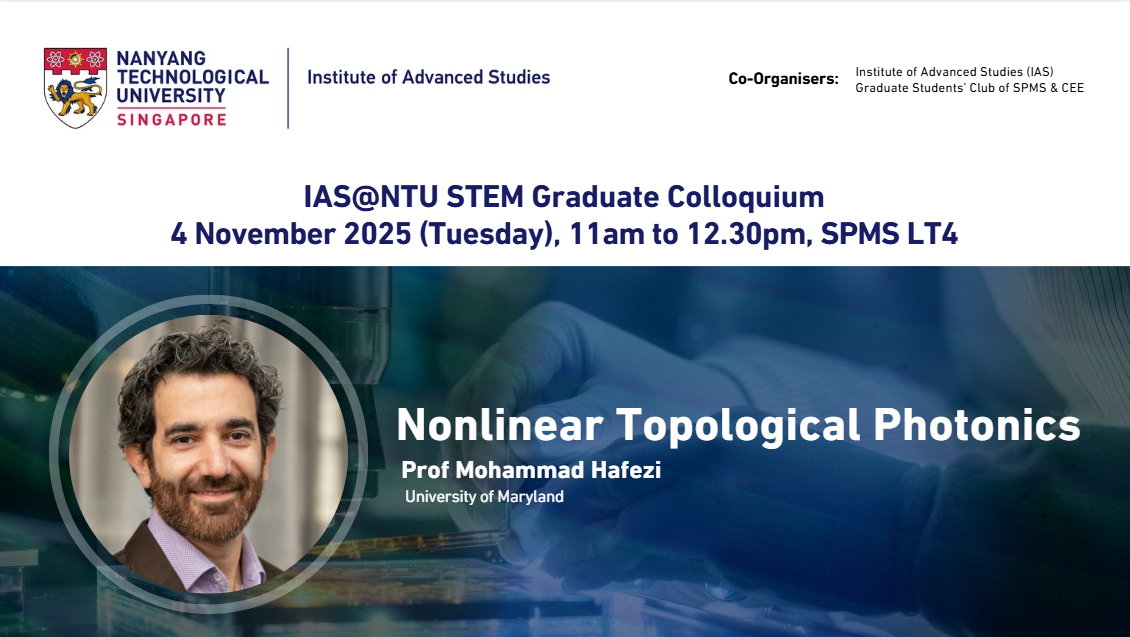
Nonlinear Topological Photonics by Prof Mohammad Hafezi
IAS@NTU STEM Graduate Colloquium Jointly Organised with the Graduate Students' Clubs
On 4 November 2025, the Institute of Advanced Studies (IAS) and the School of Physical and Mathematical Sciences (SPMS) hosted a STEM Graduate Colloquium featuring Prof Mohammad Hafezi, a Minta Martin Professor at the University of Maryland with joint appointments in Physics and Electrical and Computer Engineering. He is also Fellow of the Joint Quantum Institute, the Quantum Technology Center, and the Institute for Research in Electronics and Applied Physics.
Prof Mohammad’s research sits at the intersection of quantum optics, nanophotonics and topological physics, and has played a central role in establishing topological photonics as a field. His distinctions include the Simons Investigator Award, Sloan Research Fellowship, and election as a Fellow of the American Physical Society.
His colloquium, titled “Nonlinear Topological Photonics”, explored how ideas from topology, originally developed to understand robust electronic transport such as the quantum Hall effect, can be implemented with light and enriched by optical nonlinearity.
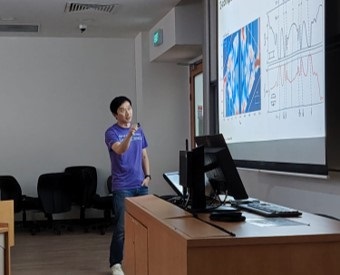
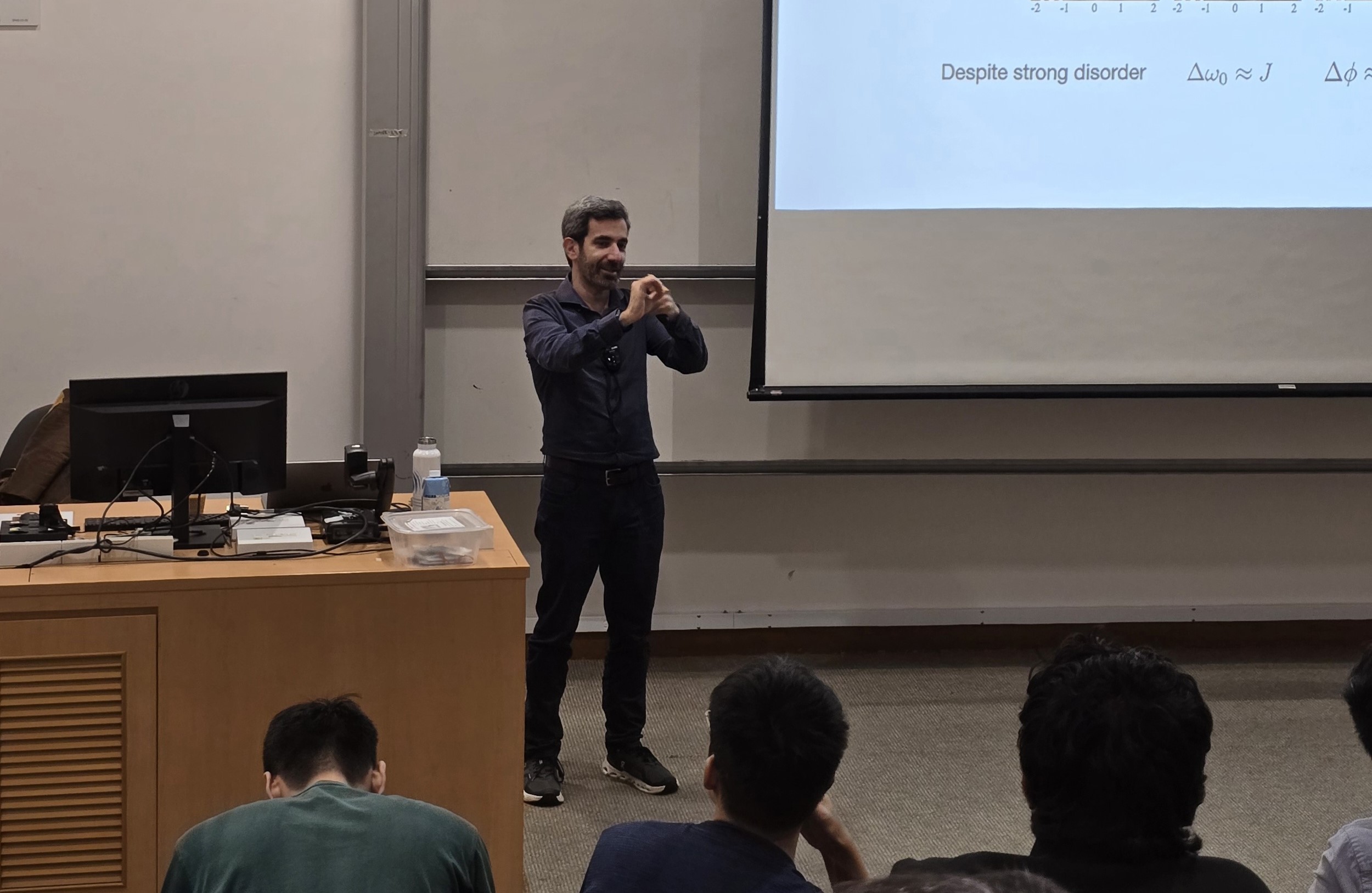 Prof Mohammad illustrates quantum optics through a phase diagram, revealing how topology enables robust, many-body photonic behaviour.
From Quantum Optics to a Phase Diagram of Light
Prof Mohammad began by framing quantum optics in terms of a phase diagram with two axes: photon number and interaction strength. In typical optical media, photon–photon interactions are weak and mediated by matter. To enhance these interactions, one can confine light in high-finesse cavities and couple it strongly to effective two-level systems, entering the regime of cavity QED.
Extending this idea from individual emitters to many coupled cavities leads to quantum many-body optics, providing photonic analogues of platforms used in quantum information processing and simulation. This served as the starting point to introduce topology as an additional “dimension” of the diagram, opening new possibilities for robust photonic behaviour.
Topology and Photonic Edge States
To build intuition, Prof Mohammad revisited the classic examples of topology in condensed matter, especially the quantum Hall effect, where conductance is quantised and insensitive to microscopic details. He emphasised that this robustness is encoded in edge states that propagate unidirectionally along the boundary and are protected against backscattering by disorder.
He then described how his group and others have created synthetic magnetic fields for photons using arrays of coupled ring resonators. By designing link resonators so that light accumulates a controlled phase when hopping around a plaquette, photons behave as if they experience a magnetic flux. The resulting band structure exhibits chiral edge modes whose presence has been directly imaged: light launched at the edge circumvents defects and missing resonators rather than reflecting backwards. These experiments establish topologically protected transport of light as a practical tool in integrated photonics.
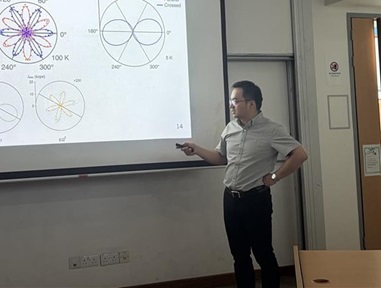
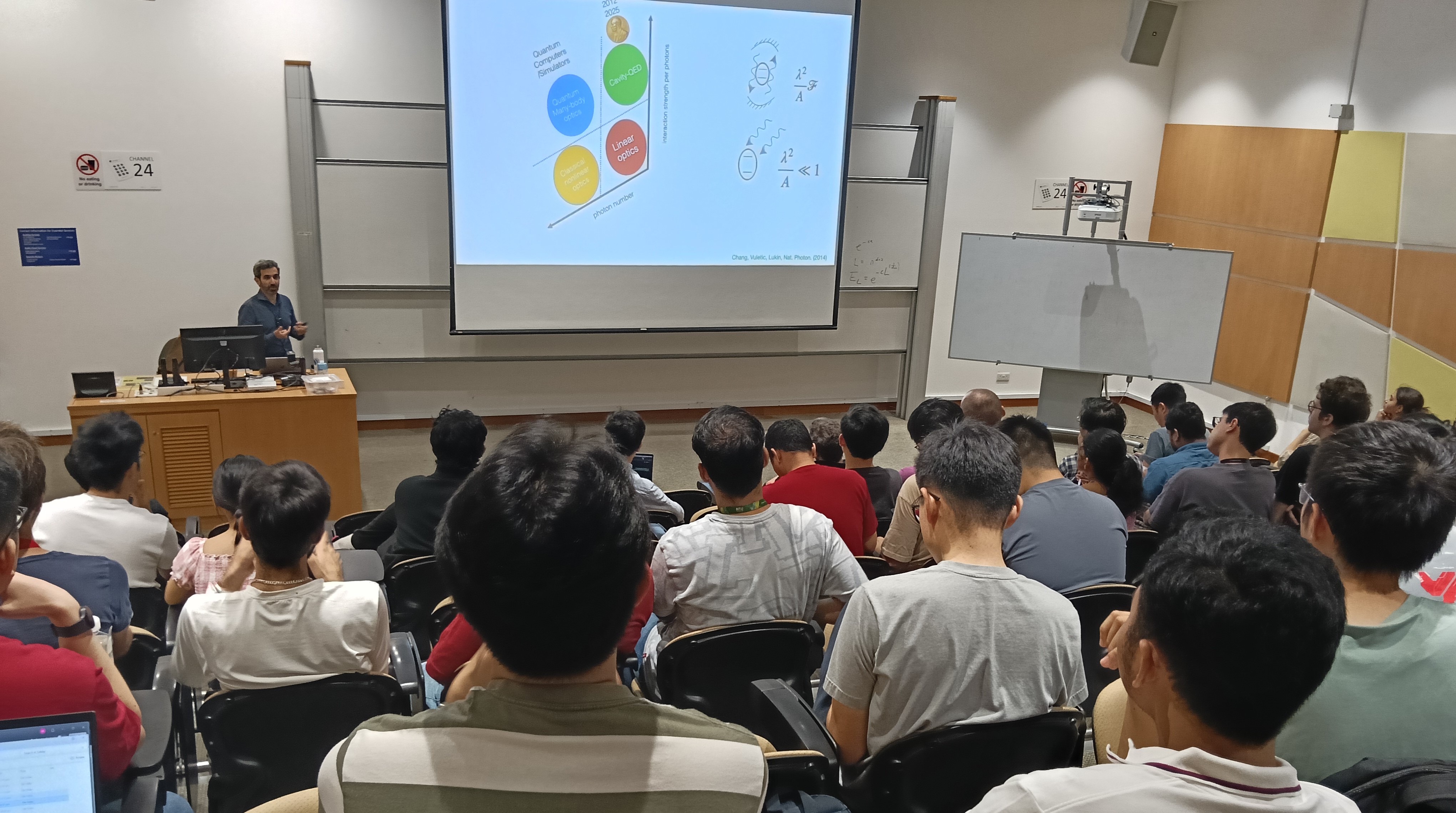 Prof Mohammad demonstrates topologically protected light transport, where photons mimic magnetic fields.
Enter Nonlinearity: Photon Pair Generation and Robust Phase Matching
Moving beyond linear Maxwell equations, Prof Mohammad turned to nonlinear topological photonics. In integrated ring resonators with Kerr nonlinearity, spontaneous four-wave mixing enables the generation of correlated photon pairs from a strong pump. In conventional one-dimensional waveguides, fabrication disorder alters resonance frequencies and destroys the precise phase matching required for efficient generation.
Topological edge modes offer a way around this limitation. Because they act as disorder-insensitive channels, the momentum and phase relations needed for four-wave mixing remain intact across different devices. Experiments on large arrays showed that while bulk modes are strongly affected by imperfections, edge-pumped configurations exhibit highly reproducible spectra and delay times, demonstrating robust, chip-to-chip-stable photon-pair generation.
Topological Frequency Combs and Nested Solitons
At higher pump powers, the same platform supports frequency combs: sets of equally spaced spectral lines corresponding to pulse trains in time. Prof Mohammad showed how, in a topological ring-resonator lattice, the comb structure becomes nested.
Each individual ring provides a fast terahertz-scale mode spacing set by its round-trip time, while coupling around the edge of the array introduces a slower gigahertz-scale modulation. The resulting spectrum exhibits fine comb teeth grouped into broader envelopes, and time-domain measurements and electronic-spectrum analysis indicate frequency locking across these scales. These “nested” structures can be viewed as topological soliton combs, where self-localised pulses circulate around the edge while maintaining coherence between many modes.
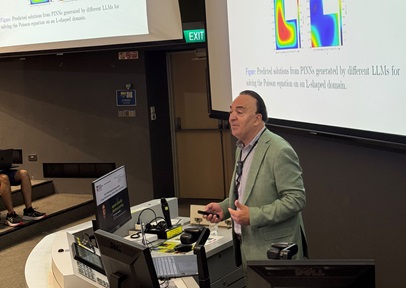
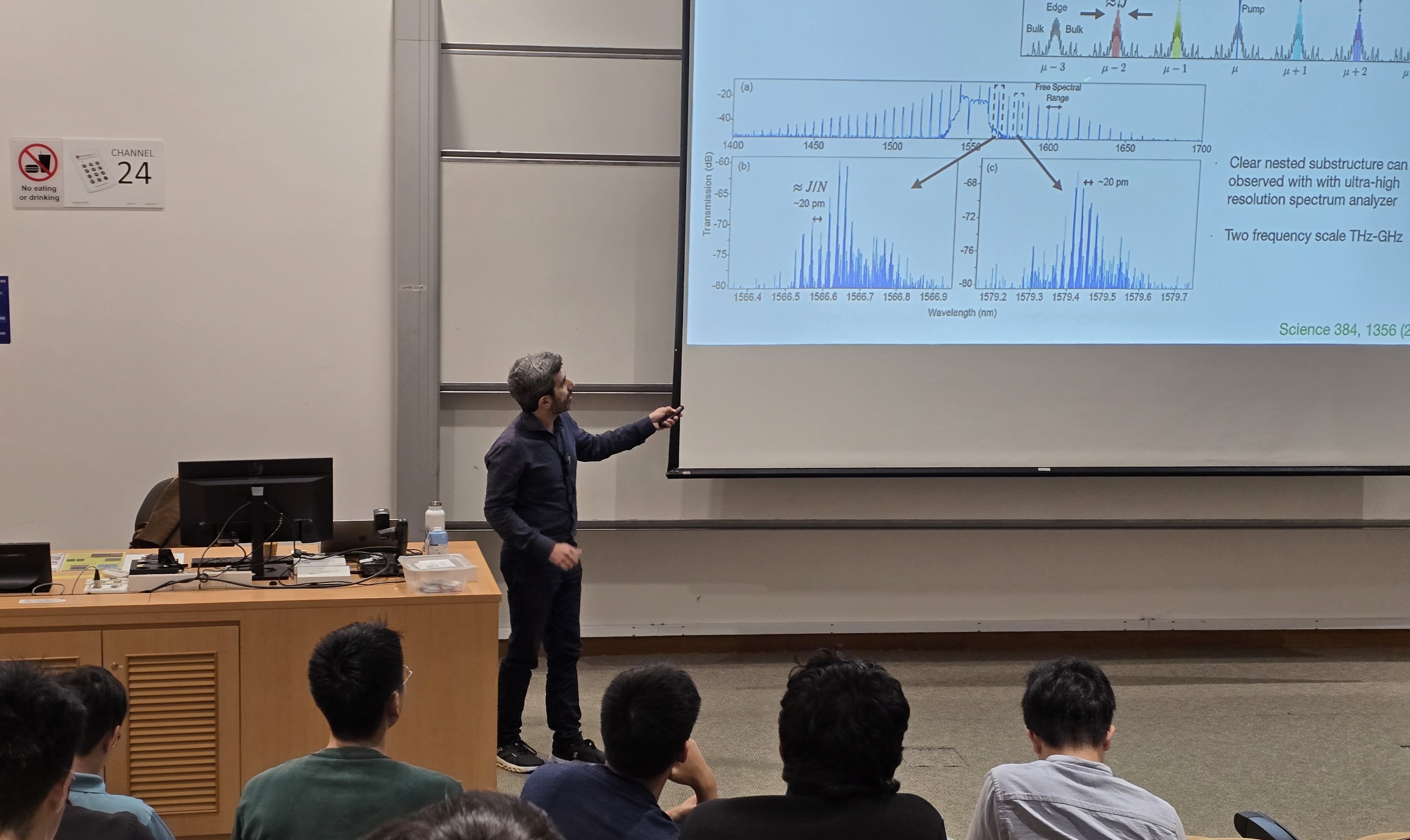 Nested topological soliton combs emerge, revealing coherent terahertz and gigahertz pulse structures.
Multi-Harmonic Generation at the Edge
A particularly striking result came from driving the array more strongly. The team observed simultaneous generation of second, third and fourth harmonics in silicon-nitride devices, without post-fabrication tuning. Despite noticeable variation in the linear spectra of different chips, all exhibited similar multi-harmonic responses once pumped in the appropriate regime.
Spatially resolved imaging, combined with spectral filtering, revealed that these harmonics are localised along the lattice edges, appearing as brightly glowing loops at different colours. Prof Mohammad suggested that the effective duplication of dispersion curves across many coupled resonators relaxes standard phase-matching constraints: multiple edge modes can participate, increasing the likelihood that at least one satisfies the required energy–momentum conditions. This leads to a robust scheme for high-efficiency, edge-confined harmonic and comb generation.
Open Questions and Outlook
In the concluding part of the talk, Prof Mohammad highlighted several open directions. On the fundamental side, the topological classification of nonlinear photonic modes is still incomplete; it remains unclear how to generalise familiar invariants and bulk–edge correspondences to driven–dissipative, mean-field regimes. On the applied side, topological frequency combs and robust harmonic generation could impact precision spectroscopy, metrology, optical communication, and quantum-light sources.
The Q&A session touched on coherence requirements for different applications, prospects for multimode squeezing and photon correlations, and the training gap between physics and engineering curricula. Prof Mohammad recommended introductory resources such as David Tong’s lecture notes on topology and mentioned ongoing efforts to make his own lecture material publicly available.
By weaving together quantum optics, condensed-matter concepts, and integrated photonics, Prof Mohammad's colloquium on Nonlinear Topological Photonics offered the audience a clear view of how topology and nonlinearity can be combined to engineer robust, scalable and versatile platforms for the next generation of optical and quantum technologies.
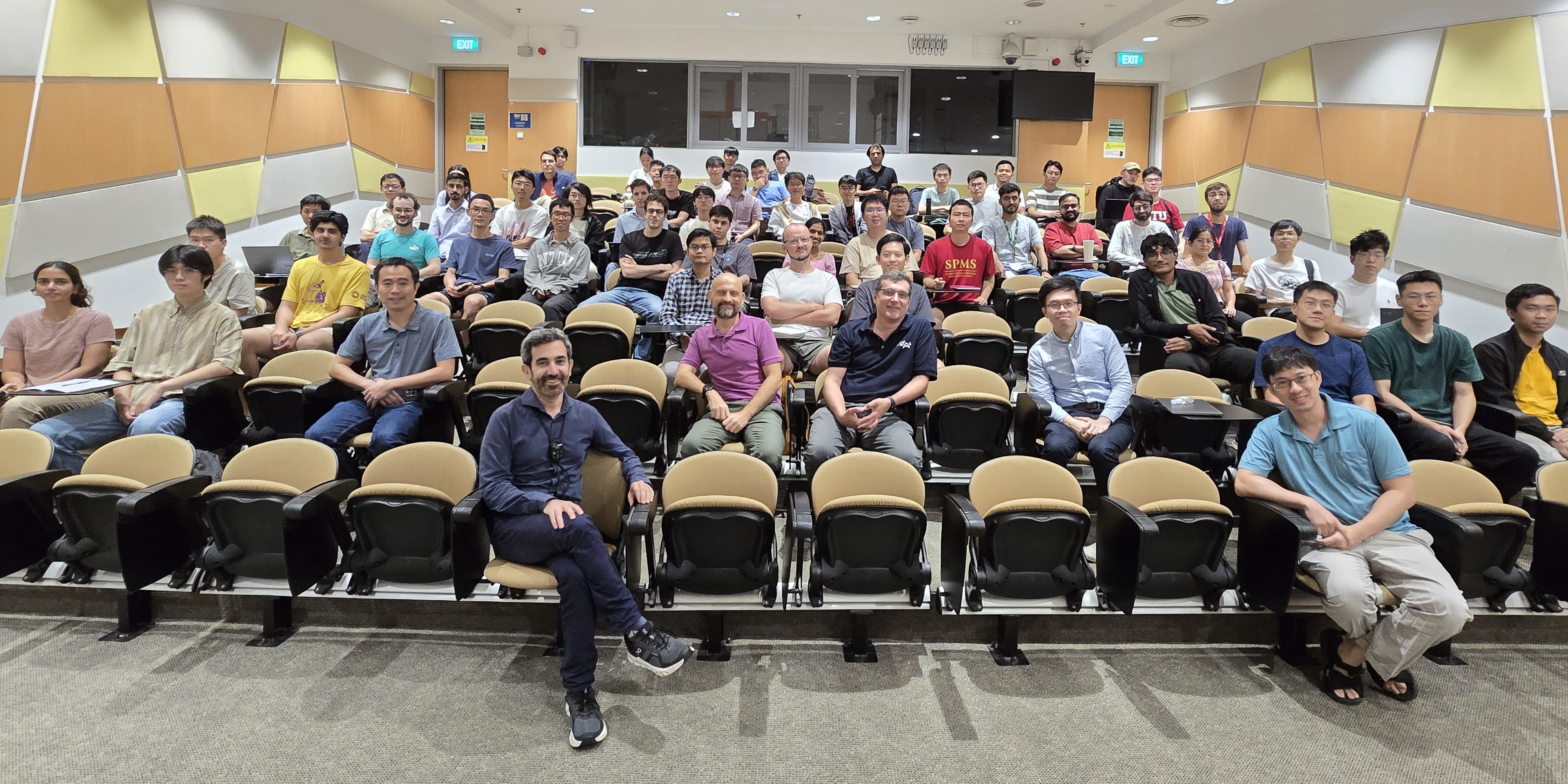
This colloquium is held in conjunction with the ongoing IAS Frontiers Seminars: Quantum Horizons series. Find out more about the upcoming seminars and register here.
Written by: Cui Peiyuan | NTU School of Physical and Mathematical Sciences Graduate Students' Club
"It was easy to follow despite being completely new to this area of work" - Adira Mohitha (PhD student, SPMS)
"The flow of the lecture was very good." - Khanra Sambuddha Ranjan (PhD student, SPMS)
Watch the recording here.