Lee Kong Chian Distinguished Professor Public Lecture by Prof Duncan Haldane
Written by Navaratna Nikhil| PhD student, School of Physics and Mathematical Sciences (SPMS, NTU)
The Institute of Advanced Studies (IAS) at Nanyang Technological University hosted a public talk by Prof Duncan Haldane (Nobel Prize in Physics 2016) on 16 July 2025. Titled Modern Quantum Mechanics is 100 Years Old This Year: Why Is There So Much Excitement? The talk offered a reflection of historical developments of quantum mechanics and a perspective on its future.
.jpg?sfvrsn=a3cfb823_1)
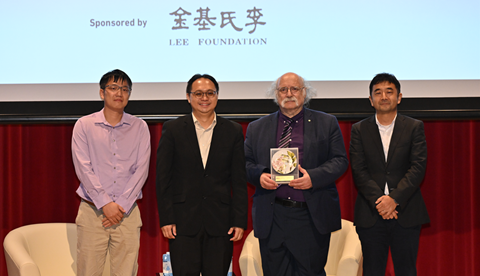
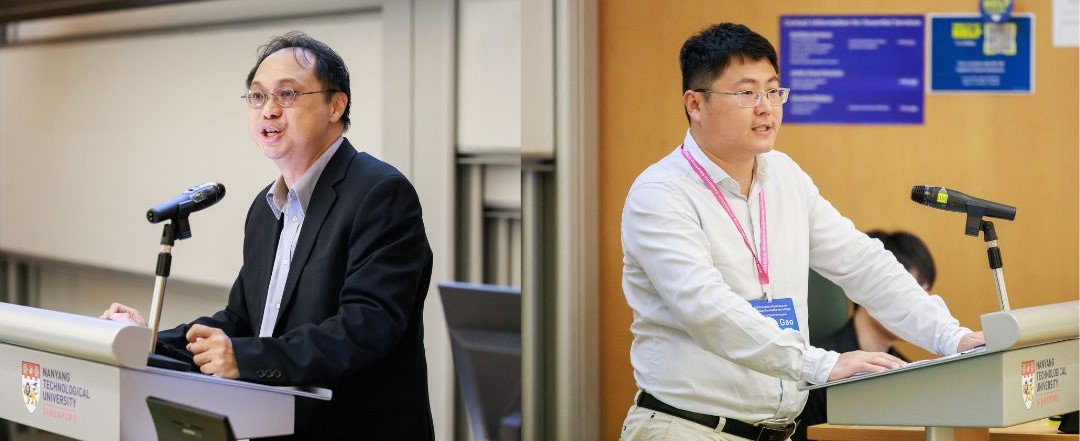 [Top, from left to right] Prof Justin Song (SPMS), Prof Gao Weibo (SPMS), Prof Duncan Haldane and Prof Sum Tze Chien. (Director, IAS); [Bottom] Opening addresses by Prof Sum Tze Chien and Guest-of-Honour Prof Gao Weibo.
The talk offered a reflection of historical developments of quantum mechanics and a perspective on its future. Prof Duncan Haldane began by emphasising the position of entanglement as the key property of quantum mechanics and in bringing forth the second quantum revolution which is expected to advance quantum computing and information processing. He stated that the central message of his talk is that a deeper understanding of quantum mechanics will reveal new and unexpected possibilities for the materials of the future and how they will augment transformative technologies. Prof Haldane noted that the foundational principles of quantum mechanics were largely established between 1925 and 1932 and have stood the test of time. However, this does not mean all possibilities have been fully explored. To illustrate this, he drew a parallel to electromagnetism, where although Maxwell’s equations were delineated by 1864, novel concepts such as photonic crystals continue to emerge and advanced applications like telecommunications and smartphones are still being developed. This perspective is summarised in his statement, “We know the laws but don’t know everything one can do with it”.
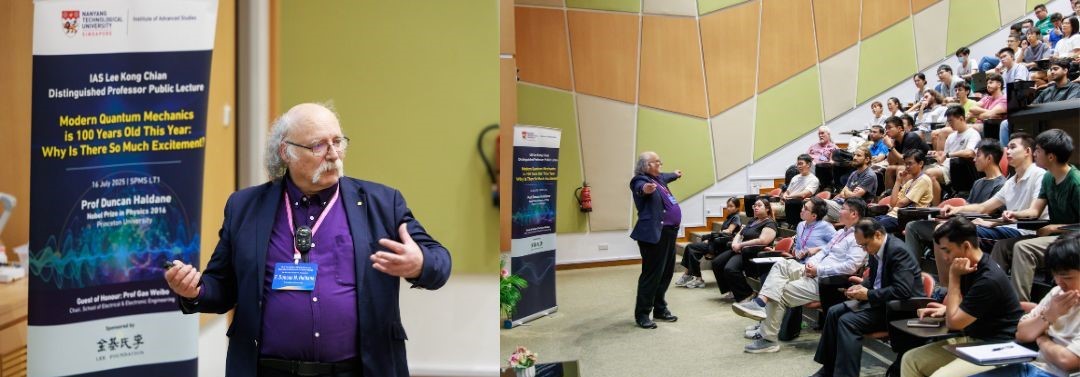 Prof Haldane highlights the second quantum revolution and the drive toward precise quantum state control.
Looking ahead, Prof Haldane emphasised that the precise control of quantum states was the central goal, steadily approaching realisation. He reiterated that we are currently in the second quantum revolution, which will deepen our understanding and expand the practical applications of quantum mechanics over the next 10 to 20 years. At the center of the second quantum revolution will be quantum entanglement, which will support interesting applications. Prof Haldane then gave an enthralling account of the historical developments of quantum mechanics. Starting from Bohr’s atomic model and progressing to the Schrödinger formulation, he traced the evolution from viewing electrons in fixed orbits to the probabilistic “electron in a fuzzy cloud” depiction. He illustrated how excited states in “Rydberg atoms” can now be imaged. This led into a discussion of Pauli Exclusion Principle, where he captured the audience’s imagination by linking it to the classical Newtonian normal force. He explained that the reason we don’t fall through the floor lies in the exclusion principle. The electrons in the floor’s atoms “exclude” those in the soles of our shoes. Building on this foundation, Prof Haldane drew a connection between Pauli Exclusion Principle and quantum entanglement, stating that the principle describes a maximally entangled state between two electrons. He further explained that this principle delineates the structure of the periodic table, as it restricts electron occupancy to two per orbital “box”. Extending this, he described chemical bonds as maximally entangled states, serving as poster child of entanglement in nature. These examples helped Prof Haldane reinforce to the audience that entanglement is the central theme in the new approaches to quantum physics.
Prof Haldane described how Albert Einstein first noted entanglement and famously referred to it as “spooky action at a distance”, a term later dubbed to “entanglement” by Schrödinger. Einstein was concerned that the idea that measuring one particle could instantaneously affect its spin-partner, regardless of distance, contradicted special relativity. At this point, Prof Haldane’s blend of scientific exposition and historical anecdotes engaged the audience. He further discussed how the EPR paradox’s challenge to the completeness of quantum mechanics, was addressed with a deeper analysis by David Bohm and John Bell. He highlighted how Alain Aspect, building on the initial foundations laid by John Clauser, experimentally confirmed that quantum theory’s predictions were accurate, and entanglement is real. Prof Haldane noted that entanglement over distances greater than that of the chemical bond is fragile to decoherence. However, modern optical fibers can be used to produce entangled EPR photon pairs separated by oceans. From here, Prof Haldane began to discuss the role of quantum entanglement in quantum information processing.
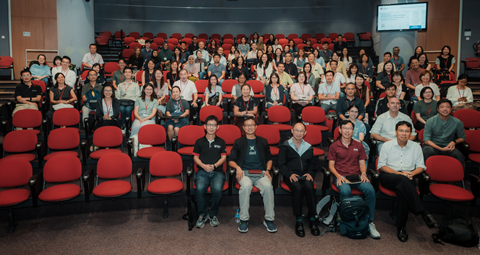
.jpg?sfvrsn=6b098943_1) In a packed lecture theatre of curious minds, Prof Haldane captivates the engaged audience with insights on fragile yet powerful qubits.
In a packed lecture theatre of curious minds, Prof Haldane captivates the engaged audience with insights on fragile yet powerful qubits.
Prof Haldane vividly explained the difference between classical bits in conventional computing and “qubits” forming the basis for quantum computing. While the former are unaffected by reading or copying, the latter are much more fragile. Qubit-based information is much richer than that of classical bits, owing to superposition, entanglement, and the ability to process a vast number of outcomes simultaneously. However, this complexity comes with increased fragility. With this context, Prof Haldane moved on to discuss the generation of remote entanglement, the “fuel” for quantum information processing.
Prof Haldane presented “topological quantum matter” as systems that could play a key role in understanding and applying quantum entanglement. Topological matter refers to phases of matter whose properties can be described by integer numbers. The global topological features allow for long-range robust entanglement. Here, Prof Haldane spoke about his seminal contributions to the development of topological states by elucidating his work on topological states in integer spin chains. He spoke about how his results were initially denounced but how he persisted. He stated that looking at the same landscape from a different perspective reveals new things.
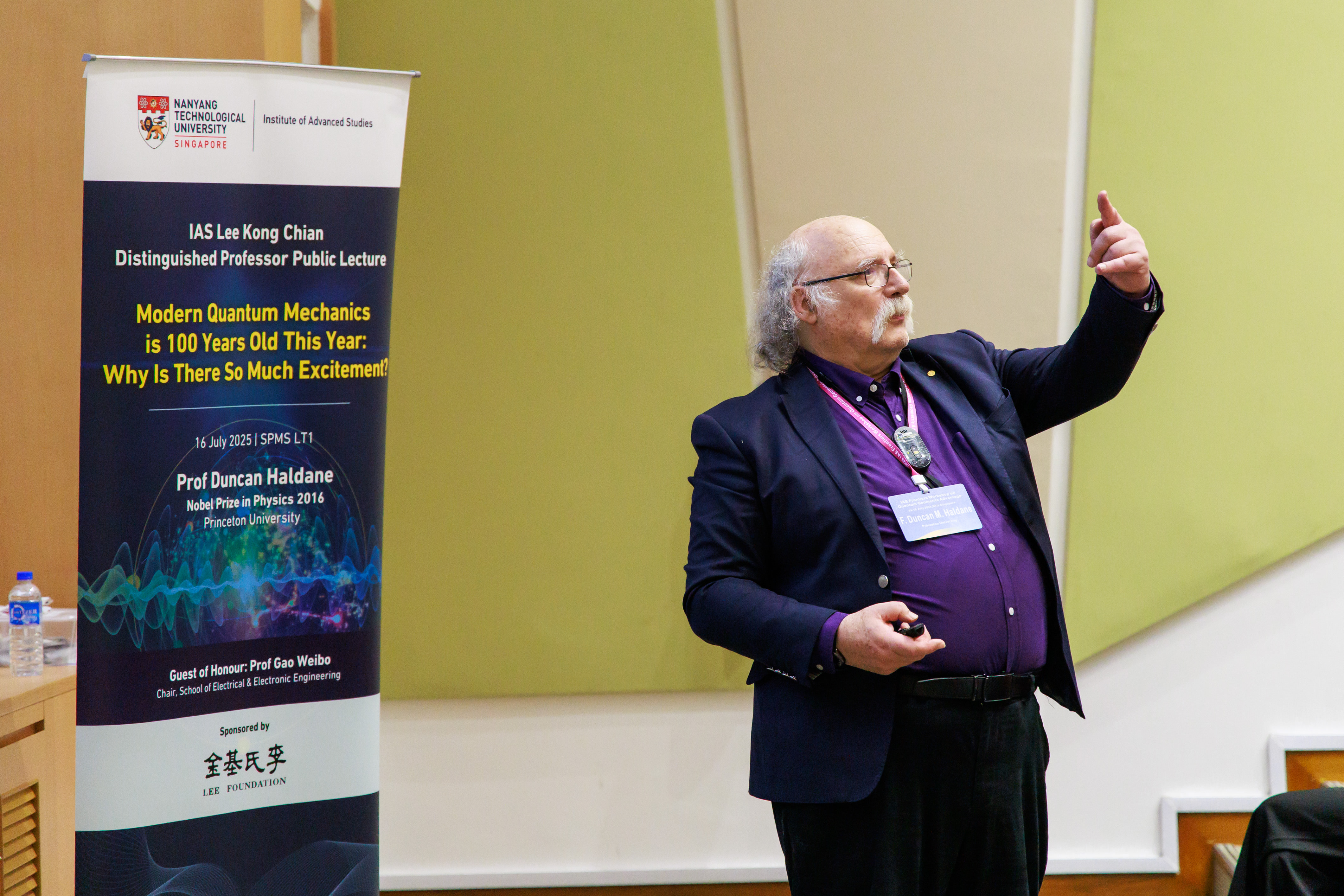 Prof Haldane explores topological states, Majorana modes, and pathways toward building robust, scalable topologically protected systems.
Prof Haldane elaborated on topological states by discussing quantised Hall conductance and chiral edge modes. He emphasised the presence of much richer topology in fractional quantum Hall effect. While early fractional states were Abelian, with quasiparticle exchanges only shifting the phase, later Non-Abelian states pioneered by Moore and Read, can store information in their entangled ground states. Information processing in these systems can be performed by “braiding” quasiparticles. Non-Abelian quantum Hall states are challenging to realise experimentally. However, similar remarkable behaviors have been identified in other systems. Prof Haldane discussed recent developments where braiding of Majorana modes, form the foundation of Microsoft’s rumored 1-billion-dollar effort towards building topologically protected qubits. Majorana modes are quasiparticles that are predicted to emerge at the edges of topological superconductors. Prof Haldane reiterated his belief that the topologically protected qubits are not just an intellectually satisfying answer to the issues of scalability and robustness-against-decoherence but are a realisable system. He emphasised that there are multiple pathways currently being explored to realise qubits, and while it remains uncertain which approach will ultimately prevail, it is certain that many things will be learnt in the second quantum revolution. For this, Prof Haldane stated, that the communities of physicists, material scientists, and experimentalists should converge and discuss even if it is difficult.
Prof Haldane closed his talk with a motivational message to students, highlighting that such extraordinary success doesn’t require exceptional genius. What it takes, he said, is luck to stumble across something truly unexpected, the preparation to recognise its significance and the commitment to purse and fight for it. He also emphasised the importance of being able to explain the arcane ideas of physics in a simple manner to expand outreach to the public, politicians, and entrepreneurs.
---copy.jpg?sfvrsn=513e04b9_1) Prof Haldane answers questions on quantum technologies, career advice, and the human side of science.
Prof Haldane answers questions on quantum technologies, career advice, and the human side of science.
The Q&A session, moderated by Prof Justin Song, covered a broad range of questions, from the future of quantum computing to reflections on the human side of science. When asked about the likelihood of quantum computers becoming household devices, Prof Haldane responded that while this may be unlikely, they could enter the same way AI-LLM tools do now. When asked what advice he would give to a young theorist, Prof Haldane advised focusing on work that others can build on and stressed the importance of pragmatism in career decisions. He encouraged being open to diverse opportunities, noting that research skills are transferable beyond academia. When asked how one should approach building novel frameworks, Prof Haldane advised starting from first principles rather than on relying on prior literature. He noted that explaining ideas to others often helps clarify one’s own understanding. On the topic of delayed recognition in science, such as Nobel prizes awarded decades after the original work, he touched on his personal experience, where the criterion for such recognition is that the work must blossom with time, and that people should be able to build on your work.
.jpg?sfvrsn=6193fed3_1)
"I enjoyed the part on entanglement as fuel for the 2nd Quantum revolution." - Jesaya Christian Ido Raja (PhD Student, MSE)
"Comfortable bits of Prof Haldane's humorous personality were showing through his lecture!" - Kyra Tan (Undergraduate Student, CSC)
"The speaker was great. I gained a lot of new knowledge." - Zhuldyz Amangeldi (PhD Student, SSS)