Institute of Physics (IPS) Meeting 2025
Written by Duan Xitong | School of Physical and Mathematical Sciences (SPMS) & Centre for Disruptive Photonic Technologies (CDPT), NTU
The Institute of Physics Singapore (IPS) Meeting 2025 continued its tradition of excellence, drawing physicists and researchers from Singapore and beyond for a vibrant exchange of knowledge and innovation. Hosted from 24 to 26 September at the Medicine and Science Library of NUS, IPS 2025 provided a dynamic platform for collaboration, networking, and scientific discovery across various fields of physics.
This annual gathering has steadily grown in both scale and significance, attracting over 500 participants and providing a unique opportunity for attendees to connect and collaborate. Across the three-day event, over 110 technical talks were delivered, covering a diverse range of topics that spanned quantum physics, photonics, electronics, 2D materials, and plasma physics. Each day featured multiple parallel session tracks, ensuring a rich and varied experience for all participants.
The event began with a series of plenary talks led by distinguished scientists who shared their expertise and offered valuable perspectives to the audience. Key highlights include:
- Dr Yao Kui, Distinguished Principal Scientist at A*STAR IMRE, highlighted the multifunctionality of ferroelectric materials (e.g., piezoelectric, pyroelectric, photovoltaic) and showed how engineered structural imperfections and heterogeneities can boost energy conversion responses for distributed sensors and edge intelligence.
- Assoc Prof Wu Lin from SUTD demonstrated Particle‑in‑Cell simulations that capture self‑consistent electron–field dynamics in quantum plasmas, revealing mechanisms such as electron-funnelling-driven second‑harmonic generation and low‑field concepts for next‑generation nanophotonic devices.
- Assoc Prof Massimo Pica Ciamarra from NTU addressed the fundamental question “What makes a glass solid?”, surveying recent theoretical and experimental advances that clarify the solidity of non‑crystalline materials.
- Visiting Research Assoc Prof Maxime Richard (Majulab & CNRS) explored quantum fluids of interacting photons in semiconductor microcavities, discussed nonclassical photon statistics, quantum blockade, and Bogoliubov‑mode dynamics.
- Prof Dale Barker, Director of the Centre for Climate Research Singapore (Meteorological Service Singapore), discussed modelling Singapore’s deep‑tropical urban climate, from Navier–Stokes‑based weather models on supercomputers to AI‑augmented prediction and projections of future climate.
- Assoc Prof Chung Keng Yeow from NUS and the Singapore Nuclear Research and Safety Institute presented advances in nuclear safety research, covering reactor safety, radionuclide dispersion, and radiobiology, alongside policy and education aspects.
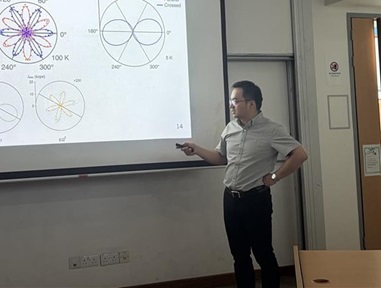
 Prof Massimo Pica Ciamarra discussing “What Makes A Glass Solid?” and advances in understanding non-crystalline solids (left); and the poster exhibition layout in the main IPS venue (right).
The poster session held on the second day offered young researchers and students a platform to showcase their work to peers. Preceding the poster exhibition featuring selected posters, a 3-minute pitch session was arranged, enabling each poster author to concisely present their key findings to the audience. The day wrapped up with pizza and drinks, as per tradition.
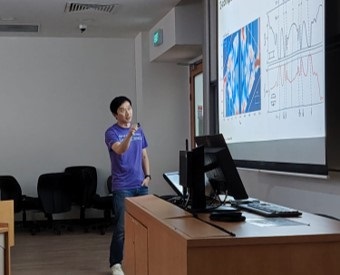
 Rui Ming Chua, researcher from CQT and NUS, delivering a 3-minute presentation titled "Quantifying Polarisation Mode Dispersion-Induced Errors in Quantum Communications" (top left); peers engaging in academic discussions during the poster session (top right); a researcher interacting with representatives from RooksVac Scientific Vaccuum Solutions (bottom left); and the audience attending a technical talk session titled "Photon Number Resolution with SNSPDs" by Shuyu Dong from EEE and CDPT in NTU (bottom right).
Annually, IPS honours distinguished researchers and academics for their remarkable contributions to their respective fields. At the IPS Awards ceremony this year, the following awards were presented:
- Prof Christian Kurtsiefer (NUS & CQT) — IPS President’s Award, for his pioneering contributions to quantum physics and relentless service to the physics community in Singapore.
- Ms Geok-Suan Tan (NIE) — IPS Physics Tech Prize, for her extraordinary dedication and technical excellence in supporting physics education and competitions in Singapore.
- Prof Yidong Chong (NTU) — IPS World Scientific Award, for his significant contributions to theoretical photonics and condensed matter physics.
- Asst Prof Di Zhu (NUS & ASTAR-IMRE*) — IPS Nanotechnology Physics Award, for his outstanding contributions to integrated nanophotonics.
- Dr Tan Zhiming, Darren (MOE) — IPS Cadi Scientific Award for the Public Awareness of Physics, for his inspiring contributions to physics education and outreach.
 Presentation to winners at the IPS Award ceremony (left); and Dr Wee Shing Koh (IPS) and Prof Kuan Eng Johnson Goh (IPS) with one of the 'Best Poster Award' winners of IPS 2025 (right).
The IPS meeting was concluded with a whiteboard session organised by Quantum SG networking, the quantum community of Singapore. The session aimed to strengthen the local quantum ecosystem by facilitating networking and collaboration among members, sharing insights, supporting project development and welcoming new members.
The success of the IPS Meeting 2025 was made possible through the collaboration of our institutional partners, including the Department of Physics and the Department of Materials Science and Engineering at the National University of Singapore (NUS); the School of Physical and Mathematical Sciences (SPMS), Division of Physics and Applied Physics (PAP) at Nanyang Technological University (NTU); the Centre for Quantum Technologies (CQT); the Institute of Advanced Studies (IAS), NTU; the Quantum Engineering Programme (QEP); the Agency for Science, Technology and Research (A*STAR); and the Singapore University of Technology and Design (SUTD).
We also thank our sponsors and exhibitors for their generous support, including Genetron, AceXon Technologies, World Scientific, Rohde & Schwarz, Wavelength Opto-Electronic, RAITH, RooksVac Scientific Vacuum Solutions, Keysight Technologies, OptoSigma (SIGMAKOKI Group), DY-LASER, Analytical Technologies, Laser 21, S-Fifteen Instruments, WE, and EINST Technology.
The IPS Meeting 2025 marked a pivotal event for physicists, researchers, and scientists, providing a forum for the exchange of ideas, the enhancement of diversity and inclusion, and the celebration of significant contributions to the discipline of physics. As participants conclude their attendance and return to their respective institutions and research projects, they leave equipped with valuable insights, potential collaborations, and renewed motivation, fostering an environment conducive to a successful year ahead in the physical sciences.