Improving and Speeding Up Quantum Measurements by Prof Paul Skrzypczyk
IAS Frontiers Seminars: Quantum Horizons, Seminar #2
On 6 October 2025, Prof Paul Skrzypczyk (University of Bristol) delivered a seminar at MAS Executive Classroom 1, SPMS on improving and speeding up quantum measurements. Quantum computers operate in a fundamentally different way from classical computers. A classical computer encodes information in bits (0 or 1), whereas a quantum computer uses qubits that can exist in a superposition of both. However, when a qubit is measured, it still yields either 0 or 1 with certain probabilities. Quantum computation derives its power from the ability to coherently control and manipulate the “probability amplitudes” of the qubits before they are measured.
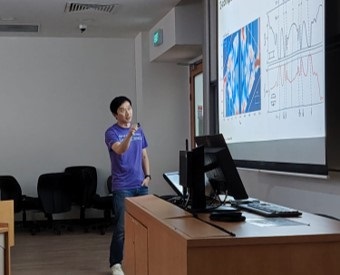
.jpg?sfvrsn=53316d64_1) Following a brief introduction by Dr Nelly Ng (SPMS), Prof Skrzypczyk discusses ways to improve and speed up noisy quantum measurements.
Following a brief introduction by Dr Nelly Ng (SPMS), Prof Skrzypczyk discusses ways to improve and speed up noisy quantum measurements.
Accurate and fast measurements are therefore important for quantum computers. In reality, though, quantum measurements are typically noisy, and they can be rather slow, which then creates a bottleneck for realizing useful quantum computers. In this seminar, Prof Skrzypczyk discussed his research, together with his collaborators, on improving and accelerating quantum measurements.
Seeking perfection in quantum measurements
Imagine a scenario commonly seen in experimental labs; suppose you want to implement a certain measurement, but due to imperfection in the measuring devices, your measurement is corrupted by noise. Given the ability of performing this imperfect measurement many times, is it possible to simulate the statistics of a perfect measurement? Prof Skrzypczyk and his collaborators answer with a resounding yes!
In the talk, Prof Skrzypczyk began by a simple case of simulating a perfect qubit measurement in Pauli-Z basis from imperfect ones. This can be done by adding extra qubits and using quantum gates that entangle the input state with them. By implementing the imperfect measurement to the entangled state, it is possible to reproduce the statistics for a perfect Pauli-Z measurement, with errors that decay quickly with the number of copies.
After providing us with an illustrative example, Prof Skrzypczyk then presented his general result: “Any (non-trivial) measurement can simulate any other measurements”, along with a sketch for the proof. This is a powerful result. Although the theorem does not prescribe a specific protocol, the proof of existence for such a scheme can motivate researchers to find the protocol to overcome measurement bottlenecks in various quantum hardwares.
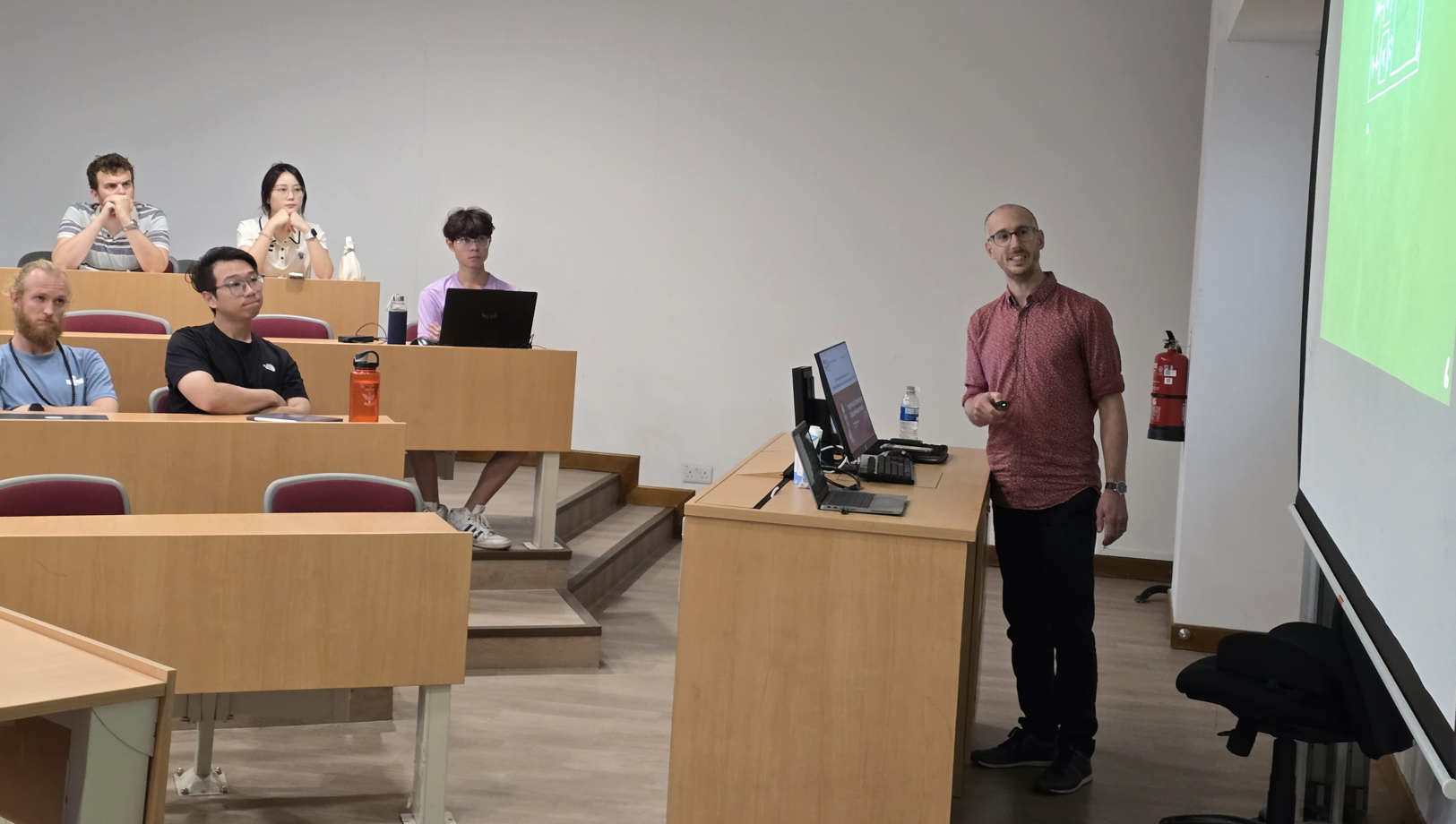 Prof Skrzypczyk explores how imperfect quantum measurements can be combined to possibly simulate perfect ones.
Speeding up quantum measurements
For a quantum computer, both the quality and the speed of measurements are important. But in reality, there is always a trade-off; highly accurate measurement often takes a lot of time, while fast measurements are often inaccurate.
Yet, Prof Skrzypczyk and his collaborators found ways to optimise for measurement speed without sacrificing the quality. This might be surprising, but there is no free-lunch after all. In their schemes, both high quality and high speed of measurements can be achieved by increasing the number qubits. They refer to this as “space-time trade-off” for quantum measurements, with “space” referring to the number of additional qubits and “time” referring to the measurement time.
By using additional qubits, one can implement the protocol for simulating ideal measurements, thereby achieving high quality, while simultaneously increasing speed through parallel measurements. The protocol has been rigorously tested under realistic cold-atom qubit conditions, demonstrating that it can accelerate quantum measurements while preserving the signal-to-noise ratio—a key metric of measurement quality. In the future, this scheme can be applied in other quantum computing platforms such as superconducting circuits and ion traps, hence driving fast and useful quantum computers closer to reality.
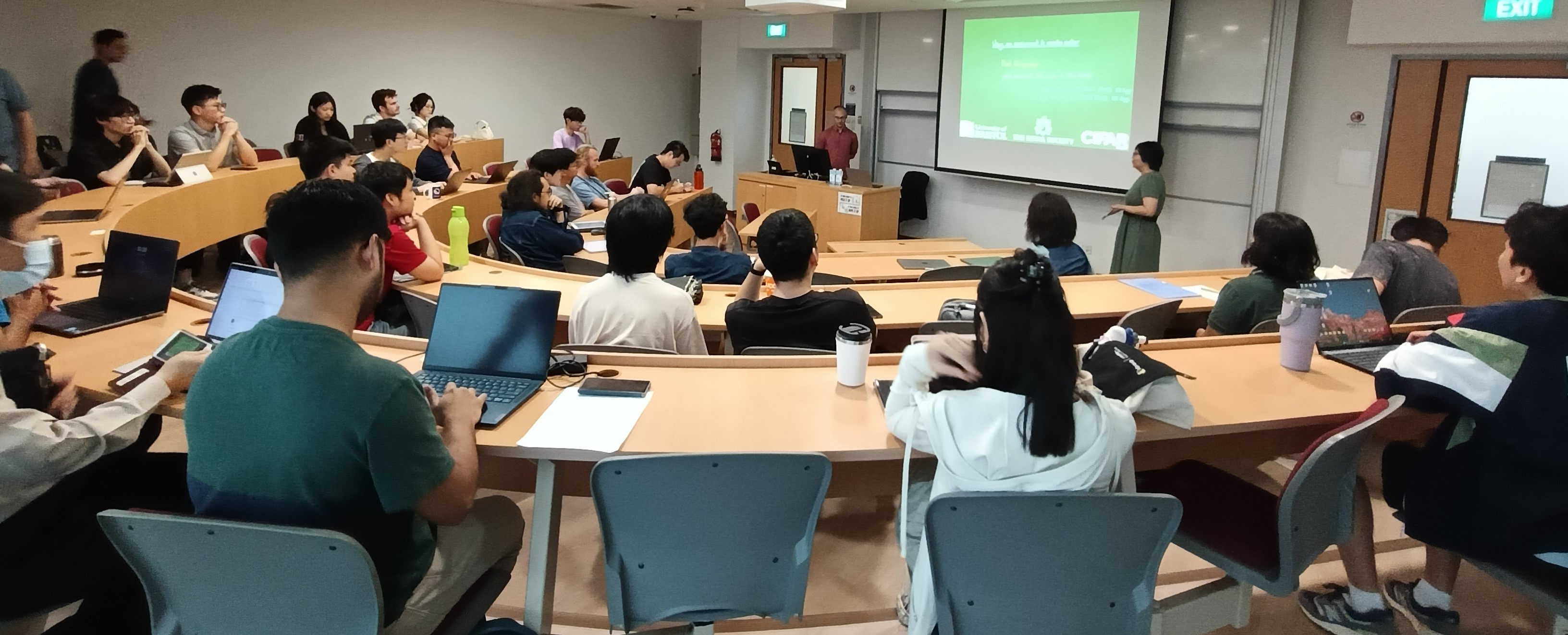 Prof Skrzypczyk wraps up his seminar with an engaging Q&A.
The seminar wrapped up with lively questions and discussions, touching on the protocol’s stability and its intriguing connections to quantum metrology, continuous-variable systems, and resource theory.
This seminar is part of the ongoing IAS Frontiers Seminars: Quantum Horizons series. Find out more about the upcoming seminars and register here.
Written by Muhammad Taufiq Murtadho | NTU School of Physical and Mathematical Sciences
“I enjoyed the idea that you can simulate any arbitrary measurement from noisy measurement.” - Qiu Kai Wei (PhD Student, SPMS)
“The insightful presentation, clear language and interesting points of view.” - Gao Wenbo (Undergraduate Student, MAE)