IAS Frontiers Workshop on Renewable Energy for a Sustainable Future
Dr Li Xinyuan | NTU School of Physical and Mathematical Sciences
The IAS Frontiers Workshop on Renewable Energy for a Sustainable Future was successfully held on July 1, 2025, at the Gaia LT6 in NTU. Jointly organised by Prof Fan Hong Jin from the School of Physical and Mathematical Sciences, and the Institute of Advanced Studies (IAS), the full-day event brought together a distinguished lineup of international scholars and industry experts to discuss the most recent advancements and future directions in renewable energy technologies. The workshop aimed to strengthen interdisciplinary exchanges and promote collaborative innovation across the fields of materials science, electrochemistry, and sustainable energy engineering.
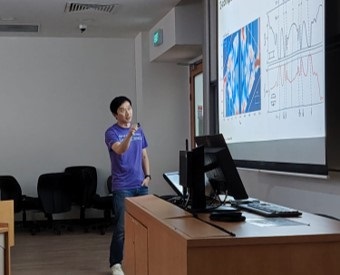
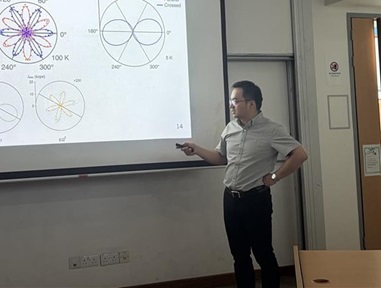
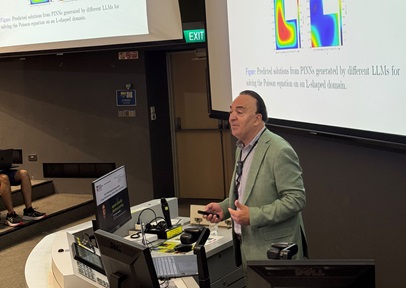
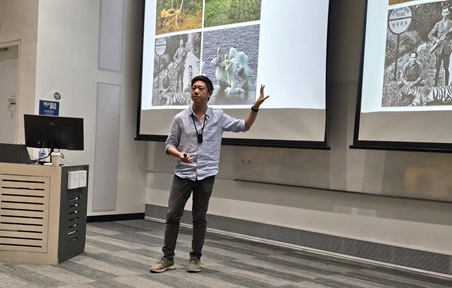
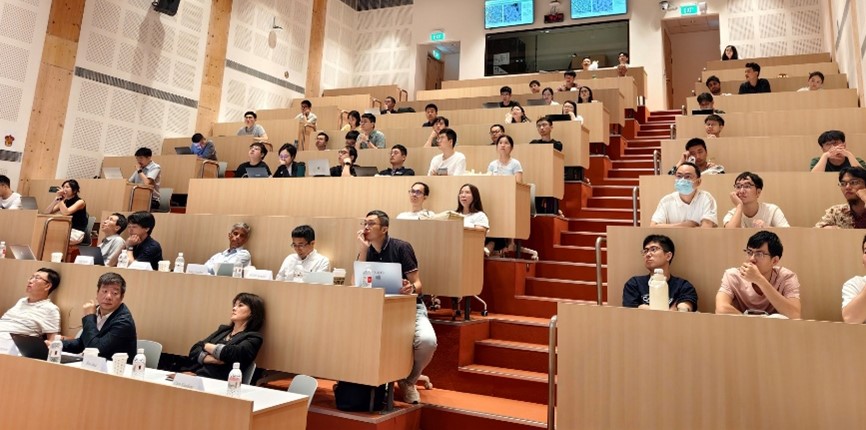 Speakers and students actively engaging in discussion during the presentations.
The event opened with a keynote lecture by Prof Meng Ying Shirley (University of Chicago), who addressed critical challenges in lithium metal batteries (LMBs), including dendrite formation and interfacial instability. She presented her team’s recent progress in electrolyte design and interfacial chemistry aimed at enhancing battery safety and extending cycle life. The keynote was followed by a series of insightful talks from globally recognised researchers. Prof Zhao Dongyuan (Fudan University) presented his group’s work on the supra-assembly of functional mesoporous materials for energy-related applications, while Prof Rose Amal (University of New South Wales) discussed solar-driven chemical pathways for the sustainable production of fuels and chemical with high economic value.
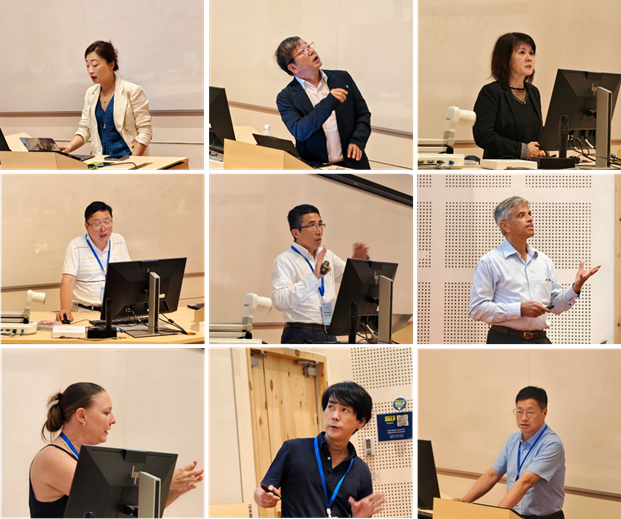 Guest speakers delivering insightful talks. From left to right: Prof Meng Ying Shirley, Prof Zhao Dongyuan,
Prof Rose Amal, Prof Qiao Shizhang, Prof Wang Lianzhou, Prof Prashant Kamat, Prof Jennifer Rupp,
Prof Yabuuchi Naoaki, and Prof Wen Zhaoyin.
Additional invited talks covered a wide range of frontier topics in the energy field. Prof Qiao Shizhang (University of Adelaide) provided a comprehensive overview of the role of electrocatalysis in energy storage and conversion, while Prof Wang Lianzhou (University of Queensland) introduced strategies to improve the stability and efficiency of hybrid perovskite materials. Prof Prashant Kamat, Editor-in-Chief of ACS Energy Letters, highlighted the critical influence of iodine chemistry on the long-term stability of metal halide perovskites. In the afternoon, Prof Jennifer Rupp (Technical University of Munich) presented a forward-looking perspective on next-generation solid-state batteries and novel energy conversion mechanisms. The program continued with Prof Yabuuchi Naoaki (Yokohama National University) discussing defect-engineered cathode materials for enhanced battery performance, followed by Prof Wen Zhaoyin (Shanghai Institute of Ceramics, CAS), who introduced innovative material design strategies for high-energy solid-state batteries.
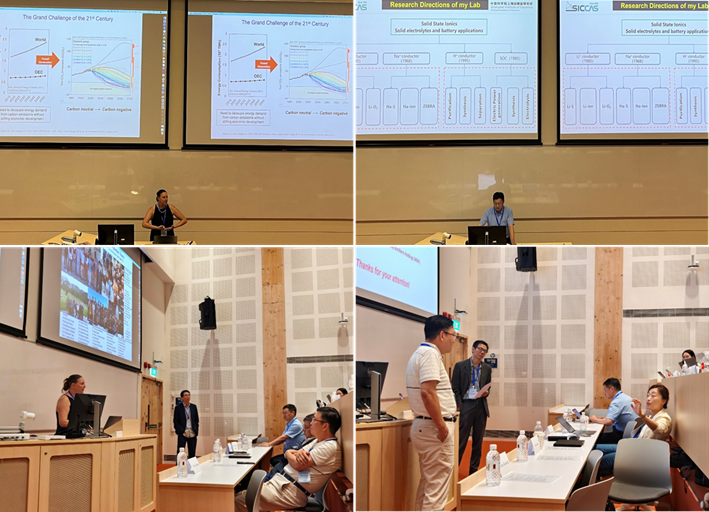 Thematic focuses of the workshop: "Perspectives on Next-Generation Batteries" and "From Research to Industrial Translation," accompanied by a lively Q&A session.
The workshop centered around two key thematic panels: "Perspectives on Next-Generation Batteries" and "From Research to Industrial Translation", which encouraged in-depth discussions spanning from fundamental research to practical implementation. Each presentation was followed by a lively Q&A session, where participants engaged in spirited dialogue with speakers, fostering intellectual exchange and inspiring future research directions.
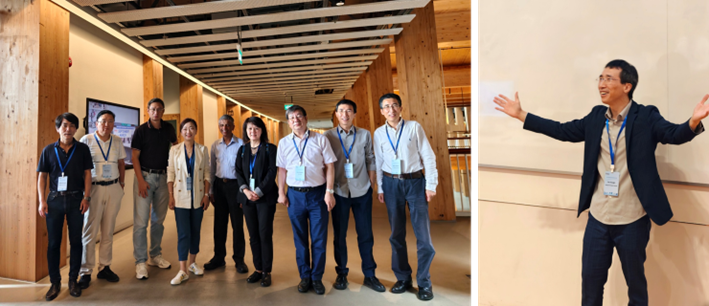
Group photo of invited experts, with closing remarks given by Prof Fan Hong Jin.
The day concluded with a group photo capturing the collaborative spirit of the event, followed by closing remarks from Prof Fan Hong Jin, who expressed his sincere gratitude to all speakers, participants, and sponsors for their invaluable contributions. He emphasised the critical role of interdisciplinary collaboration in accelerating global progress toward a sustainable energy future. The success of the workshop not only showcased the vibrant momentum of renewable energy research worldwide but also reaffirmed NTU’s position as a leading hub for international academic exchange and innovation.