IAS Frontiers Workshop on Quantum Geometric Advantage
Written by the Workshop Organising Committee | NTU School of Physical and Mathematical Sciences
The IAS Frontiers Workshop on Quantum Geometric Advantage was held from 14 to 16 July 2025 at SPMS LT1 in Nanyang Technological University (NTU), Singapore. Jointly organised by the Institute of Advanced Studies (IAS), School of Physical and Mathematical Sciences (SPMS) and the Centre for Emergent Quantum Materials (CEQM), the three-day workshop brought together over 120 participants from academia to explore recent advances in quantum geometry, topological materials, and emerging quantum devices.
.jpg?sfvrsn=d2315467_1)
The workshop is part of Singapore Ministry of Education (MOE) ’s national Tier 3 programme titled “Quantum Geometric Advantage”, which carries out cutting-edge research that seeks to harness the “advantages” given by the quantum geometric properties of quantum materials. This second edition of the workshop built on the success of the inaugural workshop held in 2023, further strengthening collaborations and setting new directions for the quantum research community.
.jpg?sfvrsn=2a561edf_1) Global experts unveil frontier topological quantum and moiré discoveries.
Global experts unveil frontier topological quantum and moiré discoveries.
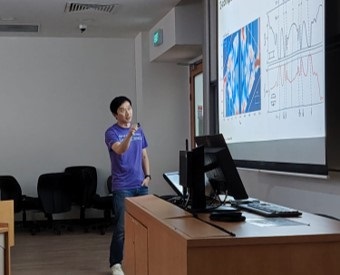
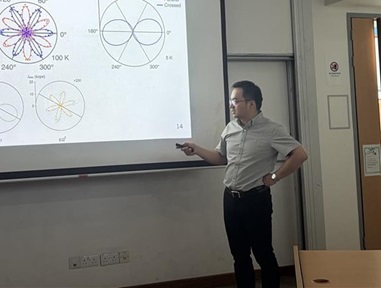
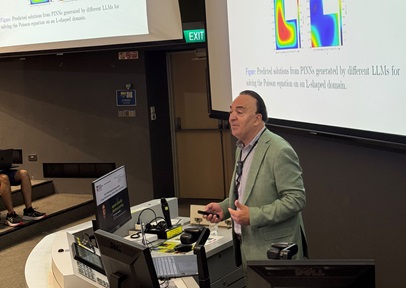
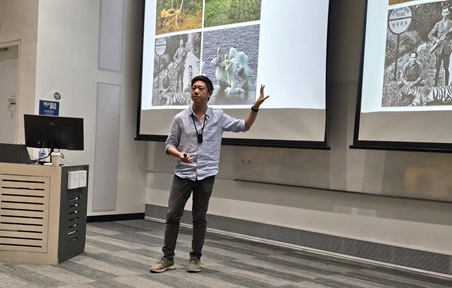
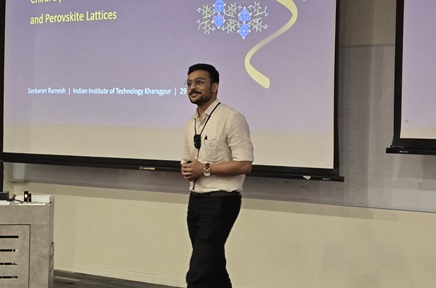
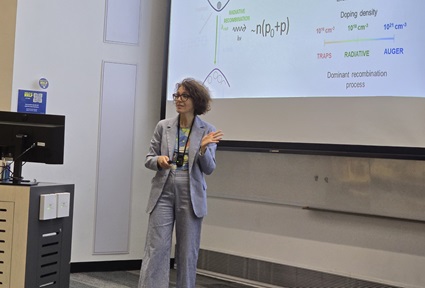
Key speakers included Nobel Laureate Prof Duncan Haldane (Princeton University), along with other eminent professors from both local and international institutions (listed in the alphabetical order of the surname): Ritesh Agrawal (U. Penn), Gerrit Bauer (Tohoku), Keneth Burch (Boston C), Sanghoon Chae (NTU), Trithep Devaul (Stanford), Michael Fuhrer (UNSW), Zahid Hasan (Princeton), Hans Hilgenkamp (Twente), Yoshihiro Iwasa (U. Tokyo), Mathias Kläui (Mainz), Junichiro Kono (Rice), Pavlos Lagoudakis (Skoltech), Hsin Lin (Academia Sinica), Netanel Lindner (Technion), Qiong Ma (Boston C), Guillaume Malpuech (CNRS), Antonio H. Castro Neto (NUS), Alexander Poddubny (Weizmann), Su Ying Quek (NUS), Anders Sandvik (BU), Pinaki Sengupta (NTU), Justin Song (NTU), Ajit Srivastava (Emory), Yoshinori Tokura (RIKEN), Nanlin Wang (Peking), Renshaw Wang (NTU), Bo Yang (NTU), and Hyunsoo Yang (NUS). Their talks covered topics ranging from topological quantum matter and spin–orbit phenomena to moiré materials, hybrid polariton systems, non-reciprocal quantum transport and nonlinear spintronics.
.jpg?sfvrsn=fabbe9ed_1) [Top] Panel discussion on the future of quantum geometric studies by (from left to right): Moderator Yang Bo, along with panellists Antonio H. Castro Neto, Duncan Haldane, Qiong Ma, Hans Hilgenkamp, and Michael Fuhrer.
[Top] Panel discussion on the future of quantum geometric studies by (from left to right): Moderator Yang Bo, along with panellists Antonio H. Castro Neto, Duncan Haldane, Qiong Ma, Hans Hilgenkamp, and Michael Fuhrer.
[Bottom left] Scientific discussions during the poster presenter session.
[Bottom right] Prof Duncan Haldane presenting the Best Poster Award certificates to one of the awardees.
Beyond the talks, the programme included a panel discussion on future directions in quantum geometric research. The panel featured both theorists and experimentalists, and explored how recent developments in quantum materials could be translated into functional devices. A poster session showcasing the work of early-career researchers was held on day one, and five outstanding contributions were recognised with poster awards.
To promote informal networking and cultural exchange, the organisers hosted a “Fruit Fiesta” durian-tasting session and banquet. The events were a light-hearted highlight of the programme, offering overseas guests a unique taste of Singapore and local fruits, while facilitating lively conversations among participants.
.jpg?sfvrsn=7830bcf2_1) [Left] Assoc Prof Justin Song (SPMS), Prof Gao Weibo (Chair, EEE), Prof Duncan Haldane, and Prof Sum Tze Chien (Director, IAS); [Right] An insightful presentation by Prof Duncan Haldane on the excitement of modern quantum mechanics to a packed lecture theatre.
[Left] Assoc Prof Justin Song (SPMS), Prof Gao Weibo (Chair, EEE), Prof Duncan Haldane, and Prof Sum Tze Chien (Director, IAS); [Right] An insightful presentation by Prof Duncan Haldane on the excitement of modern quantum mechanics to a packed lecture theatre.
A major highlight of the workshop was the public lecture by Nobel Laureate in Physics 2016, Prof Duncan Haldane, titled “Modern Quantum Mechanics is 100 Years Old This Year: Why is There So Much Excitement?" . The lecture, held on the evening of 16 July, attracted over 250 registered attendees from across Singapore. In his talk, Professor Haldane introduced key concepts in topology and illustrated how they have reshaped our understanding of quantum phases and inspired new device paradigms. The lecture was well received by students, researchers, and members of the public alike.
Overall, the workshop fostered the exchange of ideas across disciplines, and several potential collaborations and joint grant proposals emerged from the discussions. Many participants expressed strong interest in follow-up activities, including student exchanges, thematic working groups, and focused symposia on magnonics, topological photonics, and hybrid cavity systems.