For What Are We, If Not Curious? A Chat with Physics’ Accidental Rock Star Prof Duncan Haldane
An Interview by Dr Julian Tang, Ernest and Kin Media | Organised by the Institute of Advanced Studies NTU
When Professor Duncan Haldane was asked what he might have been if not a physicist, he jokingly said, “Like many kids, I wanted to be a rock star.”
Though he did not get to glitz, glam, rock and roll in the usual sense — no packed stadiums or screaming crowds — in another arena, he has certainly achieved stardom. It is one where particles and electrons take centre stage, in place of guitar riffs and drum solos. His theoretical discoveries in quantum matter have reverberated across physics, reshaping how we understand the invisible patterns that govern the Universe and earning him academic accolades instead of platinum records.
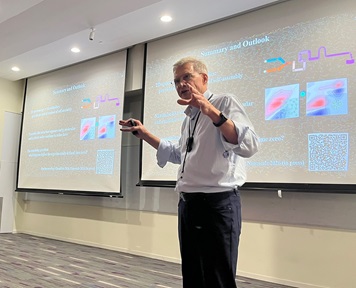
 Professor Haldane humorously recalls dreaming of rock stardom while making groundbreaking discoveries that revolutionize quantum matter physics today.
But Prof Haldane, awarded the 2016 Nobel Prize in Physics for the discovery of topological phases of matter, insists there’s no script for greatness. His pioneering work, on quantum spin chains (known as the “Haldane gap”), fractional quantum Hall effects and topological insulators, was not plotted meticulously in advance. “Some of the research discoveries are never planned,” he muses. “At times, they're accidental.”
Speaking with NTU’s Institute of Advanced Studies (IAS), where he holds an appointment as a Lee Kong Chian Distinguished Professor in relation to his visit in July 2025, Haldane shares a secret: most profound discoveries arise from the seemingly trivial. “It’s the little anomalies you pass by — tiny, peculiar details — that occasionally pull you into something utterly surprising,” he says. “Great discoveries tend to be hidden in plain sight, waiting only for the right curious eye.”
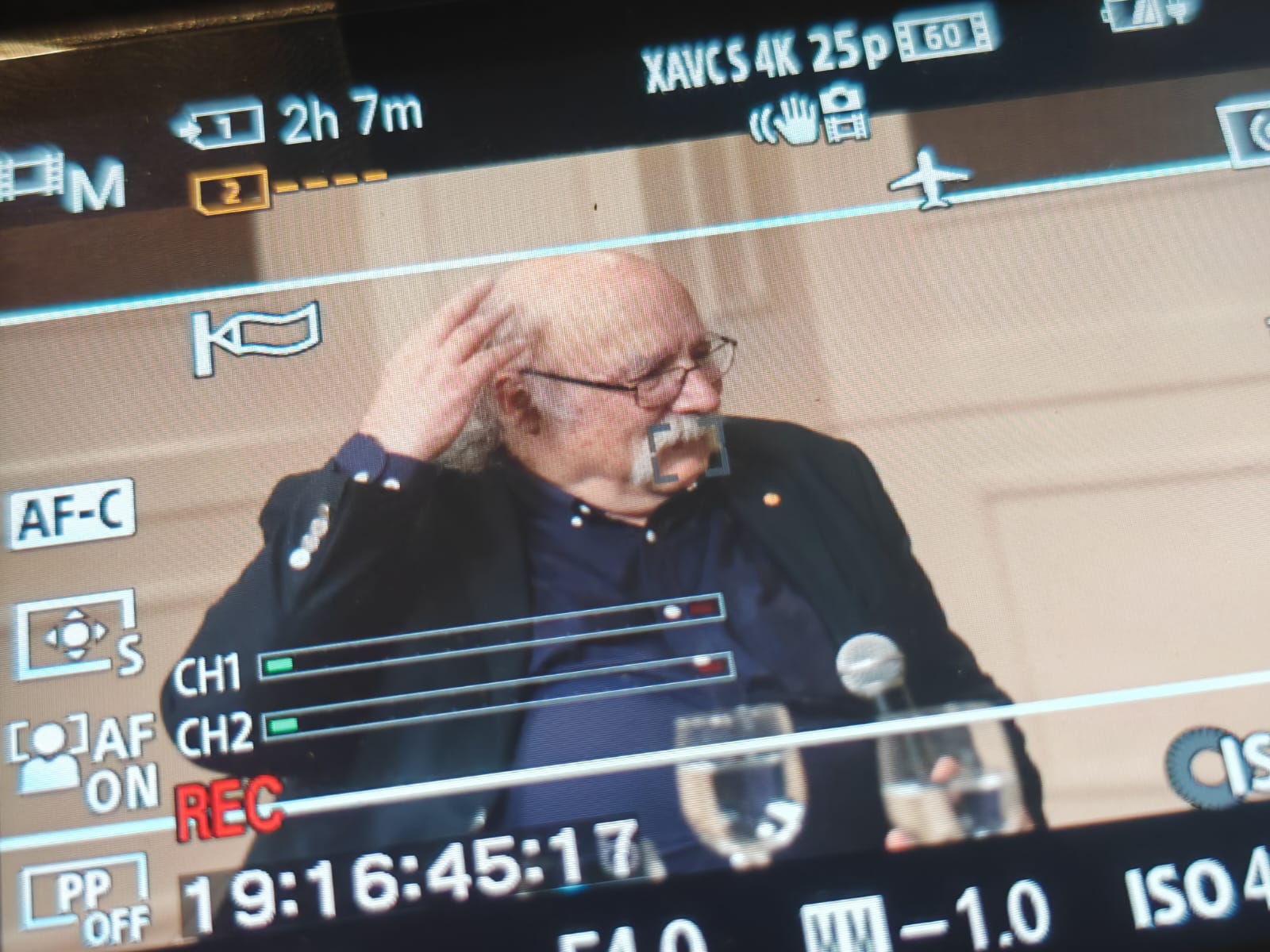 Prof Haldane is awarded the 2016 Nobel Prize in Physics for his discovery of topological phases of matter.
To Prof Haldane, curiosity is a cherished companion. An unfortunate incident involving a mouth pipette and questionable mould steered him away from the hazards of laboratory biology and resolutely towards theoretical physics. “I was too clumsy to be let loose in a lab,” he says, recalling his days as a bright-eyed undergraduate at Christ’s College, Cambridge. That self-awareness, and an insatiable appetite for the conceptual, guided him toward the rarefied world of quantum mechanics.
That world opened unexpected doors. His work, first regarded as controversial and or unconventional, would later become foundational for the study of quantum materials and condensed matter physics, paving the theoretical groundwork for today’s quantum technologies, including quantum computing and photonics.
Yet when Prof Haldane describes these seminal moments of discovery, it never sounds grandiose. He recounts vividly how the act of teaching has often helped him demolish intellectual roadblocks, the classroom becoming a gentle catalyst. “Teaching young people, even basic concepts, sometimes unlocks my own thinking,” he notes. “Explaining something clearly has an uncanny way of revealing hidden truths.”
At Princeton University, where he is the Sherman Fairchild University Professor of Physics, Prof Haldane remains devoted to teaching and mentoring. Rather than allowing the Nobel Prize to become a defining punctuation mark — an endnote on a distinguished career — he sees it simply as a chapter. “I decided it wouldn't change my life too much,” he remarks. Teaching has the added benefit of keeping him disciplined: “I can’t possibly accept every invitation I get from people. After all, someone has to cover my classes!”
There is gentle wisdom in his reflections on collaboration and scientific progress. To Prof Haldane, good science does not flourish in siloes, nor in environments dictated purely by publication pressures or prestigious journals. The magic happens in conversation, he stresses, in open-ended discussions intersecting disciplines, cultures and continents. It happens when researchers, students and scholars gather. “Science is fundamentally social,” he says. “Even Einstein spent a great deal of time discussing ideas with others.”
It is an environment Prof Haldane has encountered countless times, and one that he clearly values. At NTU IAS, he sees a similar spark: researchers from diverse fields converging, nurturing dialogues that seed novel questions. He observes that Singapore has increasingly become part of this vibrant global dialogue: “Singapore is stepping up, contributing meaningfully to this worldwide assembly fascinated by quantum materials.”

Prof Haldane shares that his scientific voyage is far from reaching its destination. He continues to probe, teach and inspire, guiding young minds towards the same relentless questioning that drove him decades ago.
But if there is one insight he holds especially dear, it is his insistence on curiosity as the indispensable trait of any aspiring scientist. “Always ask questions,” he encourages. “Don’t just accept what papers tell you; translate ideas into your own language. Confidence in research comes from independent understanding.” He credits his accomplishments to a passionate schoolteacher who ignited in him an interest in electricity and magnetism. Such mentors, he believes, form the bedrock of scientific inspiration. “A good teacher can spark something extraordinary,” says Prof Haldane.
Throughout his career Prof Haldane continued advocating openness to the unknown. His message is simple yet profound: scientific progress arises less from deliberate pursuit and more from welcoming the unexpected. “Don’t shrug off the small curiosity tugging at your sleeve,” he recommends.
And now, as he engages with scholars, faculty and students at NTU, Prof Haldane’s scientific voyage is far from reaching its destination. He continues to probe, teach and inspire, guiding young minds toward the same relentless questioning that drove him decades ago.
Perhaps his youthful aspiration was not so far off the mark after all. For what defines a rock star more aptly than inspiring generations, challenging conventional wisdom and pursuing the wonder of the unknown?
Prof Haldane sums it up best himself: “Curiosity doesn't kill. Curiosity is the thing that leads to discovering new things. Without it, we have nothing.”
Watch the full interview here.