Welcome to the School of Electrical and Electronic Engineering (EEE) as part of the College of Engineering. The School of EEE prepares students for a career as professional engineers with a broad-based multidisciplinary approach including courses outside the traditional Electrical and Electronic engineering fields - humanities and social sciences. Within the realm of EEE, the diverse areas include semiconductor devices, integrated circuits and systems, power generation and distribution, avionics, control systems, instrumentation, computer-aided design, communications, computer engineering, etc.
The practice of any area in EEE requires a sound understanding of the basic principles of electrical science and mathematics for analysing and synthesising electrical and electronic systems. With the foundation gained from the polytechnic programme, you will pursue in Year 1 to Year 4, a programme of technical courses and several courses in humanities and social sciences, designed to give you a broad background in all areas of EEE.
This website contains information pertaining to the EEE course in Year 1. The Frequently Asked Questions (FAQ) section is of particular interest.
Programme Coordinator's Message
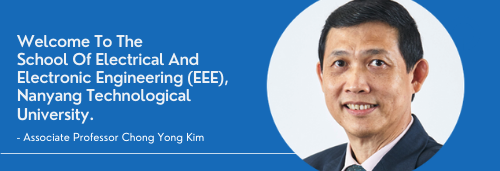
The Part-time BEng Programme started in 1996 with an initial intake of 150 undergraduates. You are the 25th selected intake of Part-time undergraduates. The current Part-time BEng Programme has been substantially revised in conjunction with the Full-time programme to better reflect the multidisciplinary nature of the electrical and electronic engineering profession. In particular, the Year 1 and Year 2 courses now incorporate broad-based areas including engineering subjects outside the traditional EEE, humanities and social sciences.
The Part-time BEng Programme is a 4 year programme as opposed to the 3 year Full-time programme for diploma holders. Part-time BEng students pursue the same core of technical courses and many of the non-engineering courses as Full-time students. The technical programme is designed to give a broad background in Electrical and Electronic Engineering with an option for specialization in Year 3 and Year 4. In view of their on-going engineering experience, Part-time students are, in general, exempted from Design and Innovation Project as well as Professional Internship. The non-engineering courses provide a more rounded and balanced BEng programme, enabling Part-time BEng graduates to prepare for management positions and entrepreneurship. Upon graduation, you can look for a career in many areas.
Most EEE graduates are employed by local or multinational corporations. Some of our graduates have ventured out to start up their own companies. As EEE provides an all-round education for students, our graduates are employed by a wide range of companies. The classes for Part-time undergraduates are conducted 4 nights a week. The programme is rigorous, challenging and interesting. Part-time students are generally advised to manage their time prudently in view of their work, study and family commitments. I hope that you have a great time in EEE and do your best to complete this Part-time BEng Programme at NTU.
Associate Professor Chong Yong Kim
CC_AY2020PT

4f390cbc-0ea9-4cdd-a59b-67b76958c385.jpg?sfvrsn=73f2ab09_3 "EEEOrientation2020_PartTimeB(ENG)")