The SPACE Project: Building Resilience Through Interdisciplinary Research
The SPACE project, short for Shaping Public Adaptive Capacity for Environmental Infectious Diseases, is a groundbreaking interdisciplinary initiative aimed at strengthening Singapore’s ability to respond to environmental infectious diseases such as dengue and COVID-19.
Spearheaded by Professor Shirley Ho, Associate Vice President (Humanities, Social Sciences & Research Communication) and one of two Lead Principal Investigators, the project exemplifies the value of cross-institutional collaboration. It was launched in partnership with CNRS France and local universities including NTU, NUS, SMU, SUTD, and SUSS, bringing together global and local expertise to tackle urgent public health challenges.
Professor Shirley, who named the project “SPACE,” explains that it connotes a boundaryless environment where researchers from diverse disciplines can collaborate freely. The name reflects the project’s mission to help communities build adaptive capacity — the ability to respond effectively to health threats — through research that integrates social sciences, biology and computer science.
SPACE is designed around four key goals:
Enhance epidemic forecasting models
Develop effective policy strategies
Improve health communication
Support urban planning with data-driven visualisations
Together, these aims support a more resilient and informed public health response.
Securing major funding through CNRS France required a compelling vision. Professor Shirley and her co-lead, Professor Natacha Aveline-Dubach from CNRS, crafted a strong research framework and assembled a team of co-investigators from NTU, NUS, SMU, SUTD, and CNRS. The team’s interdisciplinary and international structure was key to securing support. SPACE consists of four work packages (WPs), each led by Co-Principal Investigators from different institutions.
Key Findings from the SPACE Project
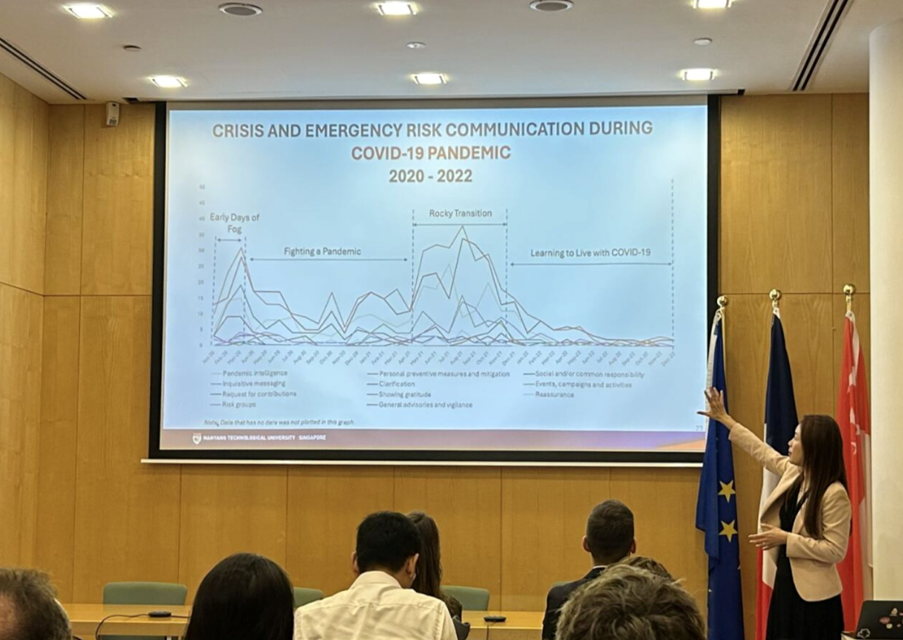
Over three years, SPACE produced several important findings. WP1 focuses on epidemic predictive modelling and found a strong interaction between urban structure and epidemic dynamics. WP2 focuses on the built and social environments, and found that residents living on lower floors in HDB flats are more vulnerable to dengue due to poor ventilation and heat stress. The communication team of this WP (under Professor Shirley Ho) showed that public support for initiatives like Project Wolbachia is influenced more by personal values and perceptions than by factual knowledge, suggesting that public health messaging should go beyond simply conveying information.
WP3 focuses on networks and green infrastructures and found that while many residents practice larval control, fewer take measures against adult mosquitoes, and motivation and a sense of responsibility play a crucial role in public compliance. Meanwhile, WP4 analysed and identified specific building traits that contribute to mosquito breeding and is now developing design guidelines to reduce those risks.
These insights underscore the fact that disease prevention is shaped by how we live, build and communicate and that public health solutions must be equally multidimensional.
What’s Next?
With SPACE completed, Professor Shirley has turned her attention to a new research project on Sustainable Societies, which is part of the Climate Transformation Programme anchored by the Earth Observatory of Singapore. This project explores how communication, psychology, and the arts can shape public attitudes and behaviours toward climate change adaptation and mitigation.
When asked what it takes to be a good researcher, she offers three simple but powerful words: “Be inquisitive. Stay curious. Always innovate.” In addition, she believes that having formal and informal mentors in their career can help faculty to become good researchers. In return, having a sense of gratitude and showing appreciation to whoever gave you the opportunity or career advice in life is likewise important.
Researchers interested in collaborating can contact Professor Shirley at tsyho@ntu.edu.sg.