
Making AI More Private and Easier to Understand
When an organisation uses artificial intelligence to analyse sensitive information, two questions matter: who can access the data, and how can the resulting prediction be understood? For sectors such as finance, healthcare and insurance, both questions can shape whether an artificial intelligence (AI) system is suitable for use.
Implicant, a Singapore-based AI startup company founded this year by Nanyang Technological University Maths professor Thomas Peyrin, is working to address these challenges. The company brings together privacy-preserving prediction and machine-learning models whose underlying logic can be inspected.
Making predictions on encrypted data
A key capability of Implicant’s platform is prediction using fully “homomorphic” encryption (FHE). In mathematics, homomorphisms are transformation that preserves operations between different representations of data. Implicant uses homomorphic cryptographic techniques to allow an AI model to compute on encrypted inputs without first decrypting them. The server performing the calculation therefore does not need access to the original input data.
The process begins when a data owner’s application encrypts the information to be analysed. A deployed model then computes on that encrypted input and returns an encrypted prediction. The authorised holder of the decryption key can decrypt the result.
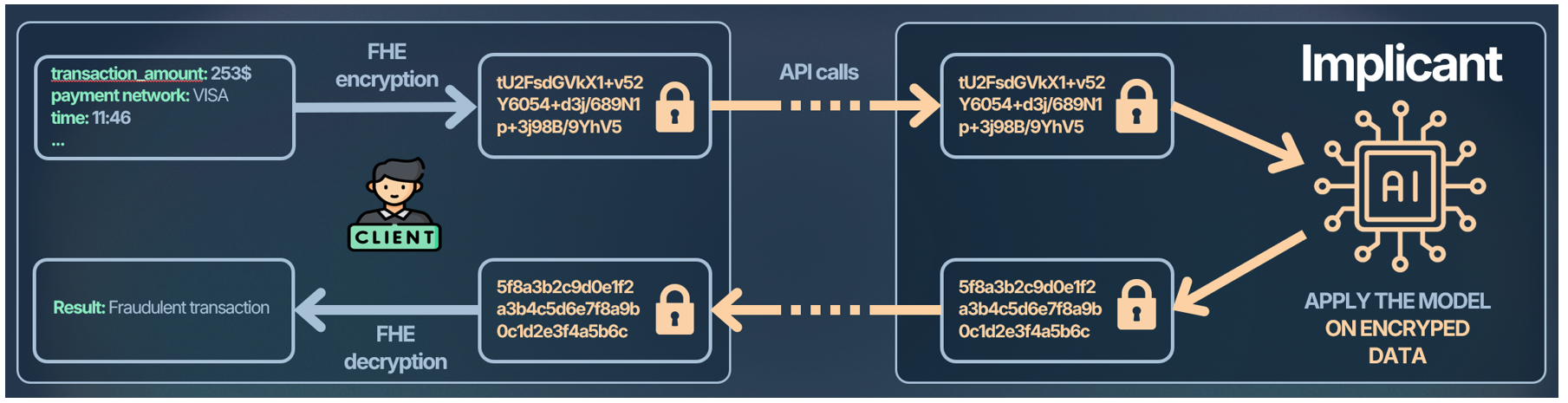
Figure 1. Prediction on encrypted data. The client encrypts transaction details before sending them to Implicant. The model computes on the encrypted inputs and returns an encrypted prediction, which the client decrypts locally. The fraud-detection example illustrates the workflow. [Image credit: Thomas Peyrin]
For example, a financial institution could use this approach to obtain a prediction from a remotely hosted model while keeping the submitted customer information encrypted throughout the calculation. This illustrates how FHE can protect inputs during prediction; the protection of data during collection, preparation and training depends on how those stages are implemented.
Making model logic inspectable
Protecting data addresses one part of the challenge. Another is understanding how a model arrives at its predictions.
One technology behind Implicant’s approach is the Truth Table Network (TTnet), first developed by Professor Peyrin and his collaborators. Its building blocks can be represented as truth tables, which set out the outputs for different combinations of inputs. This structure allows trained models to be expressed as explicit logical rules, giving users a way to inspect the logic behind their predictions.
“The research that eventually led to Implicant began in 2019, when neural networks emerged as a potential tool for cryptanalysis. These models were black boxes, but in cryptography we need to understand why a method works.” Prof Peyrin recounts “That motivated us to design a fundamentally interpretable type of neural network, so we could examine what the model was learning. This work eventually led to TTnet.” TTnets were first described in a 2024 paper Prof Peyrin published with collaborators on verifiable neural networks.
Such TTnets can be widely employed in real world situations. Consider, for example, an AI model used to assess loan default risk. Reviewing its rules could help specialists examine how inputs such as existing debt and repayment history affect its predictions. This kind of inspection can support scrutiny of a model’s behaviour, although understanding its rules does not by itself establish that its predictions are accurate or fair
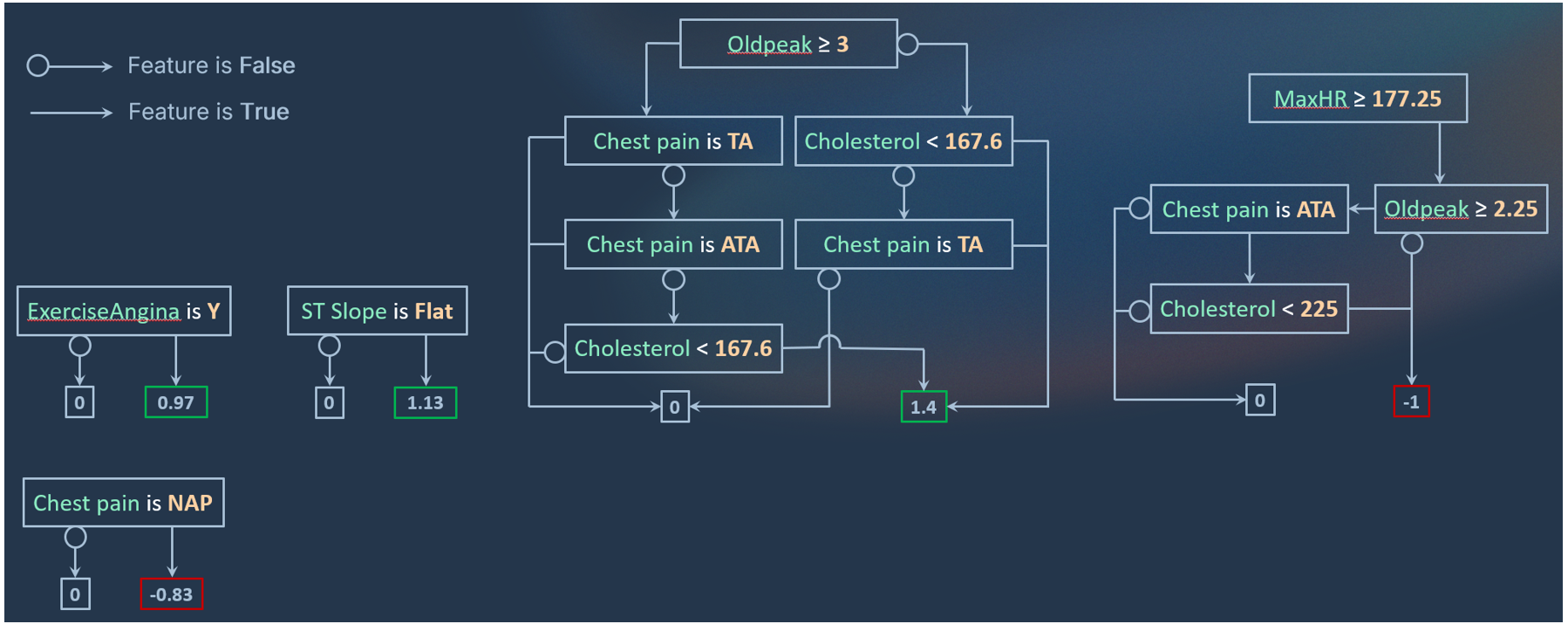
Figure 2. Inspectable model logic illustrated with heart-health features. Conditions on the input features lead to numerical rule outputs. A plain arrow indicates that a condition is true; an arrow with an open circle indicates that it is false. The diagram makes the conditions and their associated outputs visible for inspection. [Image credit: Thomas Peyrin]
Implicant incorporates TTnet into its platform to support inspectable models and computation on encrypted data. The combination connects research in neural-network design with the practical demands of deploying AI on sensitive information.
From mathematical research to practical applications
Professor Peyrin’s research spans the design and security analysis of cryptographic methods, as well as applications of machine learning to security. Through Implicant, he is bringing that expertise into tools for organisations seeking to use AI. “I have always been drawn to practical applications and to mathematical questions that can have a direct impact. Through Implicant, we are bringing that research together with cryptographic techniques that allow predictions on encrypted data.” says Prof Peyrin.
The platform supports data preparation, AI model training, AI model inspection and deployment, including training assisted by large language models (LLMs). Trained AI models can be used directly or accessed through a callable application programming interface (API), allowing organisations to integrate predictions into their existing applications and workflows.
By bringing these capabilities into a single platform, Implicant aims to help organisations move from exploring their data to deploying models, while supporting encrypted prediction and inspection of model logic.
For the School of Physical and Mathematical Sciences where NTU Maths faculty conduct mathematics research, Implicant illustrates a route from fundamental work in mathematics and computing to practical applications. For organisations exploring AI, it offers an approach to two concrete concerns: protecting the information used for predictions and understanding the logic behind them. Prof Peyrin adds, “My hope is to help organisations put AI to practical use while protecting sensitive information and giving them model logic they can inspect and understand.”
Implicant provides further information on its website and offers interactive demos of its technologies