“Artificial leaf” generates clean hydrogen from contaminated seawater
The leaf-inspired device produces hydrogen and removes a toxic industrial pollutant at the same time.
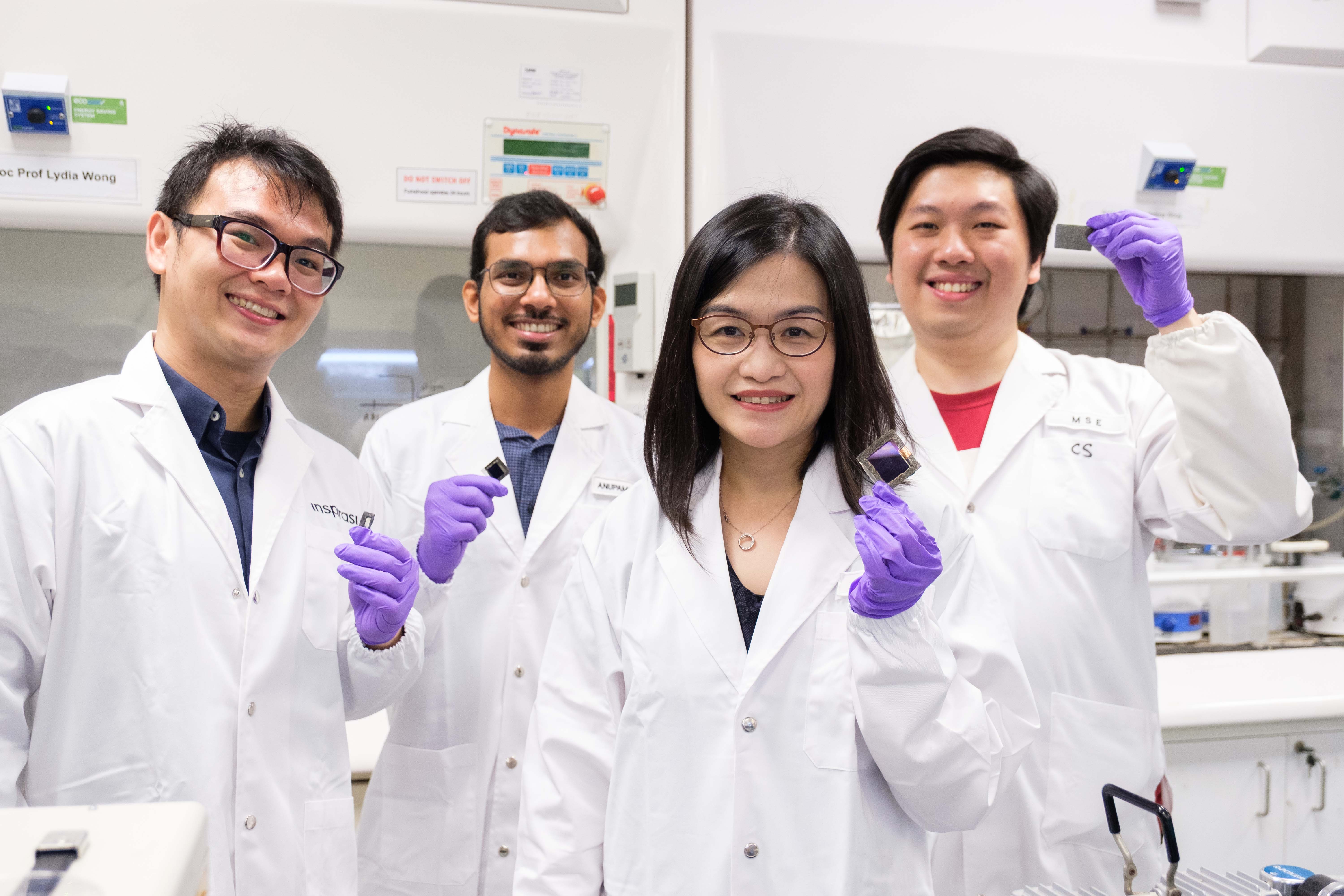
The researchers behind the innovation. From left: Dr Stener Lie, Dr Anupam Sadhu, Prof Lydia H. Wong and Dr Hao Zhe Chun of NTU’s School of Materials Science and Engineering. Credit: NTU Singapore.
Scientists from Nanyang Technological University, Singapore have designed a device that harvests sunlight to generate clean hydrogen from seawater and simultaneously degrade hydrazine, a highly toxic contaminant from industrial wastewater.
Inspired by leaves, the device directly captures sunlight and converts it into electricity to drive the reaction without the need for external power sources.
The innovation was reported in Nature Communications in May.
Two-in-one green solution
To produce green hydrogen from water, an electric current is passed through water between two electrodes, splitting the water molecules into hydrogen and oxygen – a process known as electrolysis.
In electrolysis, electrons flow to the cathode (negative electrode), where they combine with water molecules to produce hydrogen gas.
Producing hydrogen directly from electrolysis of seawater instead of freshwater improves its sustainability as additional steps to remove salt from the seawater are not required.
However, seawater presents its own challenges. Chloride ions in seawater interfere with the reaction and reduce its efficiency. Additionally, corrosive and toxic chlorine compounds are also generated that can damage the electrodes.
To boost the efficiency of hydrogen production from seawater, the researchers, led by Prof Lydia Wong of NTU’s School of Materials Science and Engineering, designed the anode (positive cathode) containing a catalyst that breaks down hydrazine into hydrogen and nitrogen. This reaction requires less energy than the oxygen-producing reaction usually involved in water electrolysis. As a result, the sunlight-powered cathode can generate hydrogen from water more efficiently and with a lower energy requirement, while the anode removes hydrazine and produces additional hydrogen.
The catalyst, containing iron, cobalt and chromium, is also resistant to corrosion and its electrical, physical and chemical properties can be easily customised.
At the same time, the production of corrosive and toxic chlorine compounds is suppressed.
Catalysing a sustainable future
To generate the electricity required to power the device, the researchers fabricated the cathode from lead halide-based perovskites – a semiconductor material that captures light and converts it to electricity. The cathode was coated with a conductive epoxy resin containing silver and copper particles as well as titanium foil to protect it from degradation.
In simulated and real seawater samples, the device generated a stable electric current from light. The photocurrent density (25 mA cm⁻²) – the amount of current generated per illuminated area of the device – was also one of the highest reported for lead-based perovskite cathodes, an indication of the device’s effectiveness at converting sunlight to electricity.
The device maintained a stable performance for over 72 hours at an illumination equivalent to the intensity of sunlight that reaches the Earth’s surface on a clear day, generating hydrogen at a high rate of 466 μmol cm-2 h-1, comparable with similar solar power-driven devices. It effectively degraded hydrazine without the need for separation from water within 30 hours, reducing its concentration from 0.5 M (equivalent to about 1.6% by weight) to 0.5 parts per billion (ppb), more than 20 times below the US Environmental Protection Agency’s permissible limit of 10 ppb.
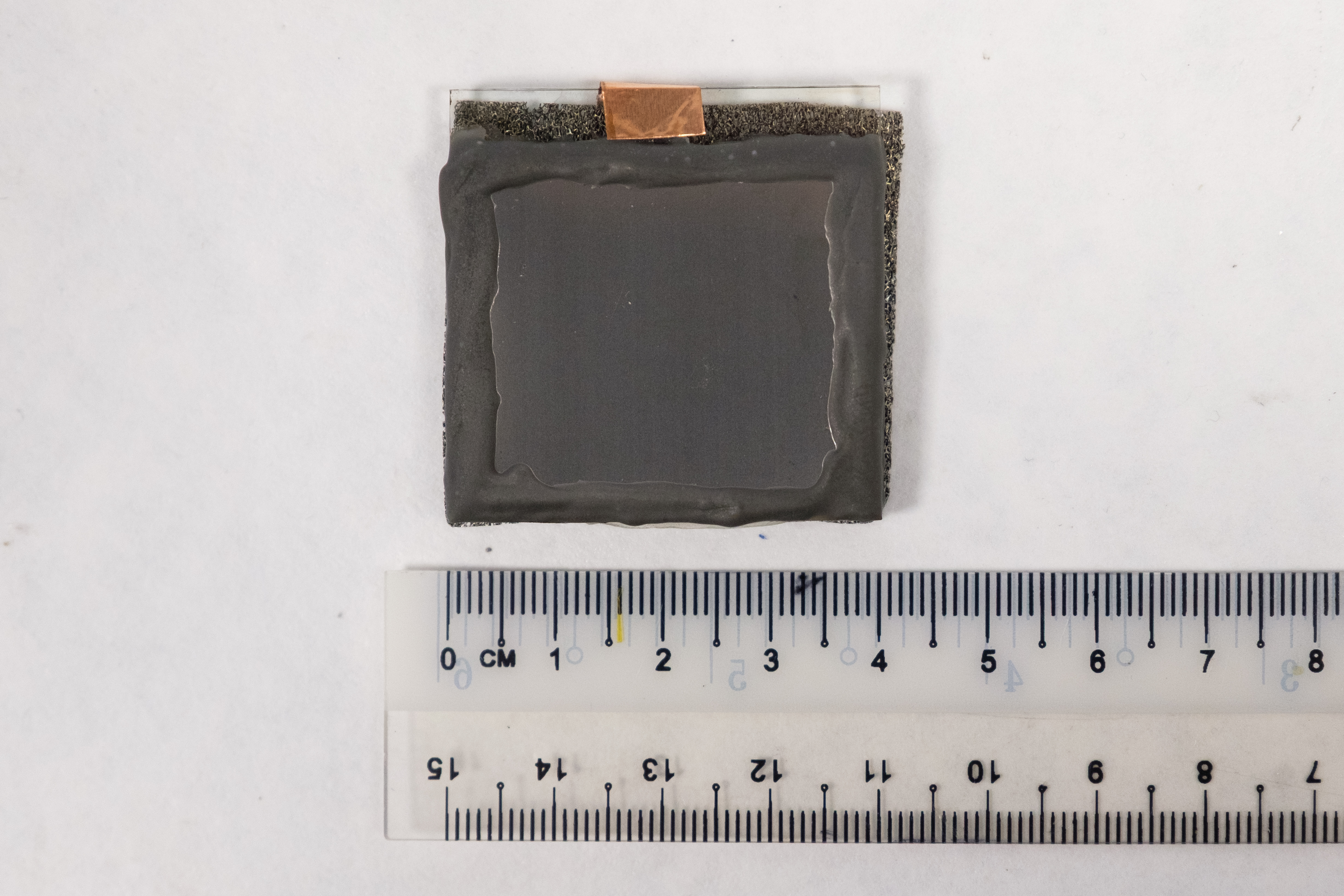
The device generates clean fuel and removes pollutants at the same time. Credit: NTU Singapore.
Hydrogen is produced at both the anode and cathode when the device is illuminated. Credit: NTU Singapore.
“This dual-function device represents a major leap forward for environmental technology. By efficiently harvesting solar energy to break down a toxic industrial pollutant while simultaneously harvesting clean fuel, we are solving both an energy problem and a pollution problem,” said Prof Wong.
“The breakthrough here lies not simply in producing solar hydrogen but in demonstrating a practical route towards multifunctional photoelectrochemical systems. Such dual-purpose approaches are likely to play an increasingly important role in the future deployment of solar fuels technologies, where economic value and environmental impact must go hand in hand,” said Prof James Durrant, Professor of Photochemistry and Sustainable Energy in the Department of Chemistry at the University of Oxford, who was not involved in the research.
The researchers are now working to develop catalysts that can expand the device’s applications beyond hydrazine degradation, including the treatment of other pollutants and the conversion of waste materials into useful products such as fuels and industrial chemicals.
Read more in “Self-powered artificial leaf using perovskite photocathode for solar hydrogen production and hydrazine degradation”, Nature Communications (2026), DOI: 10.1038/s41467-026-73326-3.