Nanoparticles for a renewable society
Microscopic innovations developed by Nanyang Asst Prof Wu Dongshuang and her team are paving the way for a carbon-neutral tomorrow.
.jpg?sfvrsn=ecbd1c2d_1 "Nanyang Asst Prof Wu Dongshuang (NTU Singapore research)")
By Wu Dongshuang and Zhu Bing
If everyone in a team has the same experience and skills, they might work well together but their collective capabilities are limited. On the other hand, a team made up of individuals with different strengths – one fast, one strategic, one creative, another calm under pressure – can achieve far more than any single person alone.
This is how multi-element nanoparticles work.
Only a few nanometres in size, these tiny particles consist of several metals. When the different metal atoms come together at the nanoscale, they interact in unique ways. Their electrons reorganise, their surfaces change and they form new “chemical personalities”. Even a small change in chemical composition can drastically influence how the nanoparticles behave.
By carefully arranging atoms at the nanoscale, we can create nanoparticles to generate cleaner hydrogen from the splitting of water and enable smarter ways to recycle carbon. Because their novel properties enable them to accelerate reactions in ways single metals cannot, these nanoparticles are extremely promising catalysts for addressing two of the world’s biggest sustainability challenges today: how to make environmentally friendly fuels and how to convert carbon dioxide into useful products.
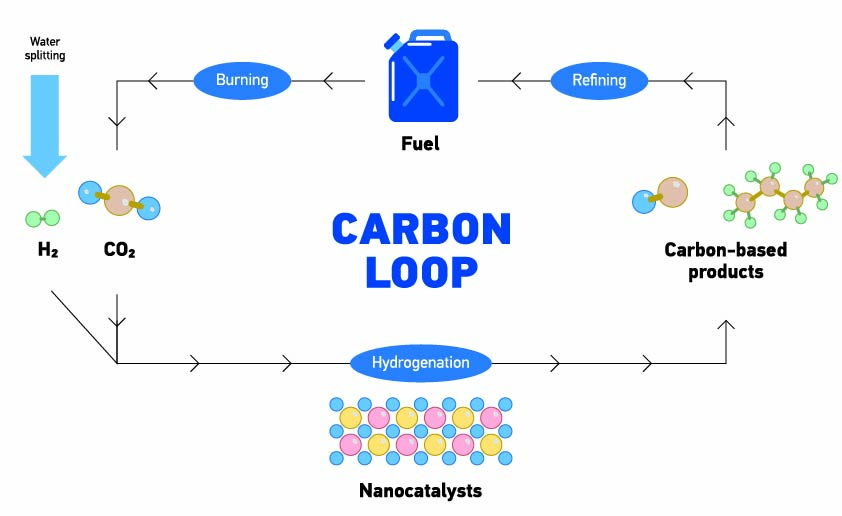
Nanocatalysts help recycle carbon by speeding up two key reactions: producing hydrogen from water and converting carbon dioxide into useful materials. Credit: NTU.
Making clean hydrogen from water
Traditional catalysts used to generate hydrogen from the splitting of water often rely on precious metals, such as platinum, ruthenium and iridium. These metals are rare, expensive and hard to scale up.
Multi-element nanoparticles made from common metals like iron, nickel, cobalt and copper can do the job just as well, or even better. However, these nanoparticles are unstable in terms of structure and composition with prolonged use, limiting their deployment.
Unexpectedly, we discovered that adding a trace amount of palladium to these nanoparticles can stabilise them – although the metal is typically considered unsuitable for the splitting of water due to its poor durability.
We hypothesise that palladium interacts with the structure of the nanoparticles and suppresses their degradation, leading to a pronounced enhancement in long-term stability.
Turning carbon dioxide into useful products
Producing hydrogen is only half the story, however. We can use this hydrogen to recycle carbon dioxide, turning it from a waste gas into a valuable raw material.
Recycling carbon dioxide is challenging because the molecule is stable and does not react easily with other chemicals. To overcome this hurdle, we have designed nanoparticles that can activate the chemical bonds in carbon dioxide in new ways, making the transformation of carbon dioxide much more efficient and enabling reactions that traditional single metal catalysts cannot achieve.
With the help of these nanocatalysts, we can convert carbon dioxide into important products, such as carbon monoxide, methanol and higher-value molecules that form the building blocks for fuels, plastics and many everyday materials.
Closing the carbon cycle
By putting these two processes together, we are working towards closing the carbon loop, where carbon is continuously reused instead of released into the atmosphere. In this cycle, carbon dioxide becomes a valuable ingredient, not waste.
Materials at the nanoscale continue to surprise us, and our research is a reminder that even the tiniest particles can help drive some of the biggest changes towards a more sustainable future.
---
Nanyang Asst Prof Wu Dongshuang of NTU’s School of Materials Science & Engineering (MSE) develops nanoparticles
for energy-related applications and beyond. Zhu Bing is a PhD student at MSE, supervised by Asst Prof Wu.
Read more about their research in Journal of the American Chemical Society (2025), DOI: 10.1021/jacs.4c18109 and
Faraday Discussions (2025), DOI: 10.1039/D5FD00084J.
The article appeared first in NTU's research & innovation magazine Pushing Frontiers (issue #26, May 2026).