Low-Complexity Method of Detecting MIMO-OTFS SCMA Signals
Synopsis
A low-complexity Memory approximate message passing (AMP) detector for multiple-input multiple-output orthogonal time frequency space (MIMO-OTFS) sparse code multiple access (SCMA) systems is proposed, which can exploit channel sparsity and leverage orthogonality-preserving message updates to achieve superior multiuser detection performance.
Opportunity
Orthogonal time frequency space (OTFS) modulation has emerged as a compelling alternative to orthogonal frequency division multiplexing (OFDM) for high-mobility communications, owing to its ability to multiplex symbols in the delay–Doppler domain and exploit the inherent sparsity and diversity of time-varying channels. When further integrated with multiple-input multiple-output (MIMO) techniques and non-orthogonal multiple access schemes such as sparse code multiple access (SCMA), OTFS systems can substantially improve spectral efficiency and support massive connectivity. However, these advantages come at the cost of a significantly increased detection complexity. In particular, the resulting large-scale system is characterized by high-dimensional signal coupling with severe inter-symbol interference (ISI), inter-Doppler interference (IDI), and inter-user interference (IUI). Conventional maximum a posteriori (MAP) detection becomes computationally intractable due to its exponential complexity, while linear detectors suffer from notable performance loss in highly correlated channels. Existing message-passing based algorithms, although more scalable, often rely on costly matrix inversions or exhibit slow convergence and instability in the presence of structured interference, making them unsuitable for practical large-scale deployments.
To overcome these challenges, we propose a customized low-complexity Memory approximate message passing (AMP) detector tailored for large-scale MIMO-OTFS SCMA systems. The proposed approach explicitly leverages the structured sparsity of the delay–Doppler channel representation, enabling efficient interference suppression through iterative message updates. By incorporating memory into the AMP framework, the detector enforces an orthogonality principle across iterations, effectively mitigating the correlation buildup that typically degrades the performance of conventional AMP algorithms. This memory-assisted mechanism eliminates the need for large matrix inversions and significantly improves convergence behavior. Furthermore, the proposed detector jointly performs channel equalization and multiuser detection in a unified framework, achieving near-optimal performance with substantially reduced computational complexity. As a result, it provides a scalable and robust solution for high-dimensional detection in next-generation high-mobility wireless systems.
Technology
A customized low-complexity Memory approximate message passing (AMP) detector is proposed for large-scale MIMO-OTFS SCMA systems in high-mobility scenarios. The proposed detector relies on matched filtering and a finite-term matrix Taylor series to approximate matrix inversion, while exploiting channel sparsity and Gaussian message approximation to reduce computational complexity, shown in Fig. 1 as below. By incorporating all preceding messages under an orthogonality principle, the algorithm ensures asymptotically independent identically distributed (IID) Gaussian estimation errors, thereby enhancing detection performance, and further derives optimal damping solutions for improved robustness.
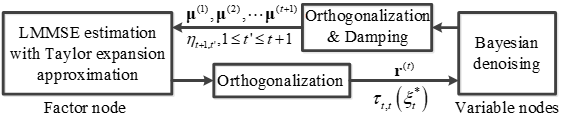
Figure 1: Proposed Memory AMP Detector for MIMO-OTFS SCMA systems.
Applications & Advantages
- The proposed schemes are expected to support massive mobile connectivity, and provide high speed and ultra-reliable communications for a wide range of emerging large-scale mobile applications, including online gaming, high-speed railway systems, low earth orbit (LEO) satellite communications, unmanned aerial vehicle (UAV) communication and vehicle-to-everything (V2X) networks.
- The proposed MIMO-OTFS SCMA systems can improve the spectrum utilization and support massive mobile user connectivity.
- The proposed low-complexity Memory AMP detector can harvest sufficient diversity coming from both the delay, Doppler and spatial domains, and outperforms the existing detectors.
- Granted countries (patent award): Germany.



.tmb-listing.jpg?sfvrsn=abbd2980_1)
.tmb-listing.jpg?sfvrsn=43b583b8_2)