Method For Interference Suppression for FMCW Automotive Radar Based On (Or Aided By) Joint Processing with Communication Signal Echoes
Synopsis
In modern intelligent transport systems (ITS), vehicles from different vendors operate simultaneously using radar and wireless communication systems. Current vehicular radars use frequency-modulated continuous wave (FMCW) chirps for sensing, but identical waveforms can cause radar-to-radar interference. This leads to ghost peaks in the radar image, degrading target detection. This work proposes a novel radar algorithm to suppress such interference.
Opportunity
In recent years, vehicular radars have proliferated due to their critical role in intelligent transport systems (ITS) and advanced driver assistance systems (ADAS). At the same time, vehicle-to-vehicle (V2V) communication has become essential for automated driving and tele-operations. However, this widespread deployment has led to significant radar-to-radar interference, especially since most automotive radars use identical FMCW chirp waveforms. Such interference introduces spurious ghost peaks in the ego vehicle’s radar output, degrading target detection performance and potentially compromising safety. Therefore, suppressing these interference remains a key challenge for reliable vehicular radar operation.
This work addresses the problem of suppressing interference-induced ghost peaks. It is assumed that each vehicle is equipped with both a conventional FMCW radar and a V2V communication system. The proposed method leverages radar sensing information extracted from communication echoes in the V2V system to suppress ghost interference peaks in the radar image of the ego vehicle.
Technology
Figure 1 illustrates the radar sensing scenario in the presence of interference. The ego vehicle (v1) transmits an FMCW chirp for radar sensing, followed by a V2V communication signal. At roughly the same time, a second vehicle (v2) transmits its own FMCW chirp, with no communication signal during this period. From v1’s perspective, both its radar and communication signals are reflected by v2, producing chirp and communication echoes. However, v2’s transmitted chirp overlaps with the received radar echo at v1, acting as interference and degrading the desired signal. This interference results in spurious ghost peaks in v1’s radar output, and the key challenge is how to effectively suppress them.
Interference cancellation is achieved by combining radar sensing outputs derived from both the chirp echo and the communication echo, as illustrated in Figure 2. The ego vehicle receives both signals, which are processed separately by the FMCW radar receiver and the communication receiver. The communication echo is used to compute the preamble ambiguity function (AF) (𝑨_𝒑𝒓𝒆 (𝑝,𝑞)) and the data AF (𝑨_𝒅𝒂𝒕𝒂 (𝑝,𝑞)), while the radar echo is used to compute the chirp AF (𝑨_𝒄𝒉𝒊𝒓𝒑 (𝑝,𝑞)). These three non-homogeneous (i.e., coming from different type of signals) AFs are then combined using a min-point combining approach to suppress interference.
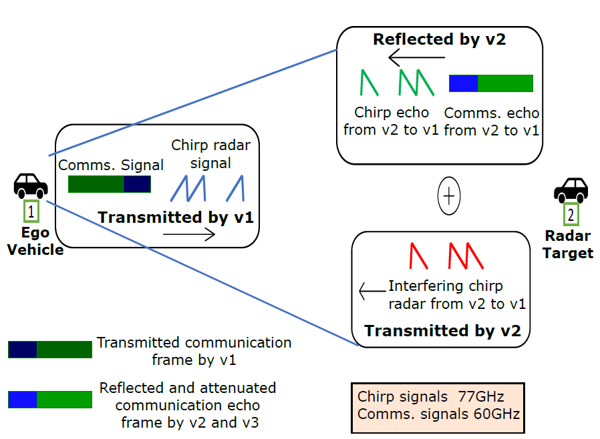
Figure 1: Radar sensing scenario in the presence of interference.
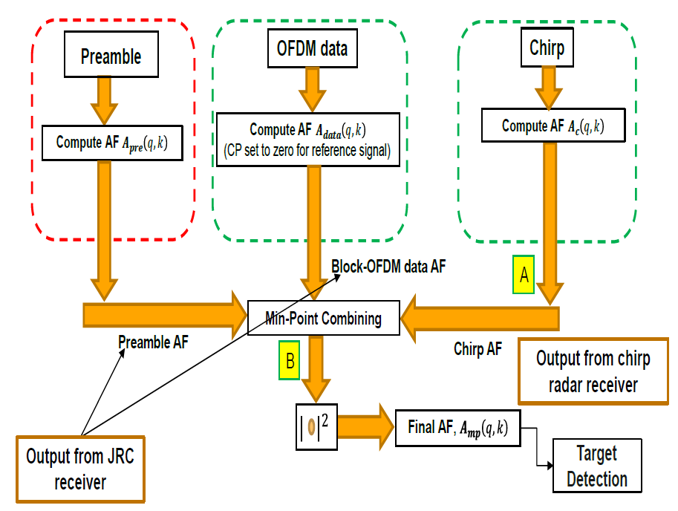
Figure 2: Proposed radar interference suppression algorithm.
Applications & Advantages
- The proposed invention is relevant for the framework of joint radar and communication, which is a well-recognized and novel paradigm for 5G-Advanced (Release 19 and above) and beyond 5G systems, e.g., 6G.
- It is observed that the proposed method along with the derived theoretical threshold has a better target detection performance in terms of 𝑷_𝑫 (up to 2dB ENR gain) as well as better interference suppression performance in terms of 𝑷_𝒓 (100 times at high ENR).
- The proposed scheme could result in more reliable automotive radar/sensing system as the probability of false positives is reduced, thus potentially creating an added-value feature for future products.
.tmb-listing.jpg?sfvrsn=abbd2980_1)
.tmb-listing.jpg?sfvrsn=43b583b8_2)
.tmb-listing.jpg?sfvrsn=57e7d9a3_2)