Low-Complexity Receiver for Reliable High-Speed Wireless Communication
Synopsis
We propose a new method that jointly improves channel estimation and signal detection for fast-moving wireless scenarios, achieving high performance with low computational cost.
Opportunity
In high-speed wireless scenarios such as vehicles, trains, or satellites in motion, the communication channel changes very quickly due to Doppler shifts and signal reflections from multiple paths. These effects make it difficult for the receiver to accurately track the channel and correctly detect the transmitted data. Conventional methods often struggle to maintain reliability under such conditions, or they require very high computational effort, which limits their practical use in real-time systems.
To address this challenge, the proposed technology introduces a new iterative receiver design that combines an efficient channel representation with a low-complexity detection method. This approach continuously refines both channel estimation and signal detection, enabling reliable communication even in fast-changing environments while keeping computational requirements low. As a result, it supports robust performance in high-mobility applications such as vehicular communications, high-speed rail systems, UAV and satellite links, and future broadband wireless networks.
Technology
In this work, we propose a hybrid iterative channel estimation and equalization techniques (MP&IC-MLSE) for orthogonal frequency division multiplexing (OFDM) transmission over DSC. In the first round of the detection, the MP&IC-MLSE uses pilot symbols to perform pilot-aided CE, and a message passing (MP) equalizer for symbol detection. In the subsequent iterations, the proposed scheme uses the detected symbols obtained from the previous iteration to perform data-aided CE and interference cancellation (IC). After CE and IC, the maximum likelihood sequence estimation (MLSE) equalization is used instead of MP to achieve optimal bit error rates (BER) performance. Simulation results show that by using the proposed MP&IC-MLSE, the CE and BER performance can be significantly improved as compared to existing iterative CE and equalization techniques, and the complexity is much lower than the conventional techniques.
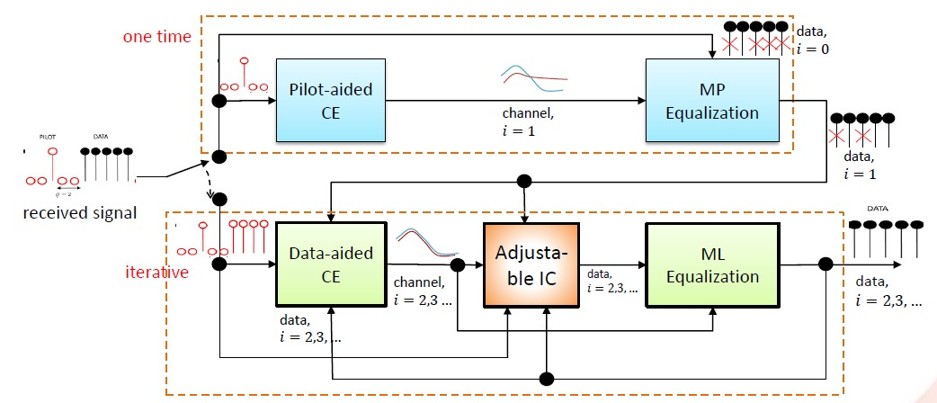
Figure 1: Block diagram of the proposed MP&IC-MLSE iterative OFDM receiver.
Applications & Advantages
- Applicable standards: current 4G and 5G cellular, new WiFi (802.11ad, 802.11bd, 60 GHz), new mmWave cellular (Release 16, 30-60 GHz), new high-speed train (600 km/h), new LEO satcom (StarLink), new radar-comm system (77 GHz, 120 GHz).
- Near optimal performance: more than 10 dB BER performance gain, approaching lower bound.
- Low complexity: Square order, up to 16 times complexity reduction compared to conventional MMSE receiver.
- Fast convergence: only 3-4 iterations.
- Wide range of applications: vehicular communications, high-speed train communications, underwater acoustic communications and low-orbit satellite communications.
.tmb-listing.jpg?sfvrsn=abbd2980_1)
.tmb-listing.jpg?sfvrsn=43b583b8_2)
.tmb-listing.jpg?sfvrsn=57e7d9a3_2)