
Method Of Processing Signals for Wireless Communications Over Time/Frequency Selective Fading Channels
Synopsis
A linear precoding scheme is proposed for orthogonal time frequency space (OTFS) systems that ensures full diversity and potential coding gains in time/frequency selective fading channels without rate loss or transmitter channel state information (CSI).
Opportunity
In high-data-rate and high-mobility wireless environments, channels typically exhibit pronounced frequency- and time-selective fading, which severely challenges conventional transmission schemes. In particular, orthogonal frequency division multiplexing (OFDM) suffers from reduced diversity gain and significant performance degradation due to Doppler-induced inter-carrier interference (ICI), as the subcarrier orthogonality is easily destroyed under rapid channel variations. Orthogonal time frequency space (OTFS) modulation has recently emerged as a promising alternative by mapping information symbols into the delay–Doppler domain, thereby converting the doubly selective channel into a quasi-static and structured representation while requiring only a single cyclic prefix (CP) per frame to maintain high spectral efficiency. However, despite these advantages, existing OTFS designs do not inherently guarantee full diversity in general time- and frequency-selective fading channels. In particular, the achievable diversity order is often limited by the signal structure and channel conditions, leaving a critical gap between theoretical potential and practical performance.
To address this limitation, we develop an enhanced OTFS transmission framework that is specifically designed to achieve full diversity while preserving spectral efficiency. The proposed approach systematically exploits the delay–Doppler domain structure through carefully designed signal processing techniques, such as diversity-enhancing precoding and symbol coupling strategies, to ensure that each transmitted symbol experiences the full richness of the channel variations across both time and frequency dimensions. By doing so, the scheme effectively transforms channel selectivity into a source of diversity gain rather than performance impairment. Importantly, this design maintains the intrinsic advantage of OTFS in requiring only a single CP per frame, thereby avoiding additional overhead. As a result, the proposed method achieves a favorable trade-off between reliability and spectral efficiency, enabling robust high-rate communications in challenging high-mobility scenarios.
Technology
A linear precoding scheme for orthogonal time frequency space (OTFS) systems based on algebraic number theory is proposed to achieve maximal diversity and potential coding gains over both multipath frequency-selective and Doppler time-selective fading channels, shown in Fig. 1 as below. The design requires no transmitter channel state information (CSI), supports arbitrary system dimensions, guarantees symbol detectability without rate loss, and outperforms unprecoded and phase-rotated OTFS schemes while being more robust than traditional orthogonal frequency division multiplexing (OFDM).
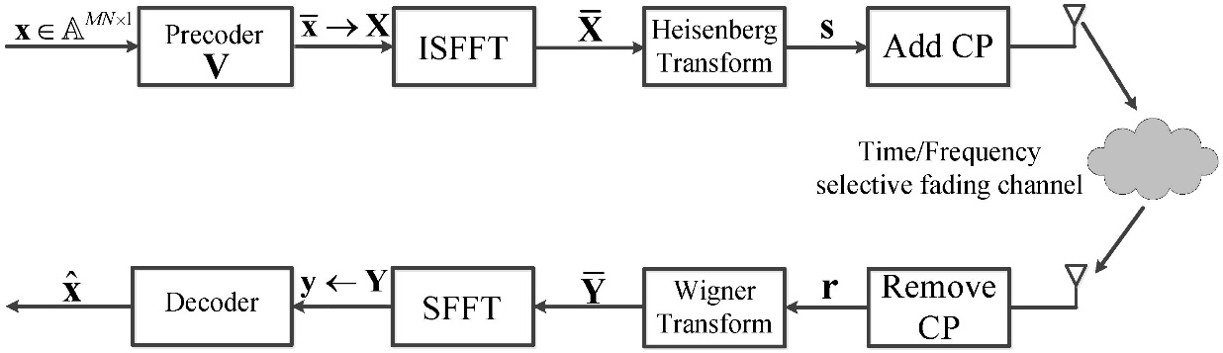
Figure 1: Proposed precoded OTFS systems for time/frequency selective fading channels.
Applications & Advantages
- The proposed schemes are expected to support high data rates wireless transmissions, and provide robust and ultra-reliable communications for a wide range of emerging large-scale applications, including online gaming, virtual reality and augmented reality, indoor wireless local area networks, wireless sensor networks, smart cities and remote health care. The proposed schemes can also be applied to high-speed railway systems, low earth orbit satellite communications, unmanned aerial vehicle communications, and vehicle-to-everything networks.
- The proposed linear precoding scheme for OTFS system can improve the spectral efficiency compared to traditional OFDM system due to only one CP is required for each OTFS frame.
- The proposed linear precoded OTFS system can guarantee the maximal diversity and potential coding gains in multipath frequency-selective and Doppler time-selective fading channels without any transmission rate loss, and outperforms the original unprecoded and the existing phase rotation OTFS systems.

.tmb-listing.jpg?sfvrsn=abbd2980_1)
.tmb-listing.jpg?sfvrsn=43b583b8_2)

.tmb-listing.jpg?sfvrsn=57e7d9a3_2)