System and Method for Affine Frequency Division Multiplexing Communication with Low Pilot Overhead and High Reliability
Synopsis
Affine frequency division multiplexing is a promising alternative to orthogonal time frequency space for high-mobility communications due to its lower pilot overhead. The proposed approach further reduces pilot requirements using a basis expansion mode while maintaining high reliability through iterative channel estimation based on detected data symbols.
Opportunity
Orthogonal Time Frequency Space (OTFS) has emerged as a promising waveform for high-mobility communications in 6G. However, due to its two-dimensional structure, the associated pilot overhead can be significantly increased. In contrast, Affine Frequency Division Multiplexing (AFDM), with its one-dimensional structure, has been proposed as a more efficient alternative. However, existing AFDM schemes still require a substantial number of pilots to accurately track time-varying channels.
The proposed technology employs basis expansion modelling (BEM) to approximate the AFDM channel, thereby reducing pilot overhead. To compensate for the initial degradation in channel estimation performance caused by fewer pilots, it further utilizes detected data symbols as pseudo-pilots to iteratively refine the channel estimation.
Technology
The proposed approach employs the generalized complex exponential BEM (GCE-BEM) to approximate the AFDM channel, introducing enhancements at both the transmitter and receiver. The one-dimensional AFDM transmission frame is illustrated in Fig. 1a, where pilot and guard symbols are configured based on the BEM order and channel conditions. The resulting AFDM reception frame with pilot and data symbols is shown in Fig. 1b. The number of required pilot and guard symbols in BEM AFDM systems is (2(Q+1)(L+1)-1), which is lower than that in BEM OTFS systems, given by (2Q+1)(2L+1).
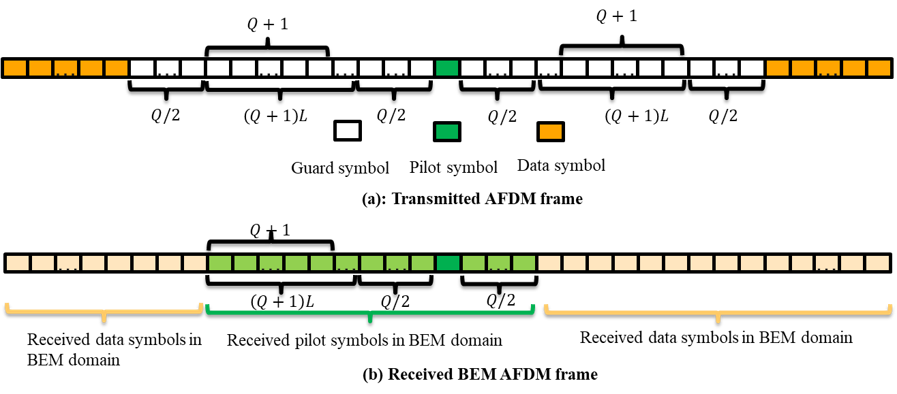
Figure 1: Proposed BEM AFDM transmission and reception frame.
Reducing pilot overhead can compromise communication reliability. To improve pilot-aided AFDM channel estimation, the detected data symbols are treated as pseudo-pilots and iteratively used to refine channel estimation, cancel pilot interference, and enhance signal detection until convergence is achieved. The proposed algorithm, termed iterative BEM-AFDM channel estimation and signal detection, is illustrated in Fig. 2. It comprises two stages. In the first stage, pilot-aided BEM channel estimation employs GCE-BEM with a lower BEM order to reduce the number of unknown coefficients and, consequently, the pilot overhead. In the second stage, data-aided BEM channel estimation increases the BEM order to mitigate modeling error and improve estimation accuracy.
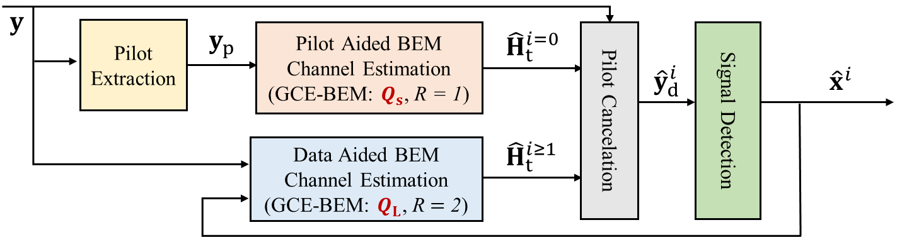
Figure 2: Block diagram of proposed BEM AFDN receiver.
Applications & Advantages
- The proposed technology can be applied to high-mobility communication scenarios, including vehicular, satellite, and underwater acoustic communications.
- When delivering comparable communication reliability, the proposed technology can reduce pilot overhead by nearly 50%.
- With comparable pilot overhead, the proposed technology can achieve a performance gain of approximately 3 dB.

.tmb-listing.jpg?sfvrsn=abbd2980_1)
.tmb-listing.jpg?sfvrsn=43b583b8_2)
.tmb-listing.jpg?sfvrsn=57e7d9a3_2)