Chirped DFT-s-OFDM: An Advanced Single-Carrier Waveform for Future Wireless Communications
Synopsis
Ubiquitous connectivity will continue to be essential for future wireless communications, encompassing diverse scenarios with many power-constrained, high-mobility terminals. By incorporating chirping into discrete Fourier transform-spread orthogonal frequency division multiplexing (DFT-s-OFDM), the proposed modulation waveform provides high communication reliability and excellent power efficiency especially in high-mobility scenarios.
Opportunity
Transmission waveform has been regarded as one of important components in every generation of communications. Orthogonal frequency division multiplexing (OFDM) was adopted for downlink transmissions in the fourth (4G) and fifth generations (5G) of communications. For the sake of low peak-to-average-power-ratio (PAPR), discrete Fourier transform spread OFDM (DFT-s-OFDM) was selected for uplink transmissions. However, they may not be suited for the high-mobility applications in the sixth generation (6G) of communications. Recent waveform candidates proposed for 6G, such as orthogonal time frequency space (OTFS) and affine frequency division multiplexing (AFDM), usually suffer from high PAPR, leading to reduced power efficiency.
To address this issue, the proposed approach incorporates a chirping operation after DFT-s-OFDM processing. This enhancement improves communication reliability, enables full frequency diversity, and increases robustness in high-mobility channels. Moreover, since the chirping operation primarily alters the signal’s frequency without affecting its amplitude, the inherently low PAPR of DFT-s-OFDM is preserved.
Technology
A novel single-carrier waveform, termed chirped DFT-s-OFDM, is proposed for future wireless communications, with its block diagram illustrated in Fig. 1. The key idea is to apply a chirp signal to the DFT-s-OFDM waveform through time-domain multiplication. The DFT-s-OFDM process consists of an M-point discrete Fourier transform (DFT), subcarrier mapping, and an N-point inverse fast Fourier transform (IFFT), where M is typically smaller than N. To further reduce the peak-to-average power ratio (PAPR), interleaved subcarrier mapping is adopted. A linear chirp, whose frequency increases linearly over time, is considered for simplicity.
The time-frequency diagrams of DFT-s-OFDM and its chirped variant are shown in Fig. 2, with N = 8, M = 4, and spreading factor SF = 2. Information symbols are mapped in the time domain in four different colors and then are repeated in the time domain with reduced amplitude, with each symbol occupying the assigned subcarrier bands. The un-assigned subcarrier bands are indicated in white color and can be used by other users. A linear chirp signal is used, in which the subcarrier frequency is increased by one subcarrier spacing per time instant. The original subcarrier k at n = 0 would be changed to k + n at time instant n. After chirping, the data symbols, e.g., in blue and orange color, can hop to the unassigned subcarrier bands to enable full band transmission. It thereby enables full exploitation of frequency diversity and enhances noise suppression.
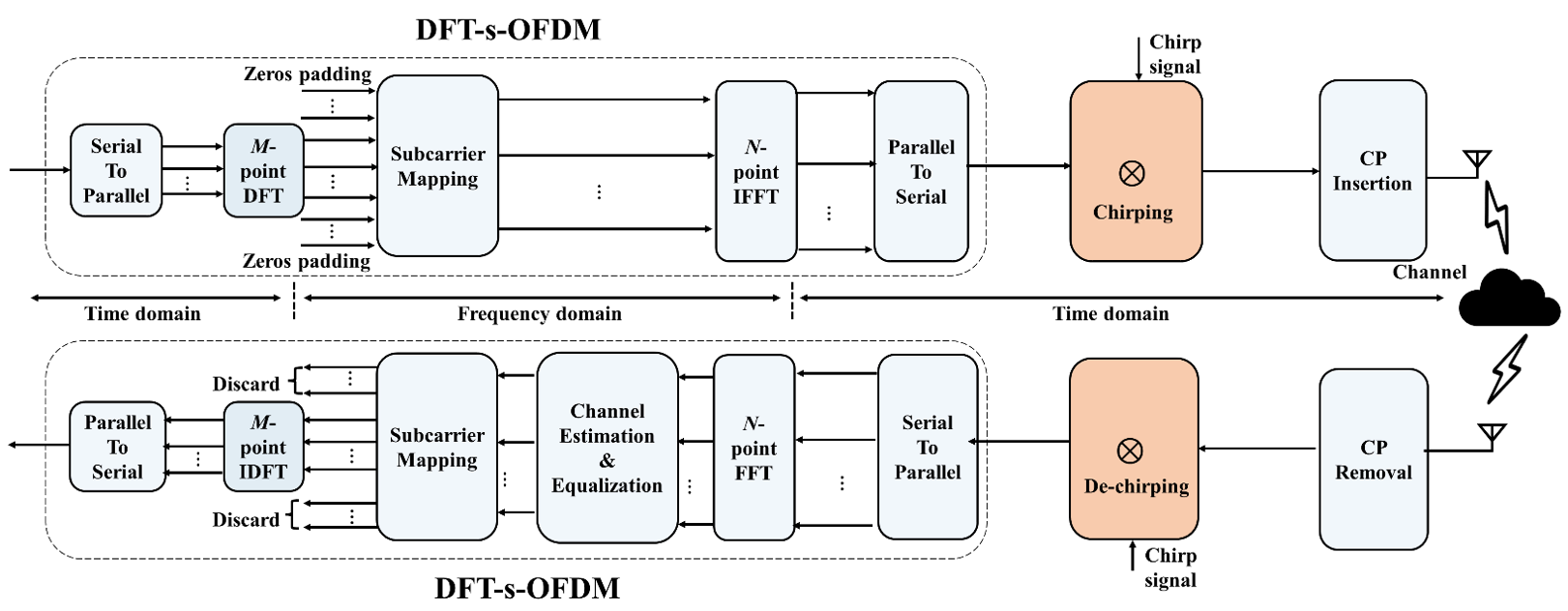
Figure 1: Block diagram of chirped DFT-s-OFDM
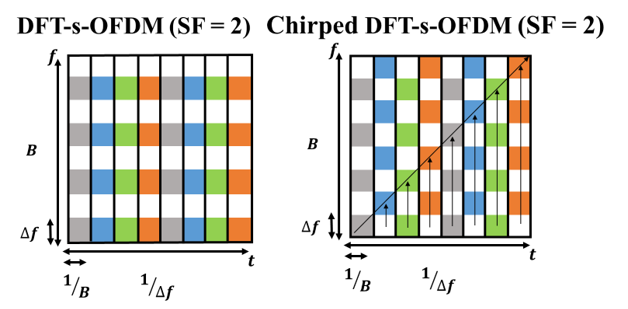
Figure 2: Time-frequency diagrams of DFT-s-OFDM and chirped DFT-s-OFDM.
Applications & Advantages
- The proposed modulation waveform is well suited for high-mobility communication scenarios, particularly for power-constrained or battery-limited devices.
- The proposed modulation waveform preserves a PAPR comparable to that of the underlying constellation symbols, resulting in significantly higher power efficiency than existing 6G waveform candidates.
- By enabling full-band transmission through chirping, the proposed modulation waveform exploits full frequency diversity and demonstrates greater resilience to Doppler shifts compared to DFT-s-OFDM.
.tmb-listing.jpg?sfvrsn=abbd2980_1)
.tmb-listing.jpg?sfvrsn=43b583b8_2)
.tmb-listing.jpg?sfvrsn=57e7d9a3_2)