
System and Method for Orthogonal Time Frequency Space Communication with Zero-Overhead Pilots and Turbo Reception
Synopsis
In high-mobility channels with complex propagation environments—such as those with multiple paths and high velocities—pilot overhead can increase significantly, reducing transmission efficiency. The proposed technology addresses this by superimposing pilots directly onto each data symbol, effectively eliminating pilot overhead. Additionally, it introduces a Turbo receiver to improve communication reliability. This approach is especially effective for high-mobility scenarios in dense urban environments.
Opportunity
The six generation (6G) wireless communication network is expected to commercialize at around 2030. It is anticipated to achieve higher throughput, higher data rate, enhanced reliability, and lower latency over the fifth generation (5G) communication network. Orthogonal time frequency space (OTFS) has been regarded as one of important technologies of 6G, thanks to its remarkable performance in high-mobility communications. Several OTFS channel estimation and signal detection algorithms have been developed in the literature. However, existing OTFS studies suffer from low spectral efficiency and limited communication reliability due to constraints imposed by the wireless channel. Specifically, their spectral efficiency decreases as the number of propagation paths and the velocity increase.
To overcome these limitations, the proposed approach superimposes pilots onto each data symbol, thereby reducing pilot overhead to zero. To further enhance communication reliability, the initial channel estimates obtained from the superimposed pilots are refined using a turbo receiver with iterative channel estimation, signal detection, and data decoding.
Technology
The proposed technology enhances performance at both the transmitter and receiver. On the transmitter side, the superimposed pilot power ratio and the basis expansion model (BEM) order are optimized to maximize the resulting signal-to-interference-and-noise ratio (SINR), which is closely related to the initial bit error rate (BER) when using superimposed pilots. Turbo BEM OTFS receiver with iterative BEM channel estimation, signal detection, and data decoding is then proposed. In the beginning, superimposed pilots with optimized power ratio are utilized to perform an initial (rough) BEM channel estimation using the optimized BEM order, while data is treated as interference. Subsequently, signal detection, demapping, deinterleaving, and channel decoding are performed to generate a posteriori and extrinsic log-likelihood ratios (LLRs) of the data bits. These LLRs, referred to as soft information, are then fed back to iteratively refine the BEM channel estimation, signal detection, and decoding. Through this iterative exchange of soft information, the proposed Turbo receiver enhances communication reliability. The block diagram of the Turbo receiver is shown in Fig. 1.
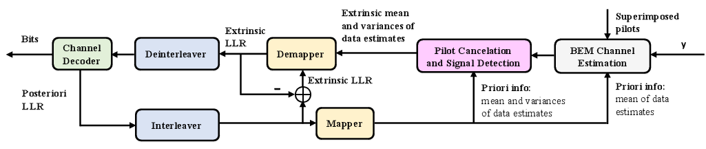
Figure 1: Block diagram of Turbo BEM OTFS receiver with soft information exchange between BEM channel estimation, signal detection, and data decoding.
Applications & Advantages
- The proposed technology is well suited for high-mobility communication scenarios, particularly in dense urban environments with complex propagation conditions.
- By exploiting superimposed pilots, the proposed technology eliminates pilot overhead, thereby significantly improving spectral efficiency.
- The proposed technology achieves higher reliability than state-of-the-art methods, providing a performance gain of around 2 dB.
- The proposed technology has been granted in Germany. https://web.ip7.tech/app/DetailView/AnonymousDetailView/DE102023111169

.tmb-listing.jpg?sfvrsn=abbd2980_1)
.tmb-listing.jpg?sfvrsn=43b583b8_2)
.tmb-listing.jpg?sfvrsn=57e7d9a3_2)