Floquet Engineering of Quantum Materials by Prof Shuyun Zhou
IAS Frontiers Seminars: Quantum Horizons, Seminar #1
The IAS Frontiers seminar series “Quantum Horizons” brings leading international quantum physicists and engineers to share insights on the frontiers of quantum phenomena, broadly defined. While the series focuses on the intersection of quantum materials and quantum devices, some seminars also explore the connections between quantum information and thermodynamics.
This series is especially timely for two reasons: (1) 2025 marks the United Nations International Year of Quantum Science and Technology, and (2) Rapid experimental and theoretical breakthroughs have accelerated progress in the fundamental understanding of quantum materials, information, and thermodynamics.
The first talk of the series, held on 8 September 2025, featured Prof Shuyun Zhou (Tsinghua University), who discussed how time-periodic light fields can be harnessed to engineer electronic states in quantum materials. With characteristic clarity, she guided the audience from the fundamentals of Floquet physics to recent breakthroughs involving black phosphorus and topological insulators, showcasing time- and angle-resolved photoemission spectroscopy (TrARPES) as a powerful probe of ultrafast electronic dynamics.
The seminar gave undergraduates, graduate students, and faculty members the rare opportunity to hear from one of the world’s leading experts on light–matter interactions, whose pioneering work has established Floquet engineering as a one of the key topics in quantum materials research.
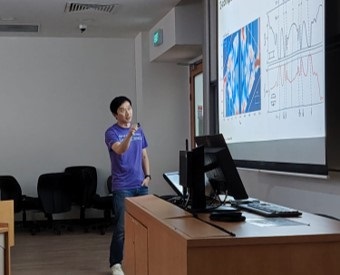
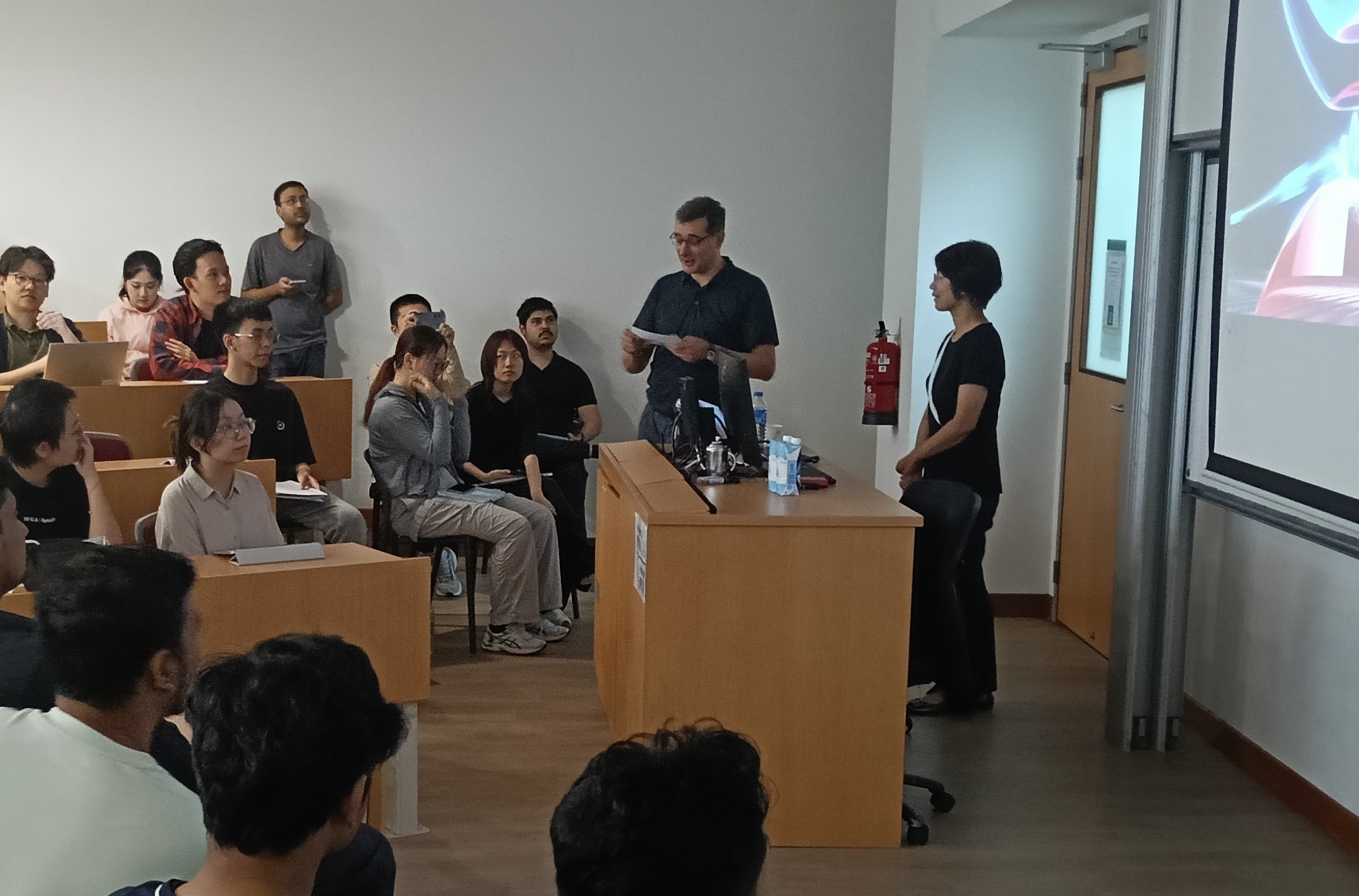 Prof Cesari Soci delivers a brief opening address to welcome Prof Zhou and the seminar audience.
Prof Zhou began by outlining the central idea: when a material is driven by a time-periodic light field, its electronic states hybridize with photons to form so-called Floquet states. This “photon dressing” provides a dynamic tuning knob, enabling transient modifications of band structures, gap openings, and even symmetry breaking — all on ultrafast timescales.
Using black phosphorus as base material, she demonstrated how resonant and below-gap optical pumping lead to distinct outcomes. Resonant pumping strongly enhances electronic transitions and modifies the bandgap, while below-gap pumping renormalizes the dispersion without direct excitation. Together, these experiments show how light can reversibly reshape the energy landscape of a semiconductor.
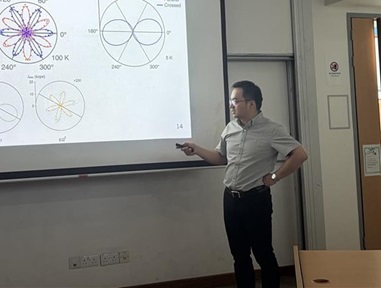
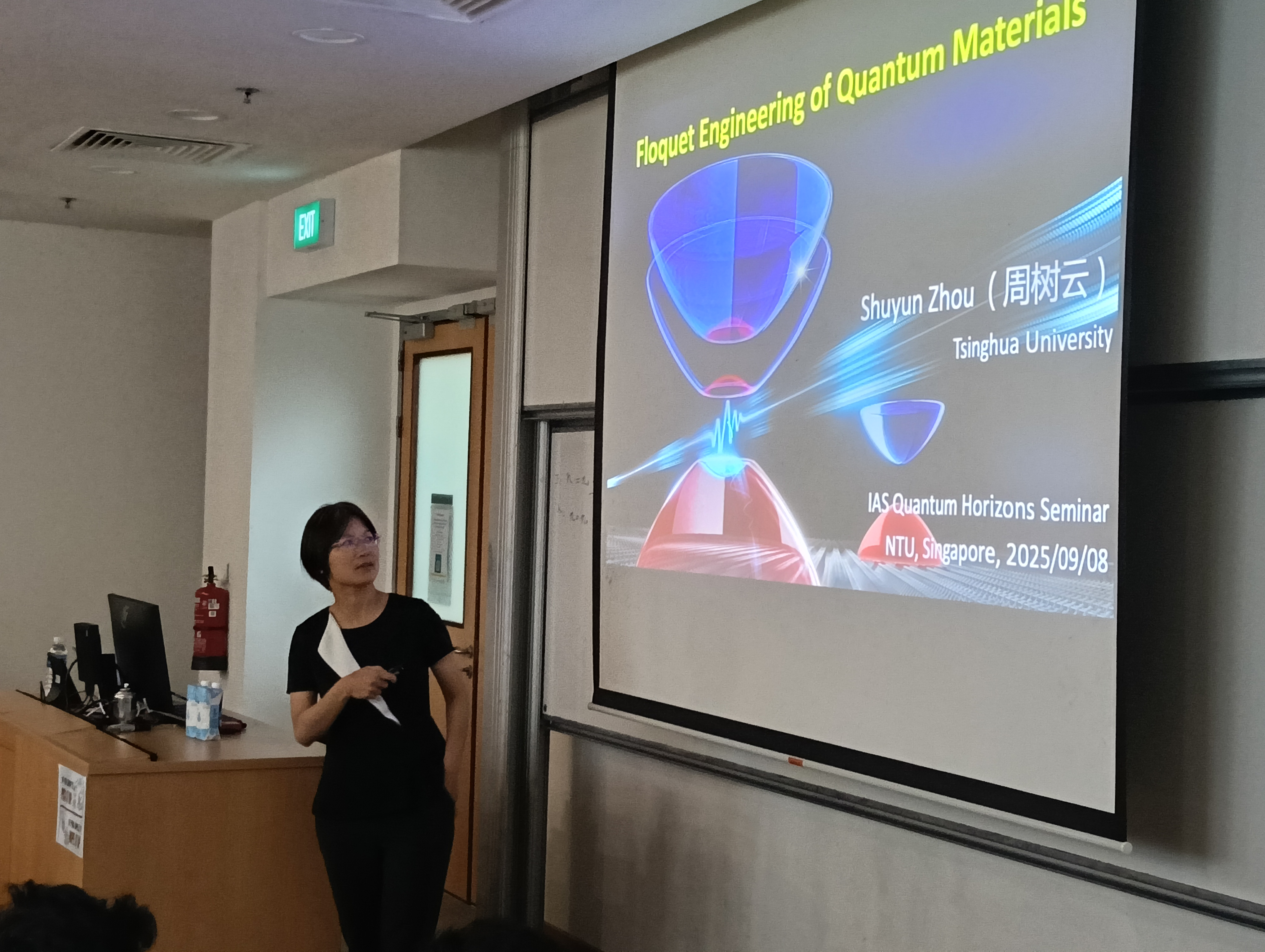 Prof Zhou outlines how light-driven Floquet states reshape band structures, symmetry, and topological phases.
Beyond energy shifts, TrARPES revealed striking wavefunction and symmetry engineering. In black phosphorus, light created “hot spots” in momentum space, where electronic states are strongly modulated in a k-dependent fashion. More remarkably, the glide-mirror symmetry protecting nodal-line features was broken by the optical drive, leading to the formation of a fully gapped nodal ring — a nonequilibrium topological phase not accessible under equilibrium conditions.
Prof Zhou then turned to a subtle but important distinction: Floquet states arise from photon-dressed bands, while Volkov states stem from photon-dressed photoelectrons. Using interference patterns observed in black phosphorus, her group successfully disentangled these two contributions, establishing clear evidence for Floquet-Volkov interference. This insight provides a deeper understanding of how light and matter jointly determine photoemission spectra.
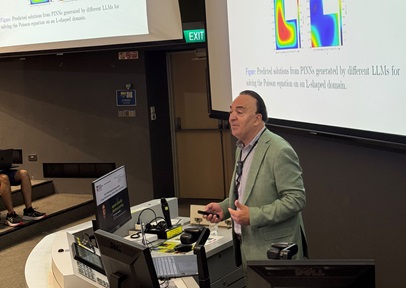
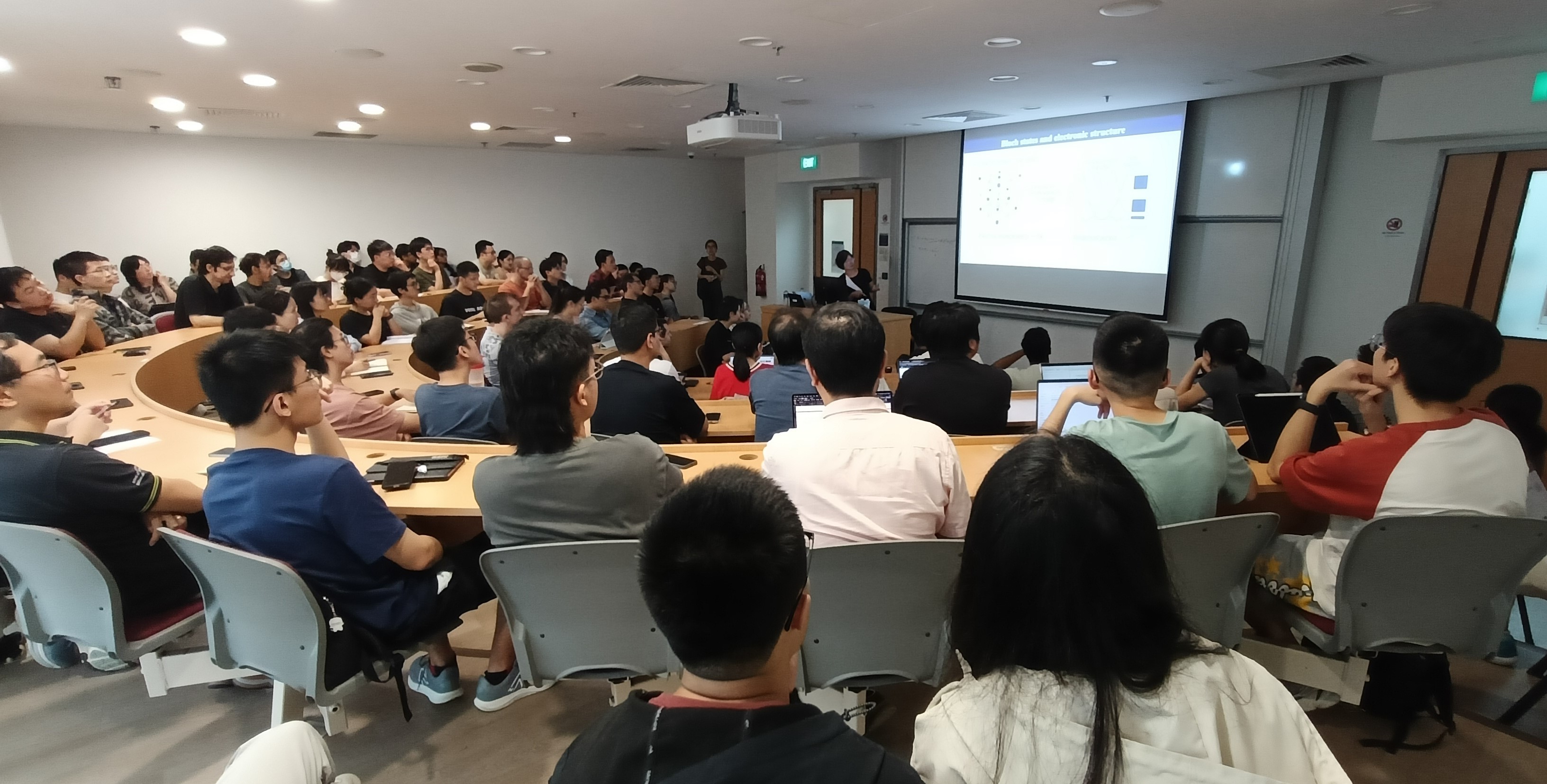 Prof Zhou captivates a packed seminar room, revealing light’s power to control topological surface states.
The seminar next explored Bi₂Te₃, a canonical topological insulator. Here, the pump light plays dual roles. At higher photon energies, photo-excitation dominates, driving electrons from the bulk valence band into unoccupied surface states. At lower photon energies, light-field dressing of the surface states themselves becomes the prevailing effect. This tunability illustrates the delicate balance between excitation and dressing, offering precise control over topological surface states.
Prof Zhou emphasised that these findings have broad significance for both fundamental physics and future technologies. By leveraging light as a control parameter, researchers can transiently create topological phases, induce symmetry breaking, and design ultrafast optoelectronic functionalities. TrARPES, with its ability to directly probe transient band structures, stands out as a vital tool for mapping this new frontier.
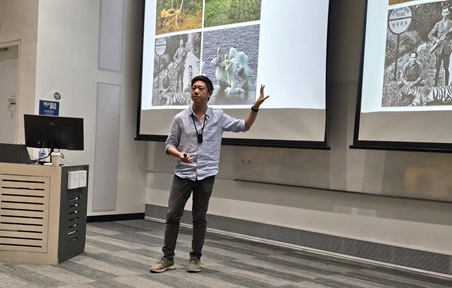
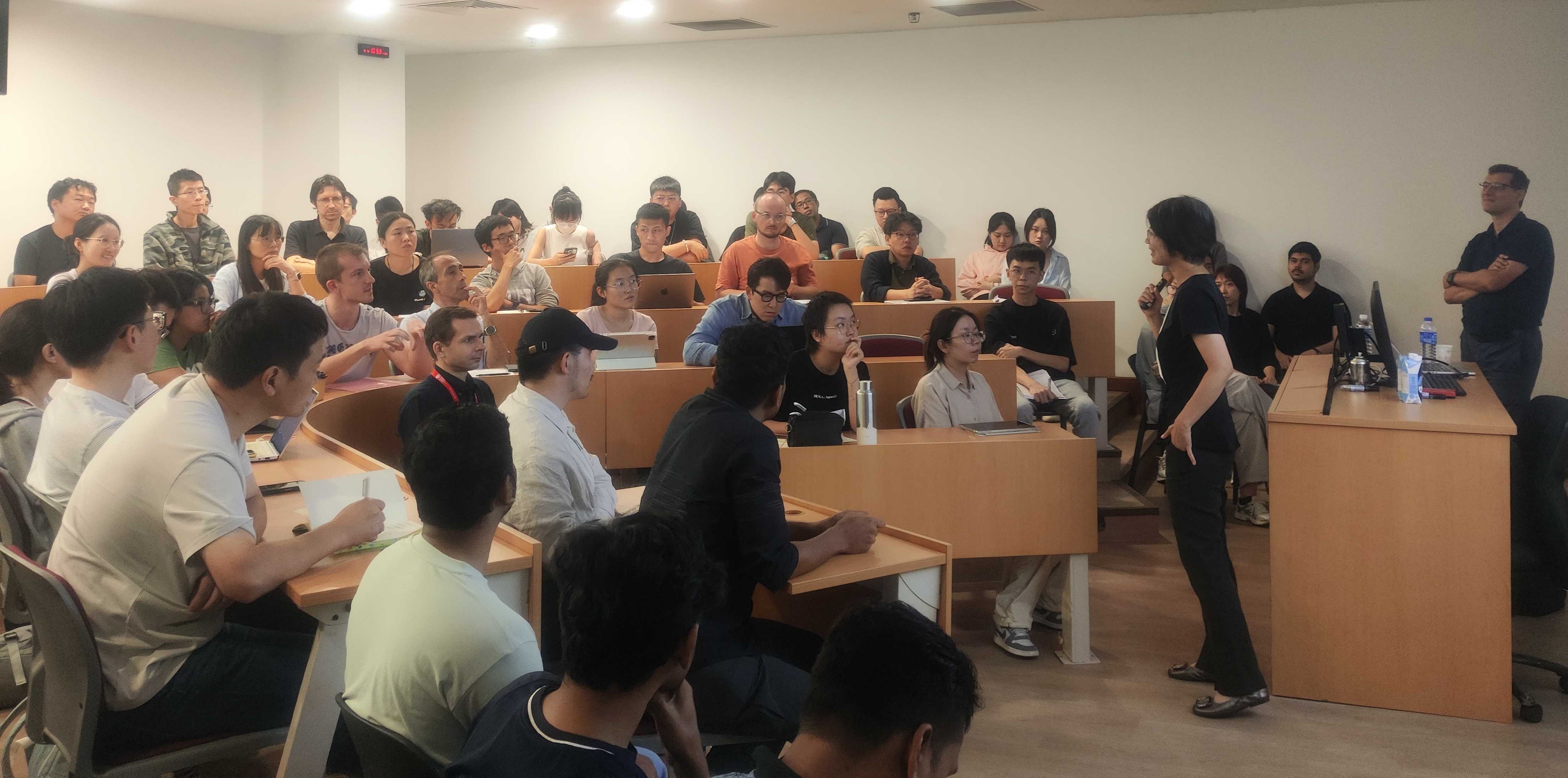 Prof Zhou concludes with engaging questions from the audience, highlighting Floquet states’ stability and future device applications.
The seminar concluded with lively questions from the audience, ranging from the stability of Floquet states to possible device applications. Prof Zhou’s presentation showcased how a combination of elegant experiments and conceptual clarity can open new horizons in condensed matter physics.
Her pioneering contributions have already been recognised by major international prizes, including the Huang Kun Physics Prize, the Sir Martin Wood Low Temperature Prize, and the L’Oréal-UNESCO Award for Women in Science (China). At NTU, her talk was not only a technical deep dive into Floquet engineering but also an inspiring reminder of how light can be used to rewrite the rules of quantum materials.
Written by Niu Yinning | NTU School of Physical and Mathematical Sciences
“It opens up new world of floquet engineering for me!” - John Tan (PhD Student, SPMS)
“Detailed explanation during the talk, easy to follow!” - Francisco (PhD Student, SPMS)
"I particularly enjoyed the section on light-induced emergent properties." - Liu Yuchen (PhD Student, IGP)
In the 2nd talk of the series held on 6 October 2025, Prof Paul Skrzypczyk (University of Bristol), showcases how breakthroughs in light manipulation and quantum measurement are driving advances in quantum materials and computing. Read more about Prof Paul Skrzypczyk’s talk, “Improving and Speeding Up Quantum Measurements.”