From Crystal to Coherence: Unpacking Phase Transformations in Metal Halide Perovskites by Prof Juan-Pablo Correa-Baena
IAS@NTU STEM Graduate Colloquium Jointly Organised with the Graduate Students' Clubs
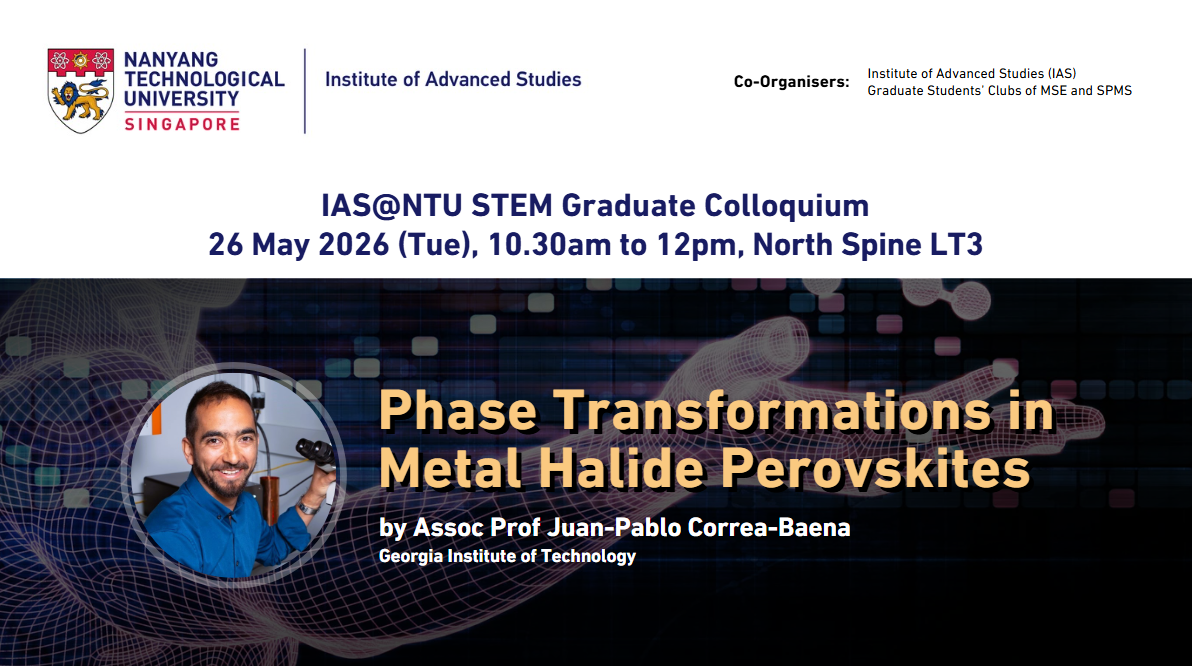
On 26 May 2026, the IAS@NTU STEM Graduate Colloquium Series welcomed Associate Professor Juan-Pablo Correa-Baena, from the School of Materials Science and Engineering at the Georgia Institute of Technology, for an illuminating colloquium titled "Phase Transformations in Metal Halide Perovskites." Held at North Spine Lecture Theatre 3, the session brought together graduate students, faculty, and researchers from across NTU, united by a shared curiosity about one of the most exciting material families in modern energy and photonics research.
The colloquium offered a sweeping journey through the world of metal halide perovskites from their fundamental crystal chemistry all the way to frontier topics in quantum light-matter interaction with Prof Correa-Baena striking a rare balance between accessibility and depth that kept the audience engaged throughout.
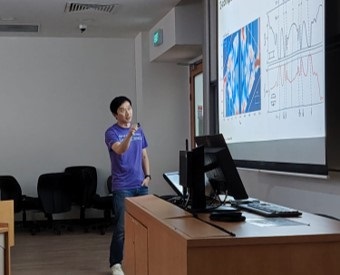
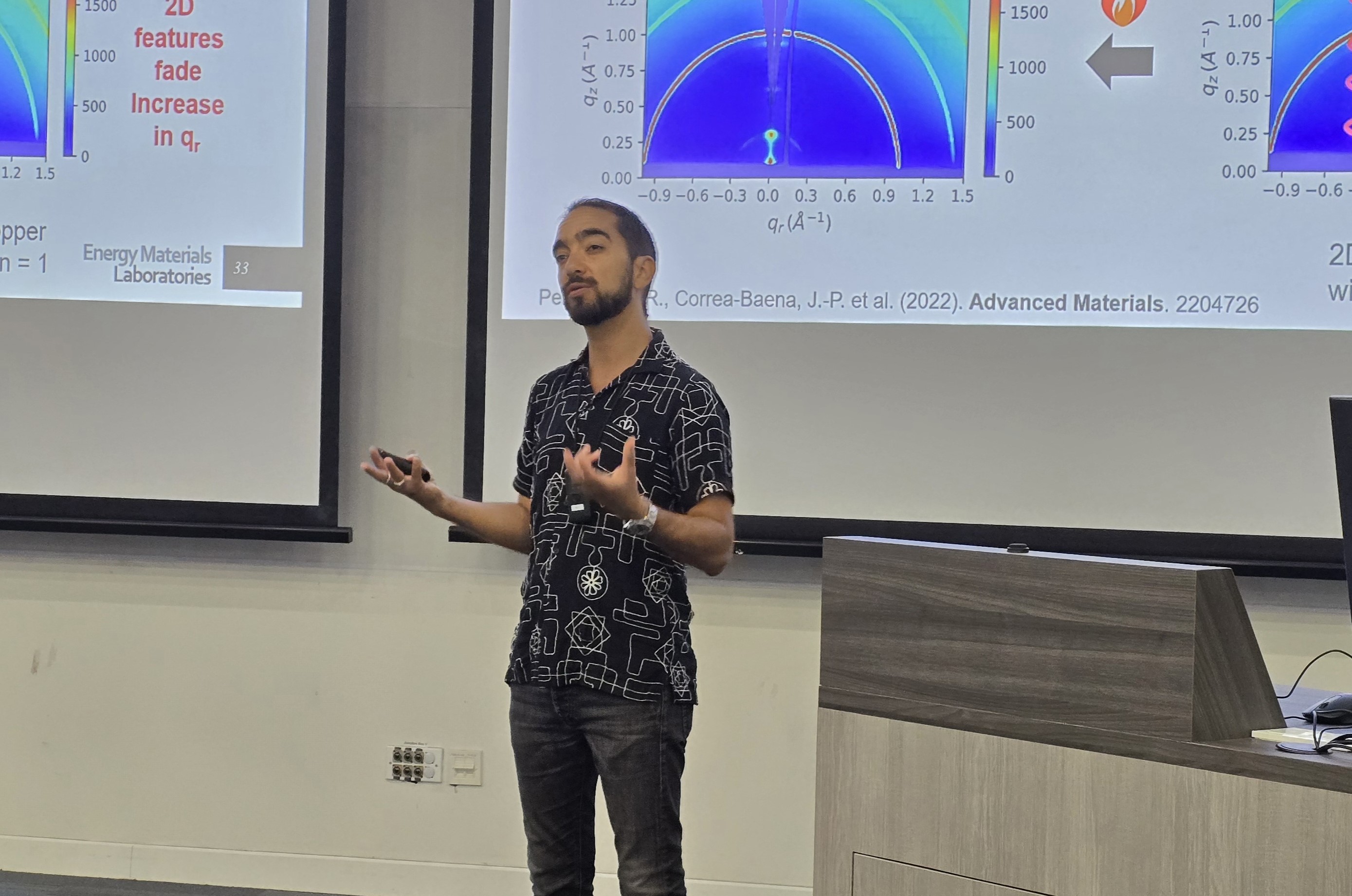 Prof Correa-Baena delivered an engaging overview of metal halide perovskites and quantum light-matter interactions.
Building the Foundation
Prof Correa-Baena opened with the basics, introducing the ABX₃ crystal structure of halide perovskites, where the A-site can be occupied by organic or inorganic cations such as methylammonium (MA⁺), formamidinium (FA⁺), or cesium (Cs⁺), the B-site by metals like Pb²⁺ or Sn²⁺, and the X-site by halides such as I⁻, Br⁻, or Cl⁻. What makes this family particularly compelling, he explained, is its extraordinary chemical tunability, by simply swapping these constituents, one can shift the photoluminescence emission across the entire visible spectrum, from deep blue to near-infrared. This design flexibility makes perovskites uniquely versatile for applications ranging from solar cells to light-emitting devices and photodetectors.
He also drew a clear distinction between 3D bulk perovskites and their lower-dimensional counterparts, 2D, 1D, and 0D variants, showing how reducing the structural dimensionality confines excitons and dramatically alters both optical and electronic properties.
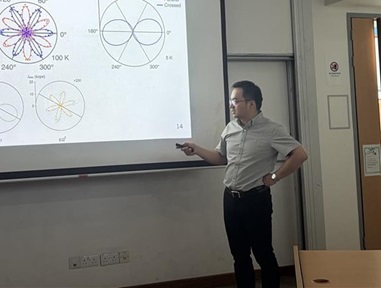
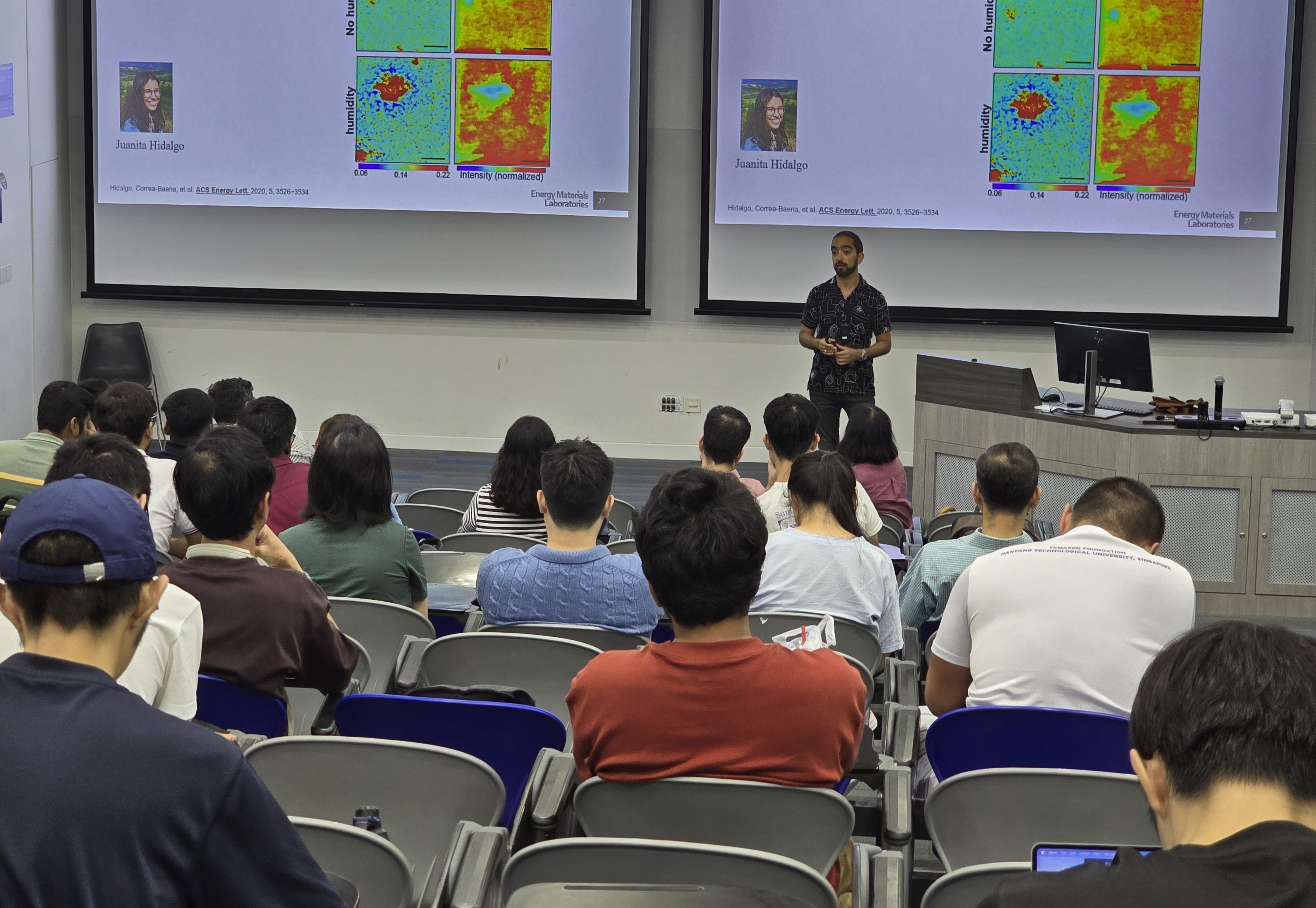 Prof Correa-Baena highlighted the adaptability of perovskite materials for future technologies.
Defects, Device and Degradation
With the structural foundation laid, Prof Correa-Baena pivoted to one of the central challenges in the field: defects. He walked the audience through a taxonomy of point defects, vacancies, interstitials, Frenkel and Schottky defects, before connecting them to real device performance losses. A key insight was that perovskites tend to form shallow defects rather than deep trap states, which partly explains their remarkably long charge-carrier lifetimes, photoluminescence decay data showed that perovskites outlast conventional CdTe by orders of magnitude on the microsecond timescale.
He then presented the full device architecture of a perovskite solar cell, emphasising the critical role of thin 2D interlayers and the use of large organic molecules such as phenethylammonium iodide (PEAI) at interfaces to suppress non-radiative losses and boost open-circuit voltage.
The degradation section was particularly vivid. Using time-resolved GIWAXS data, Prof Correa-Baena showed how FAPbI₃ perovskites respond very differently under dry air, humid nitrogen, and humid air. The simultaneous presence of water and oxygen proved to be the most aggressive combination, driving irreversible phase transformation. Capping the surface with a PEAI layer was shown to dramatically suppress this degradation, a practical and elegant solution to a long-standing stability challenge.
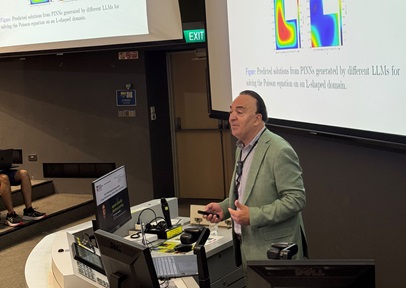
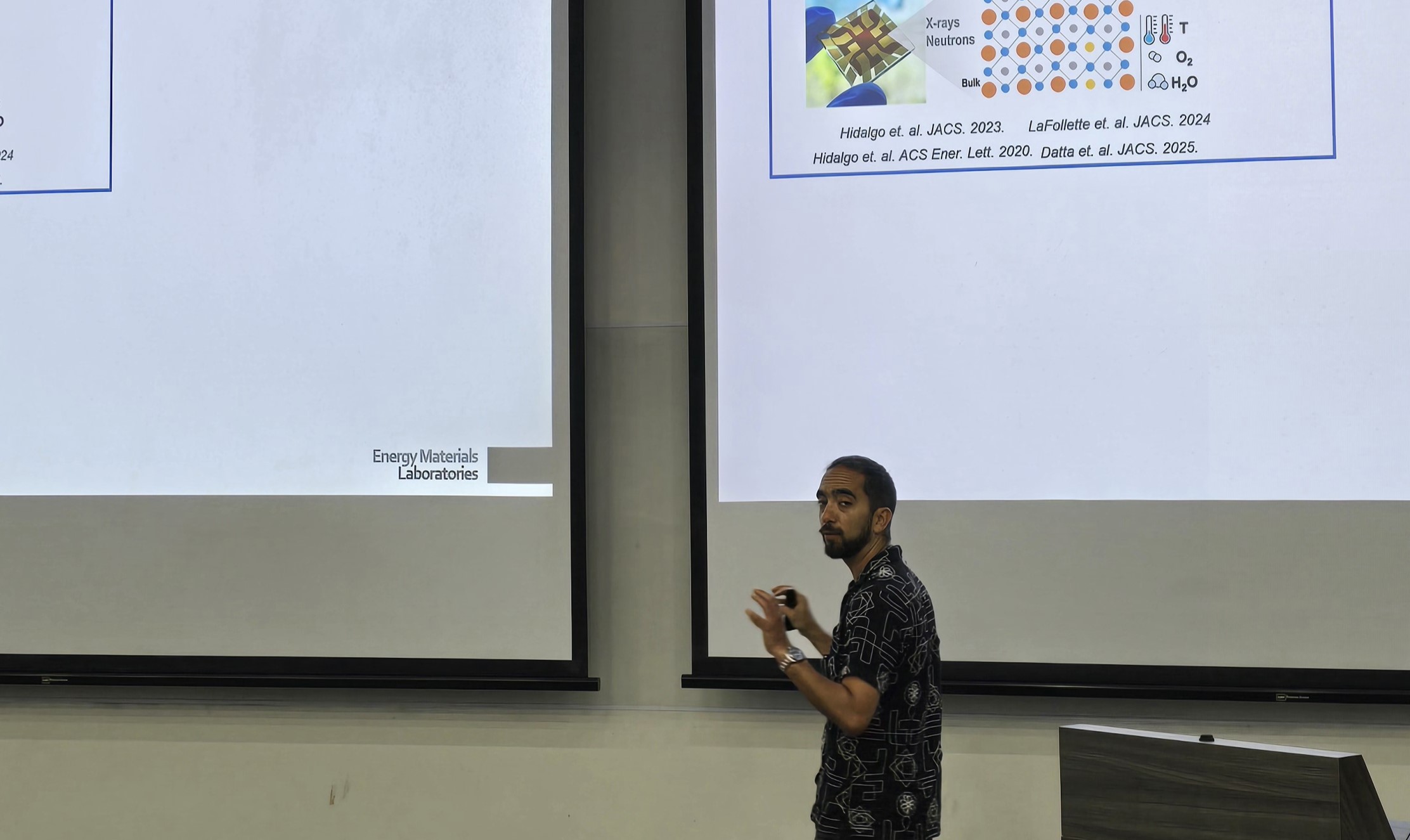 Attendees gained insights into advances that strengthened solar cell performance and stability.
Polaritons, Phonons and Frontier Physics
The final segment ventured into more advanced territory, exploring 2D Ruddlesden-Popper perovskites as a platform for exciton-polariton physics. By embedding (PEA)₂PbI₄ into an optical microcavity under strong-coupling conditions, his group demonstrated the formation of hybrid light-matter quasiparticles known as polaritons. The organic spacer cation, he showed, directly controls exciton-phonon coupling, tuning the spectral lineshape and the coherence of emitted radiation.
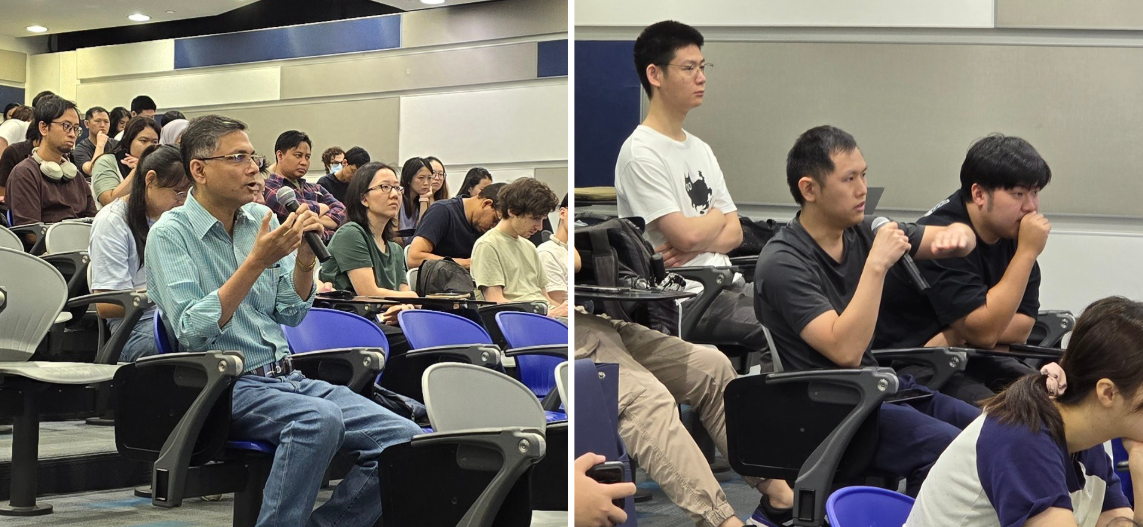 Attendees engaged in a lively Q&A, discussing key findings, future applications, and research opportunities.
Engaging Discussions and Conclusion
Particularly striking was time-resolved scattering data revealing an oscillatory sign reversal in the diffraction signal modulation, a fingerprint of coherent polariton dynamics unfolding on picosecond timescales. The Q&A that followed was spirited and wide-ranging, with questions on polariton scattering mechanisms, coherent emission, and the prospects for room-temperature polariton condensation. The session culminated in a rich, extended discussion between Prof Correa-Baena and NTU faculty Prof Annalisa Bruno and Prof Nripan Mathews, a fitting end to a colloquium that bridged the worlds of energy materials and quantum photonics.
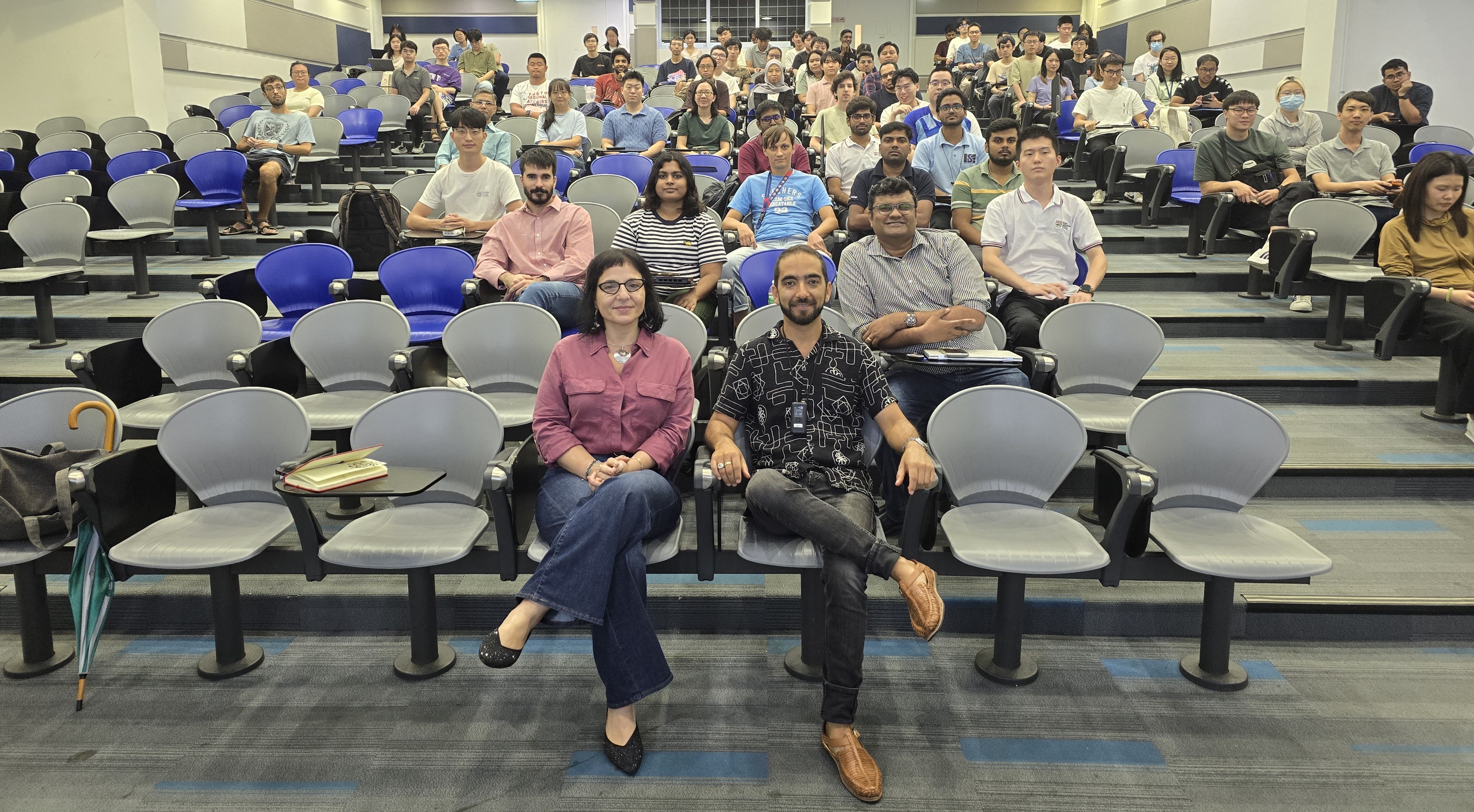
Written by: Rohit Duvvuri | NTU School of Materials Science and Engineering Graduate Student’ Club
“The colloquium was a masterclass in connecting the chemistry of a material all the way to its quantum optical behavior - Prof Correa-Baena made every step of that journey feel intuitive and exciting." - Chinmay Thool (PhD student, MSE)
"The presentation was well-structured, engaging, and easy to follow. I particularly enjoyed how the speaker explained complex concepts clearly with real-world examples and illustrations. The content was insightful, and it gave me many new perspectives and inspirations related to my research area. The Q&A session was also very interactive and thought-provoking." - Li Yanan (PhD student, MSE)
"It was interesting to see the new characterisation technique that the Prof Correa-Baena's group was developing" - Daniel Lock (PhD student, MSE)
"I enjoyed the presentation, particularly the 2D changes measured with X-Ray Fluorescence was really interesting." - Agarwal Nikunj (PhD student, SPMS)
Watch the recording here.