Deterministic Domain Switching and Magnetically Switchable Quantum Geometric Photocurrents in a Van der Waals Antiferromagnet by Prof Liang Wu
IAS Frontiers Seminars: Quantum Horizons, Seminar #1 (AY26/27)
The seminar, held on 11 August 2026, featured Prof Liang Wu (University of Pennsylvania), who presented how nonlinear optical techniques can be used to detect antiferromagnetic order in the 2D material MnPSe₃. Specifically, he explained how antiferromagnetic domains can be imaged down to the monolayer limit, how the Néel vector can be controlled, and how the magnetic order influences photocurrents associated with quantum geometry.
Prof Wu began by introducing the motivation for studying antiferromagnetic spintronics. While the characteristic spin dynamics of conventional ferromagnetic materials typically lie in the gigahertz regime, antiferromagnets can support spin dynamics in the terahertz regime. Antiferromagnets also produce no stray magnetic field and are robust against external magnetic field perturbations. However, detecting and switching antiferromagnetic domains remains challenging. Prof Wu then introduced MnPSe₃, a layered antiferromagnet in which neighbouring manganese spins point in opposite directions. The magnetic order is described by the Néel vector, defined by the difference between the spins on the two magnetic sublattices. Reversing the spins produces two antiferromagnetic domains with opposite Néel vectors.
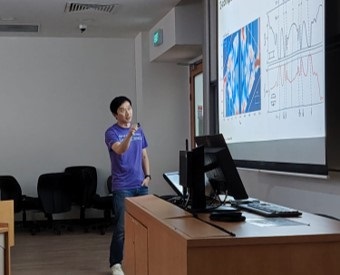
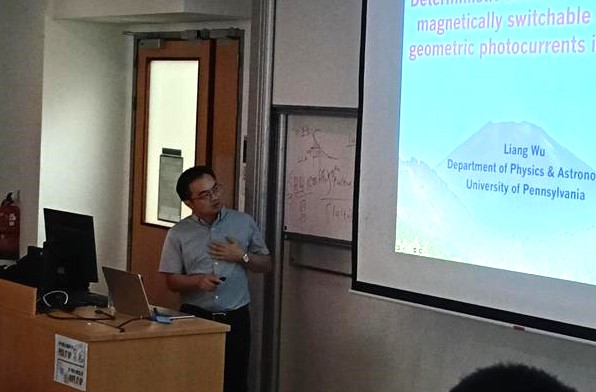 Prof Liang Wu discussed nonlinear optical techniques for probing antiferromagnetic order in 2D materials.
To detect these domains, his group uses second harmonic generation (SHG), a nonlinear optical process in which light at a given frequency generates a response at twice that frequency. By analysing the SHG signal, the direction of the Néel vector can be identified and 180-degree antiferromagnetic domains can be distinguished. Using this technique, Prof Wu’s group detected long-range antiferromagnetic order down to monolayer MnPSe₃.
Prof Wu then explained how the magnetic order can be controlled using strain. The three-fold crystalline anisotropy gives rise to a six-state clock model, corresponding to six possible directions of the Néel vector. However, experiments commonly revealed only two domains. He showed that uniaxial strain selects two opposite orientations from the six possible states, producing an effective Ising order. Changing the direction of the applied strain also changes the direction of the Néel vector.
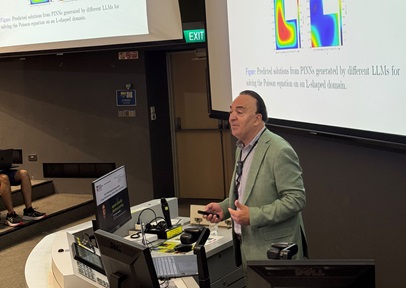
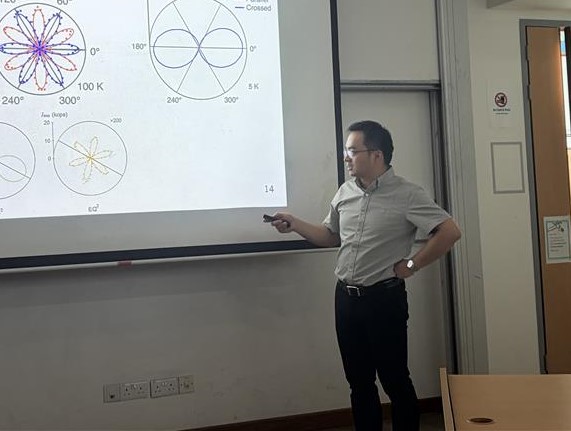 Prof Wu explained how Second harmonic generation (SHG) can enable the detection of antiferromagnetic domains down to monolayer MnPSe₃.
The seminar then explored how an external magnetic field can further control the antiferromagnetic state. An in-plane magnetic field can continuously rotate the Néel vector. More strikingly, reversing the magnetic field allows deterministic switching between two 180-degree antiferromagnetic domains. Prof. Wu explained that this switching is possible because a surface magnetic moment allows the magnetic field to select between the two opposite domains.
Prof Wu subsequently introduced terahertz emission spectroscopy to investigate photocurrents in MnPSe₃. When a femtosecond laser pulse excites the material, the resulting photocurrent generates terahertz radiation. The emitted terahertz field is proportional to the time derivative of the photocurrent, providing information about its behaviour. He then discussed the connection between these photocurrents and quantum geometry. The geometry of quantum states can be described by the quantum metric and Berry curvature. In the antiferromagnetic state of MnPSe₃, inversion symmetry (P) and time-reversal symmetry (T) are individually broken, but their combined PT symmetry is preserved.
Prof Wu presented two types of photocurrents in this PT-invariant antiferromagnet: a linear injection current and a circular shift current. The linear injection current is related to the two-state quantum metric, while the circular shift current is associated with geometric torsion. The injection current arises from the different velocities of photoexcited carriers, whereas the shift current is related to the displacement of the electron cloud. Most importantly, Prof Wu showed that the linear injection current reverses direction when the Néel vector is flipped by 180-degrees. Since the Néel vector can be controlled using strain and magnetic field, the photocurrent can also be controlled through the antiferromagnetic state of the material.
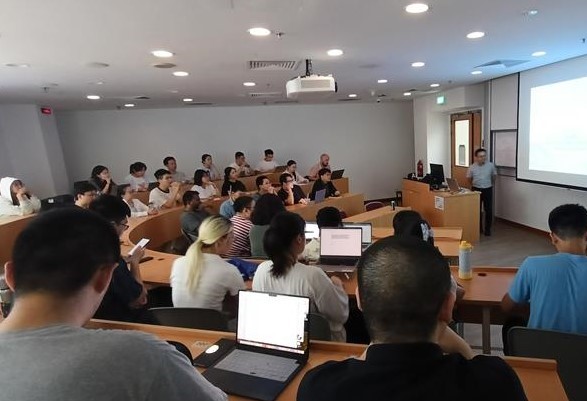 The seminar concluded with an engaging Q&A on antiferromagnetism, nonlinear optics and quantum geometry.
After his presentation, Prof Wu received questions from the attendees, ranging from magnetic-domain control to the interpretation of photocurrent measurements and relaxation times. Prof. Wu’s presentation demonstrated how nonlinear optics can be used to detect antiferromagnetic order and investigate the quantum geometry of electronic states, while strain and magnetic fields provide ways to control magnetic domains. His work highlights the connection between antiferromagnetism, nonlinear optical responses and quantum geometry in MnPSe₃.
This seminar is part of the IAS Frontiers Seminars: Quantum Horizons series. Find out more about the AY26/27 seminars here.
Written by Tan Fei| NTU School of Physical and Mathematical Sciences
"I enjoyed the discussion of the use of SHG to confirm inversion symmetry" - Om Sardar (PhD Student, SPMS)
"It was interesting to explore the idea of using the magnetic field to control the domain wall and Néel vector " - Wang Shicong (PhD, SPMS)
"The overall talk was easy to follow along because Prof Liang Wu spent time to introduce the concepts" - John Tan (PhD student, SPMS)