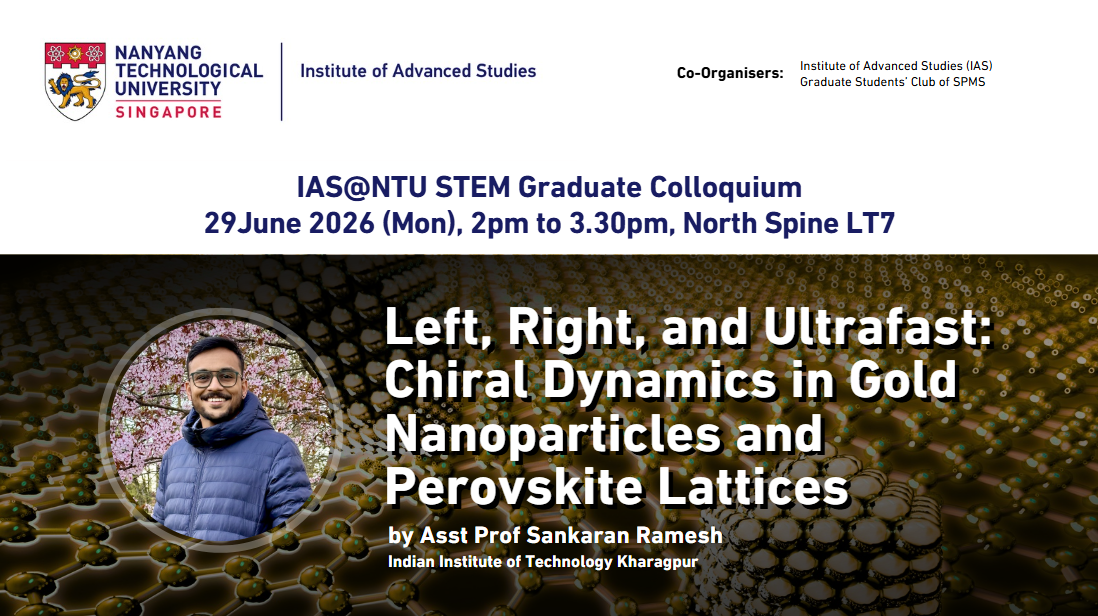
Left, Right and Ultrafast: Chiral Dynamics in Gold Nanoparticles and Perovskite Lattices by Asst Prof Sankaran Ramesh
IAS@NTU STEM Graduate Colloquium Jointly Organised with the Graduate Students' Clubs
On 29 June 2026, the IAS@NTU STEM Graduate Colloquium Series hosted Asst Prof Sankaran Ramesh from the Indian Institute of Technology Kharagpur for a colloquium titled “Left, Right, and Ultrafast: Chiral Dynamics in Gold Nanoparticles and Perovskite Lattices” during which Prof Sankaran took the audience on a journey through the fascinating world of chirality, revealing how the "handedness" of materials and light can be used to manipulate energy at the nanoscale and on ultrafast timescales.
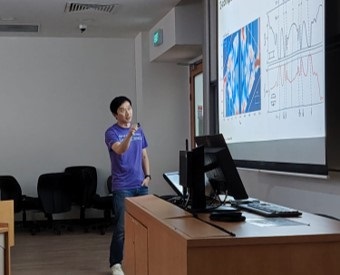
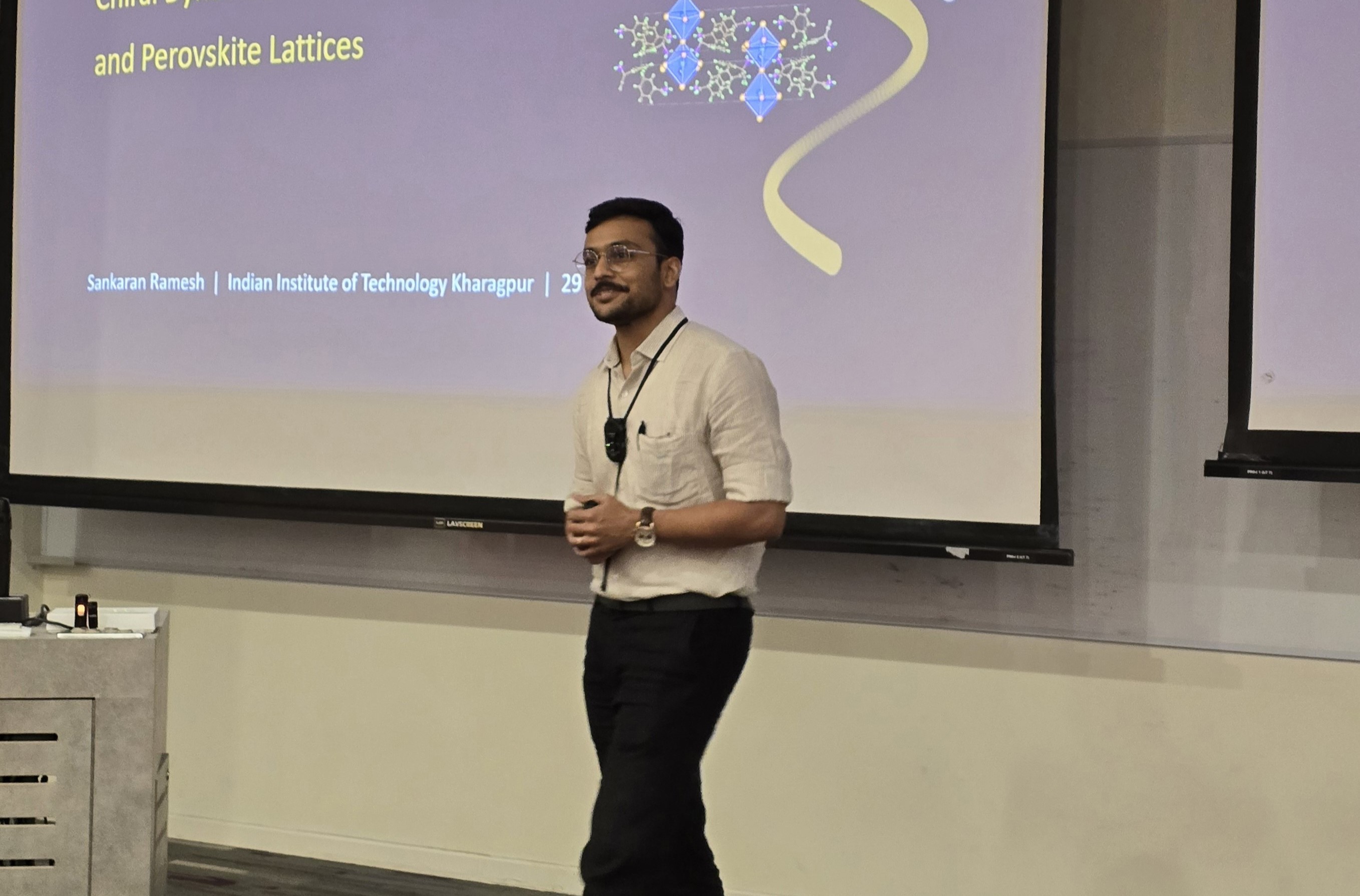 Asst Prof Sankaran Ramesh explored nanoscale chiral dynamics during his engaging colloquium on ultrafast materials.
Chirality refers to the property of an object that cannot be superimposed onto its mirror image, much like our left and right hands. Although two chiral structures may have identical chemical compositions, their different spatial arrangements can give rise to remarkably different physical, chemical, and biological properties. Interestingly, chirality is not limited to matter alone. Light itself can also possess handedness through left- and right-circularly polarised states that interact differently with chiral materials. This difference in absorption is measured through circular dichroism (CD) and serves as one of the most powerful fingerprints of optical chirality.
Prof Sankaran explained this interaction using an intuitive picture of light absorption. In an ordinary material, the electric field of light drives charges to oscillate back and forth, producing an electric dipole response. Chiral materials, however, exhibit coupled electric- and magnetic-dipole responses, allowing left- and right-circularly polarised light to interact differently with the material. The rotating electromagnetic fields of LCP and RCP light therefore couple differently to these electric and magnetic dipoles, giving rise to circular dichroism. In essence, optical chirality emerges from the interplay between electric and magnetic dipole responses.
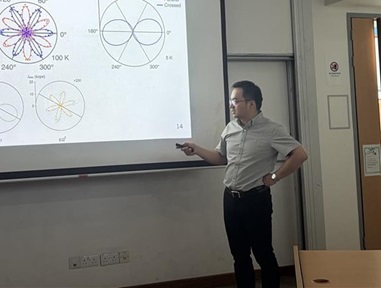
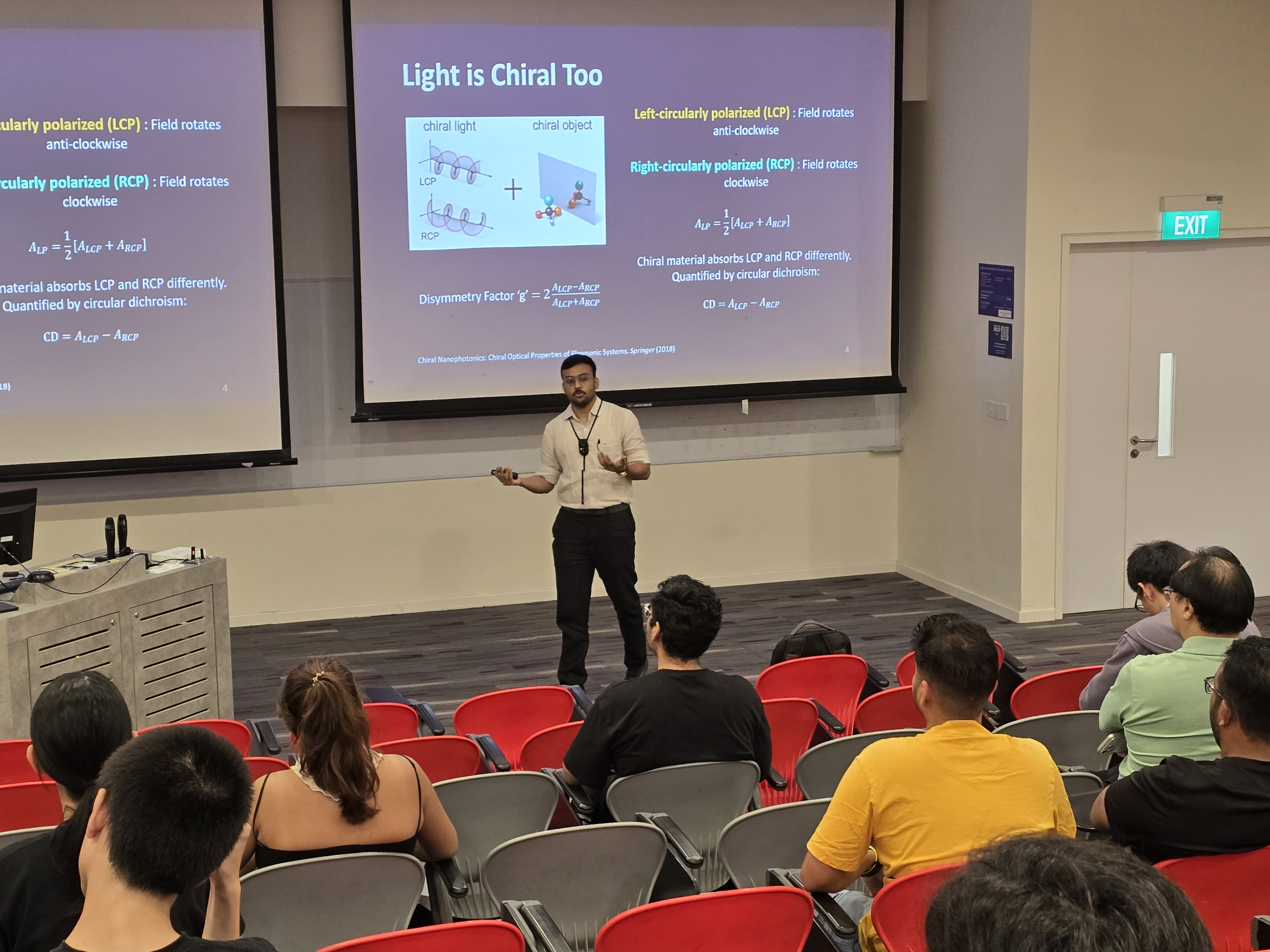 Prof Sankaran explained how the interplay of electric and magnetic dipoles generates optical chirality.
Understanding these interactions has implications that extend well beyond fundamental optics. Chiral spectroscopy plays an important role in pharmaceutical and biomedical research by enabling highly sensitive detection of molecular handedness. More broadly, controlling chirality offers new opportunities in polarisation-based quantum information processing, spin-selective photonic devices, and asymmetric optical circuits where light propagation depends on its
polarisation state.
Chiral Gold Helicoids: Following Energy Flow
The first half of the colloquium focused on chiral plasmonic nanostructures, specifically helicoidal gold nanoparticles coupled to molecular J-aggregates.
When light interacts with metallic nanoparticles, the conduction electrons oscillate collectively, producing localised surface plasmons. These resonances strongly confine electromagnetic fields near the nanoparticle surface, making plasmonic materials highly attractive for manipulating light at dimensions far below its wavelength. Unlike conventional spherical nanoparticles, however, the helicoidal gold structures studied by Prof Sankaran's group possess an intrinsic sense of rotation that breaks mirror symmetry. Their geometry therefore gives plasmons a distinct handedness, allowing the nanoparticles to interact differently with left- and right-circularly polarised light.
To investigate how optical energy moves around these chiral nanostructures, the researchers fabricated hybrid heterostructures by coating the gold helicoids with TDBC J-aggregates through electrostatic self-assembly. J-aggregates consist of dye molecules arranged head-to-tail, allowing them to absorb and emit light collectively through delocalised excitons with exceptionally sharp optical resonances. Surprisingly, absorption and circular dichroism spectroscopy revealed spectral splitting, while the narrow excitonic signature expected from the isolated dye aggregates was not observed as a distinct peak. The experimental observations appeared inconsistent with the conventional picture of strong plasmon-exciton coupling.
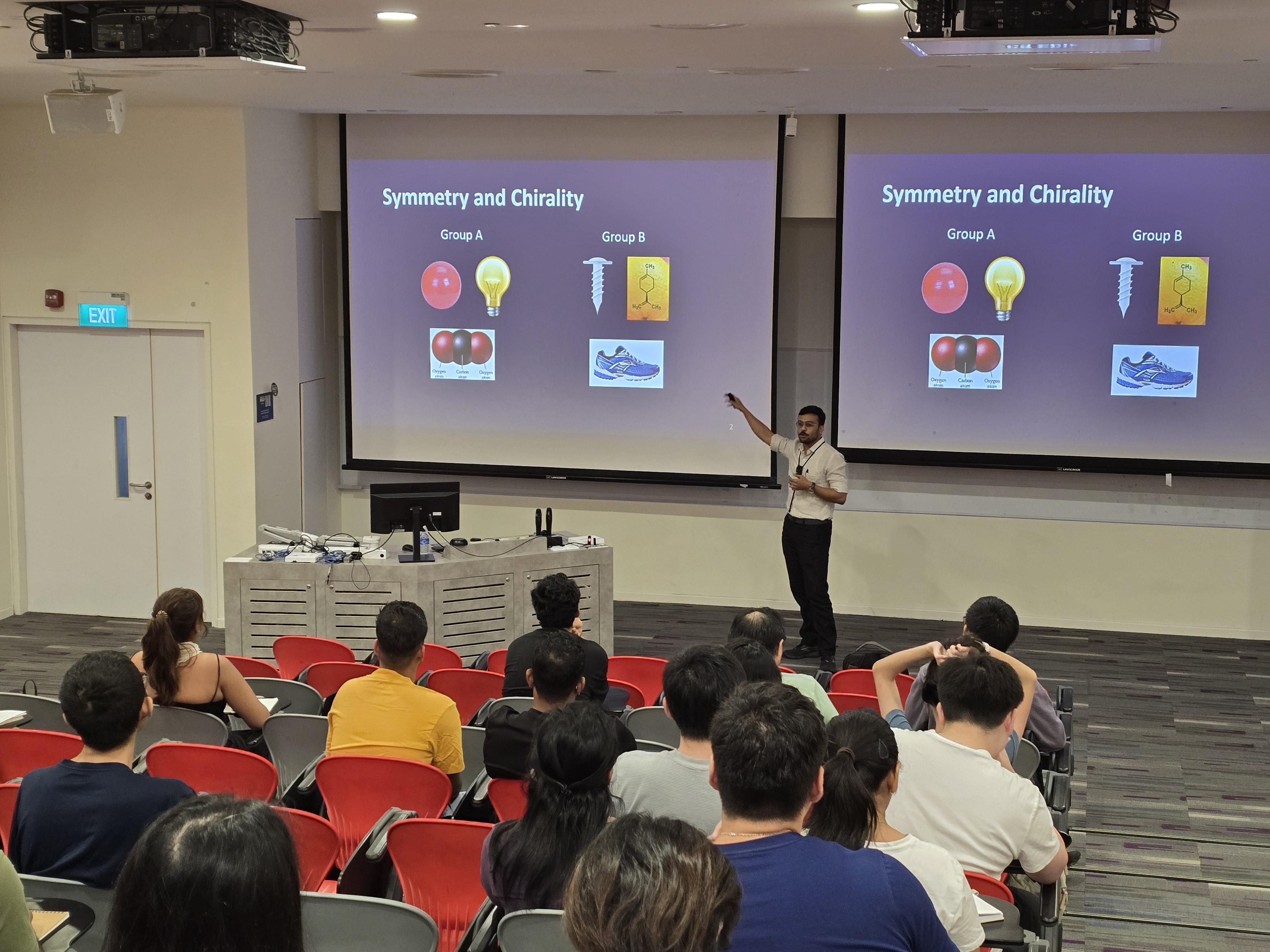 Intriguing experimental results emerged from coating helicoidal gold nanoparticles with J-aggregates to study light interactions.
The explanation emerged from a three-by-three non-Hermitian model, which showed that this system lies in an intermediate coupling regime dominated by interference rather than strong coupling. Changing the helicity of the incident light modifies the interference between electric- and magnetic-dipole responses, producing a Fano-like spectral feature whose depth can be tuned simply by switching the polarisation.
Electron energy-loss spectroscopy (EELS) further revealed spectral splitting similar to the optical measurements, establishing a clear connection between near- and far-field responses. Spatial mapping further showed that the lower-energy mode is localised within the chiral gaps, whereas the upper-energy mode resides near the outer edges, demonstrating that light polarisation selects spatially distinct hybrid states. Femtosecond transient absorption measurements further showed that the gap-localised response relaxes more rapidly when molecular aggregates are present. Rather than strong coupling, the results point to an intermediate regime where additional relaxation through dark excitonic states creates a fast energy-dissipation pathway concentrated within the chiral gaps. Prof Sankaran concluded this part of the talk by highlighting that the handedness of light controls how plasmonic and excitonic modes interfere, determining where energy is localised and how rapidly it dissipates in the chiral gold nanostructures.
Chiral Perovskites: Handedness Across Interfaces
The second part of the talk shifted from metallic nanostructures to two-dimensional hybrid perovskites, a class of materials consisting of alternating inorganic lead-iodide layers separated by organic spacer molecules. While the inorganic sheets host strongly absorbing excitons, the organic spacers themselves can be synthesised in either left- or right-handed forms.
This naturally raises an intriguing question: Can the chirality of a relatively small organic molecule influence the optical properties of the much larger inorganic lattice?
Steady-state optical measurements provided the first clue. The isolated chiral organic molecules exhibit circular dichroism in the ultraviolet region, while racemic mixtures show no chiral optical response, as expected. Surprisingly, once incorporated into the layered perovskite, a strong circular dichroism signal appeared near the excitonic resonance of the inorganic lead-iodide layers. In other words, an achiral inorganic lattice had acquired a measurable chiral optical response.
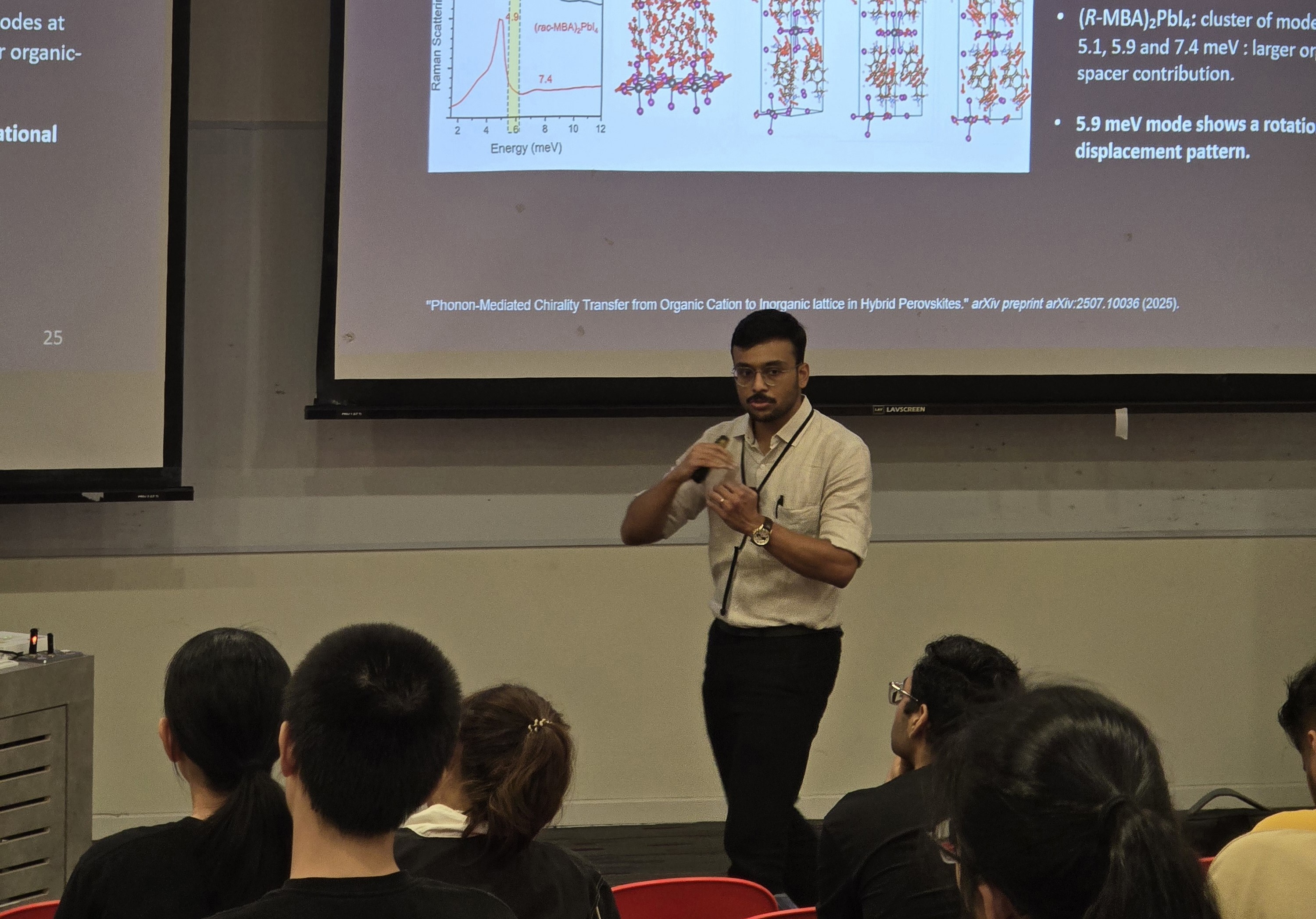 Asst Prof Sankaran questioned whether tiny organic molecules could successfully transfer their chirality to much larger inorganic lattices.
To uncover how this transfer of chirality occurs, Prof Sankaran's group once again turned to ultrafast pump-probe spectroscopy. By monitoring the temporal evolution of excitonic absorption, they compared the lattice dynamics of chiral and racemic perovskite films. Although both systems exhibited similar excitonic fine structures, only the chiral material displayed an additional vibrational mode at 5.7 meV. This observation suggested that chirality activates a specific phonon mode that is absent in the non-chiral material.
Density functional theory identified this mode as a coupled rotational vibration in which the organic spacer and Pb-I framework move together. This "rotational handshake" provides a microscopic pathway through which chirality is transferred from the organic layer to the inorganic excitons. Rather than directly modifying the electronic structure, the chiral organic molecules communicate their handedness to the inorganic excitons through this specific lattice vibration, demonstrating that phonons can actively mediate the transfer of chirality between structurally distinct parts of the hybrid material.
Chirality as a New Control Knob
Although the two material systems are very different, both demonstrate that chirality can actively control how optical excitations are generated, transferred, and dissipated. Looking ahead, Prof Sankaran highlighted chirality as a powerful new degree of freedom for designing functional materials. By understanding how chirality is generated, transferred, and manipulated, researchers may eventually learn to control it deliberately, enabling new generations of chiral light sources, spin-selective optoelectronic devices, and ultrasensitive optical sensors.
His work illustrates how combining advanced nanofabrication, ultrafast spectroscopy, and theoretical modelling can uncover the microscopic mechanisms that govern chiral light-matter interactions, bringing us closer to harnessing chirality as an active tool in future quantum and photonic technologies.
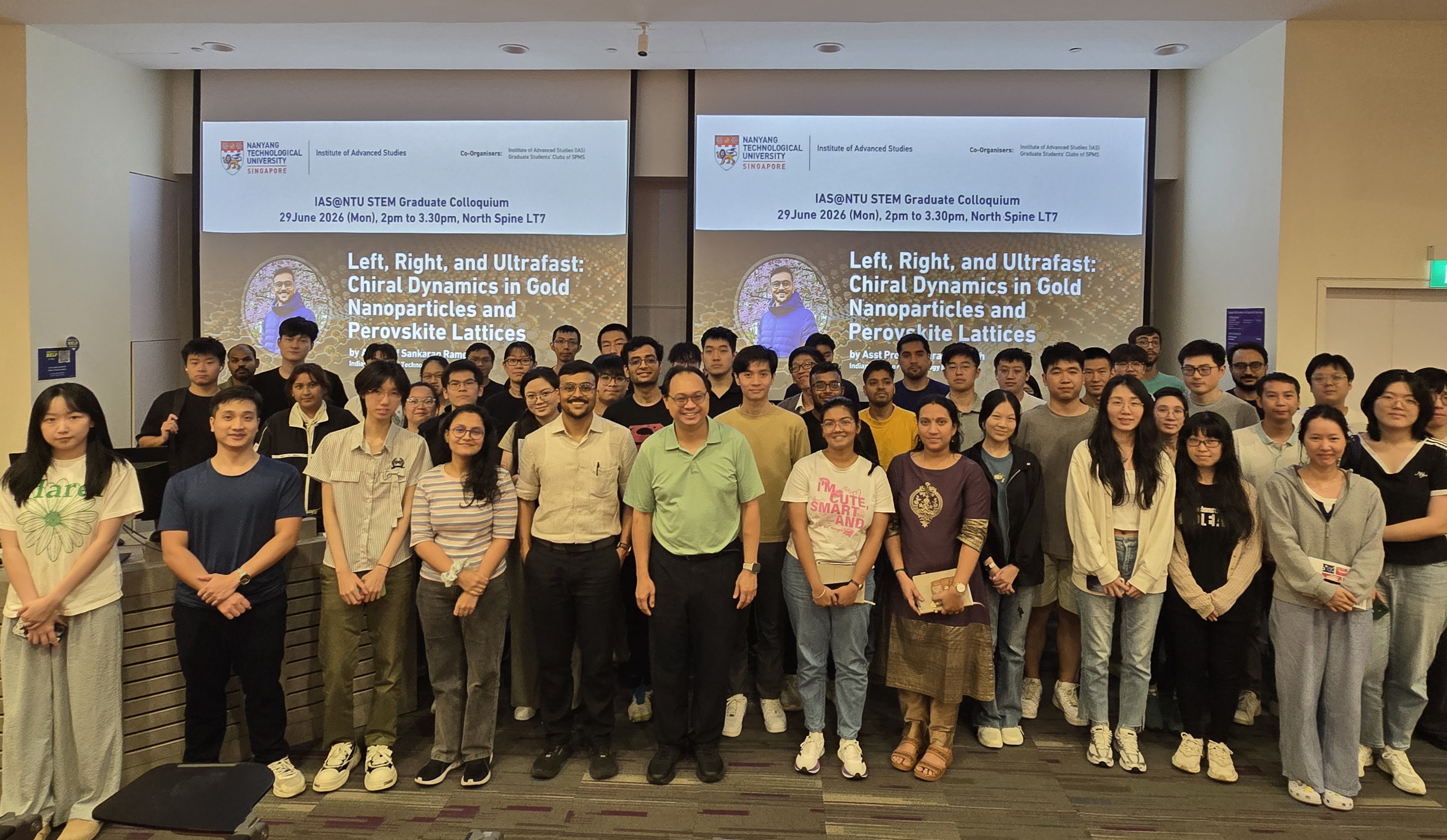
Written by: Adira Mohitha | NTU School of Physical and Mathematical Sciences Graduate Student’ Club
"This is an interesting and new topic to me, good flow of presentation, clear and easy to understand" - Zhang Yanchen (PhD student, MAE)
"The professor has a good way of presenting which made it easy for people of other backgrounds to understand." - Khushbu (PhD student, SPMS)
"I enjoyed the part about integrating chiral organic molecules into with perovskite " - Junxi Peng (PhD student, MAE)
Watch the recording here.