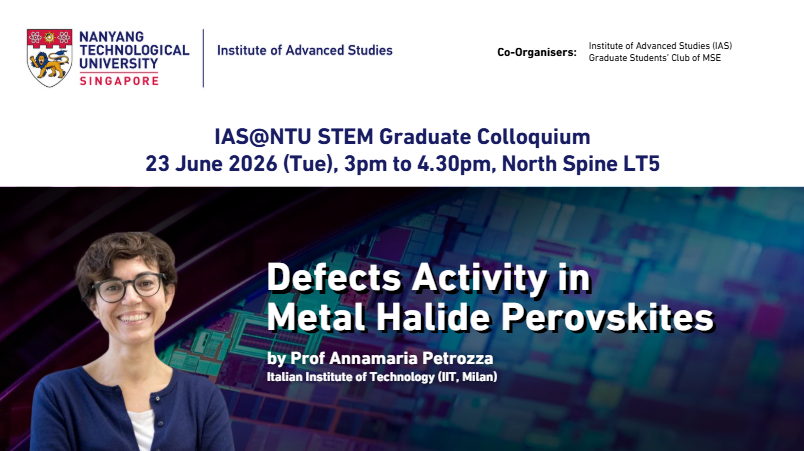
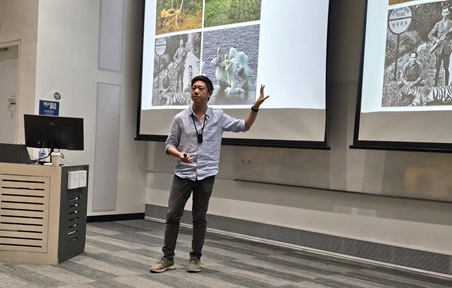
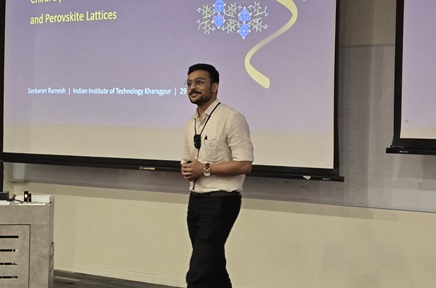
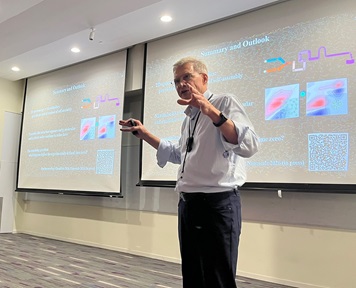
Defects Activity in Metal Halide Perovskites by Prof Annamaria Petrozza
IAS@NTU STEM Graduate Colloquium Jointly Organised with the Graduate Students' Clubs
On 23 June 2026, the IAS@NTU STEM Graduate Colloquium Series hosted Prof Annamaria Petrozza, Director of the Center for Nano Science and Technology and Head of the Advanced Materials for Optoelectronics group at the Italian Institute of Technology (IIT, Milan), for a colloquium titled "Defects Activity in Metal Halide Perovskites". Held at the North Spine LT5, the colloquium drew a packed audience of graduate students and faculty, reflecting how central perovskite defect physics has become to the optoelectronics community. Prof Petrozza's credentials set the tone for the session: she received the MIT Technology Review's "Innovators Under 35 Italy" award in 2014 for her pioneering work on perovskites, the MRS Innovation in Materials Characterisation Award in 2022, and has been a Fellow of the Royal Society of Chemistry since 2023.
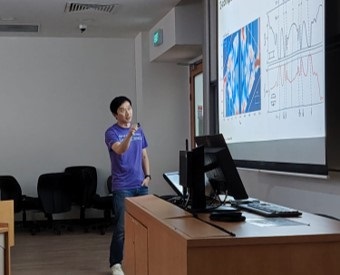
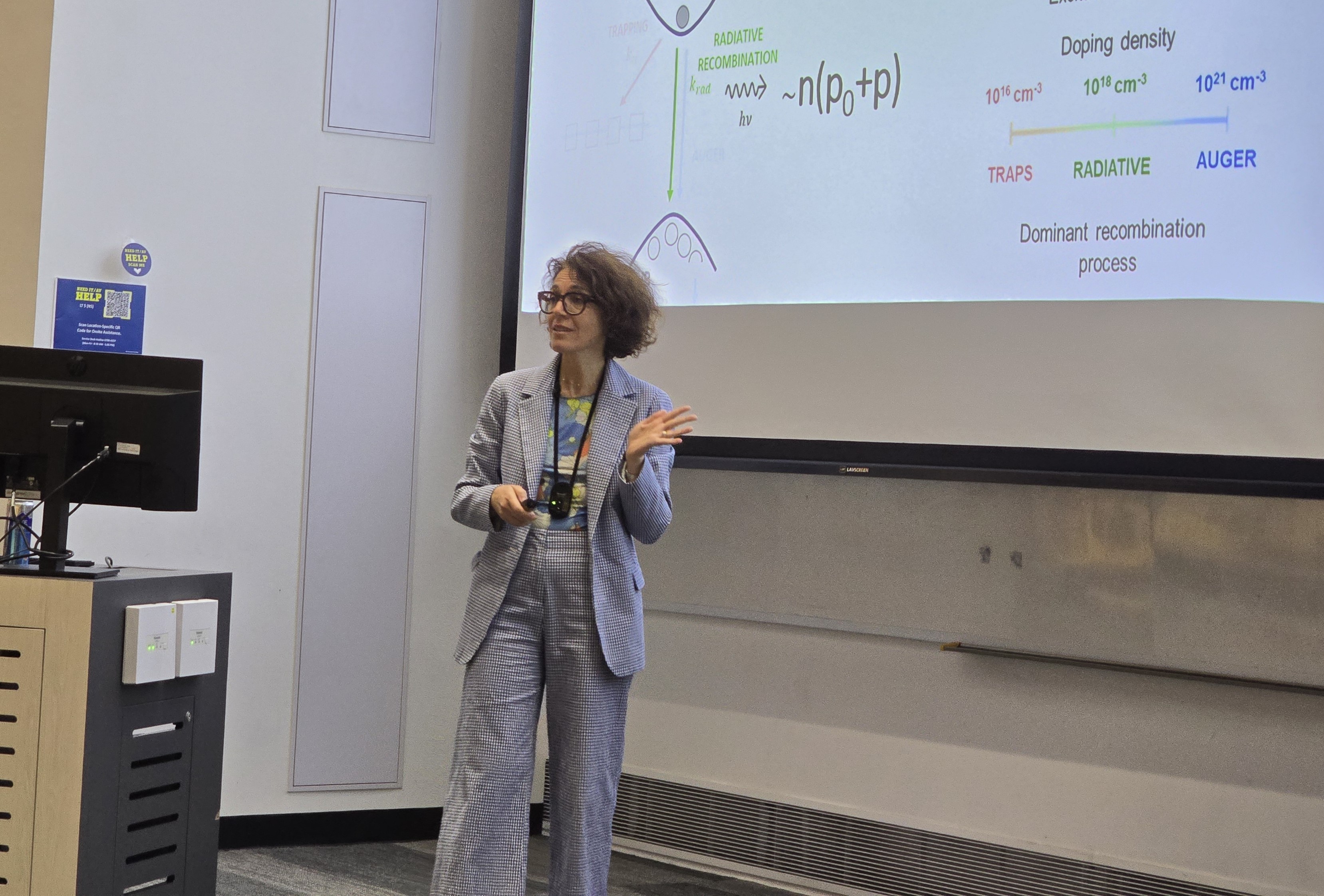 Prof Petrozza introduced metal halide perovskites as versatile semiconductors with highly tunable optoelectronic properties and applications.
Building the Foundation
Prof Petrozza opened by introducing metal halide perovskites as an appealing platform for next-generation optoelectronic technology, prized above all for their tunable bandgap, a feature achieved simply by redesigning the chemical composition of the ABX₃ crystalline unit. She walked through the general formula, with the X-site occupied by halide anions (I⁻, Cl⁻, Br⁻), the metal site by Pb²⁺ or Sn²⁺, and the A-site by an inorganic or organic cation such as Cs⁺, MA⁺, or FA⁺. She emphasised that this compositional freedom is what makes perovskites a "library of semiconductors" rather than a single material, enabling applications spanning photovoltaics, photodetectors, and light-emitting devices, all from the same structural family. This framing set up the rest of Prof Petrozza's presentation, which probed how the very flexibility that makes perovskites so versatile also makes them prone to defects and instability.
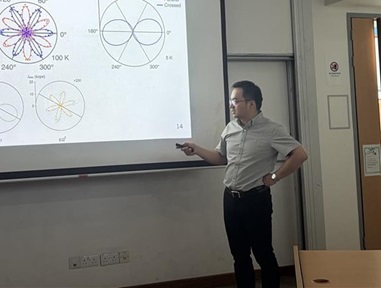
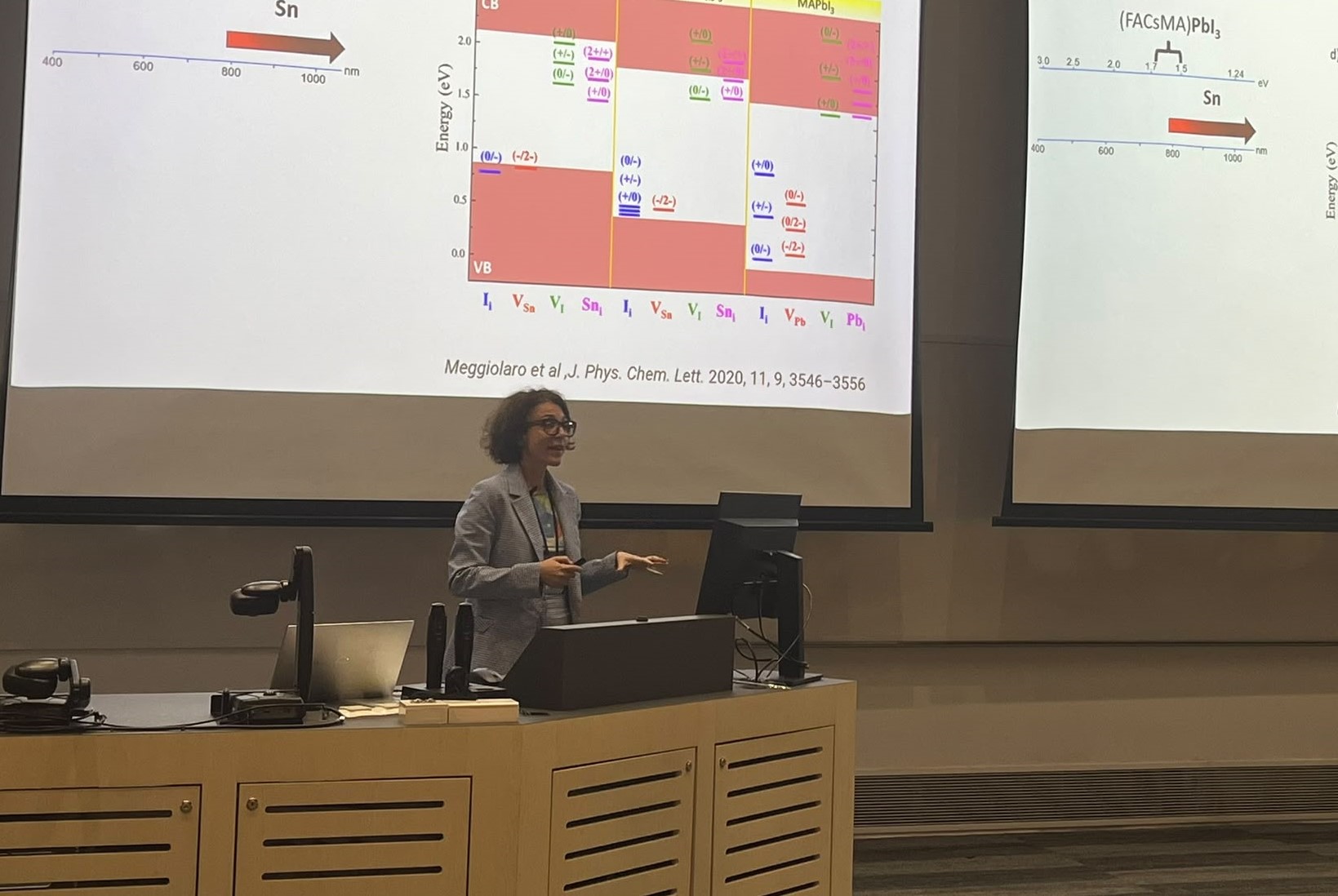 Prof Petrozza outlined the relationship between perovskite composition, performance, and material stability challenges.
Disorder, Defects and Carrier Traps
The heart of the talk traced how defects, especially iodine interstitials, define the charge carrier dynamics of the semiconductor. She distinguished static disorder (octahedral distortion within the crystal lattice), dynamic disorder (ion motion under light or heat), and trap-mediated emission dynamics, using normalised PL quantum yield curves against excitation density to show the classic "filling traps" to "band-to-band" to "Auger" progression. A key insight was that these defects are amphoteric: they trap holes reversibly and almost effortlessly, but trap electrons over microsecond timescales, a mechanism that paradoxically boosts open-circuit voltage while simultaneously feeding iodine-molecule formation and photodegradation. She illustrated this trade-off with transient absorption data and a simple "bucket of water" analogy, showing how the same defect population that appears benign for efficiency metrics can be the very culprit behind long-term stability losses. Building on this, she described how surface passivation strategies, such as capping films with polyethylene oxide to neutralise under-coordinated lead sites, could suppress iodine escape and meaningfully improve photostability without sacrificing performance.
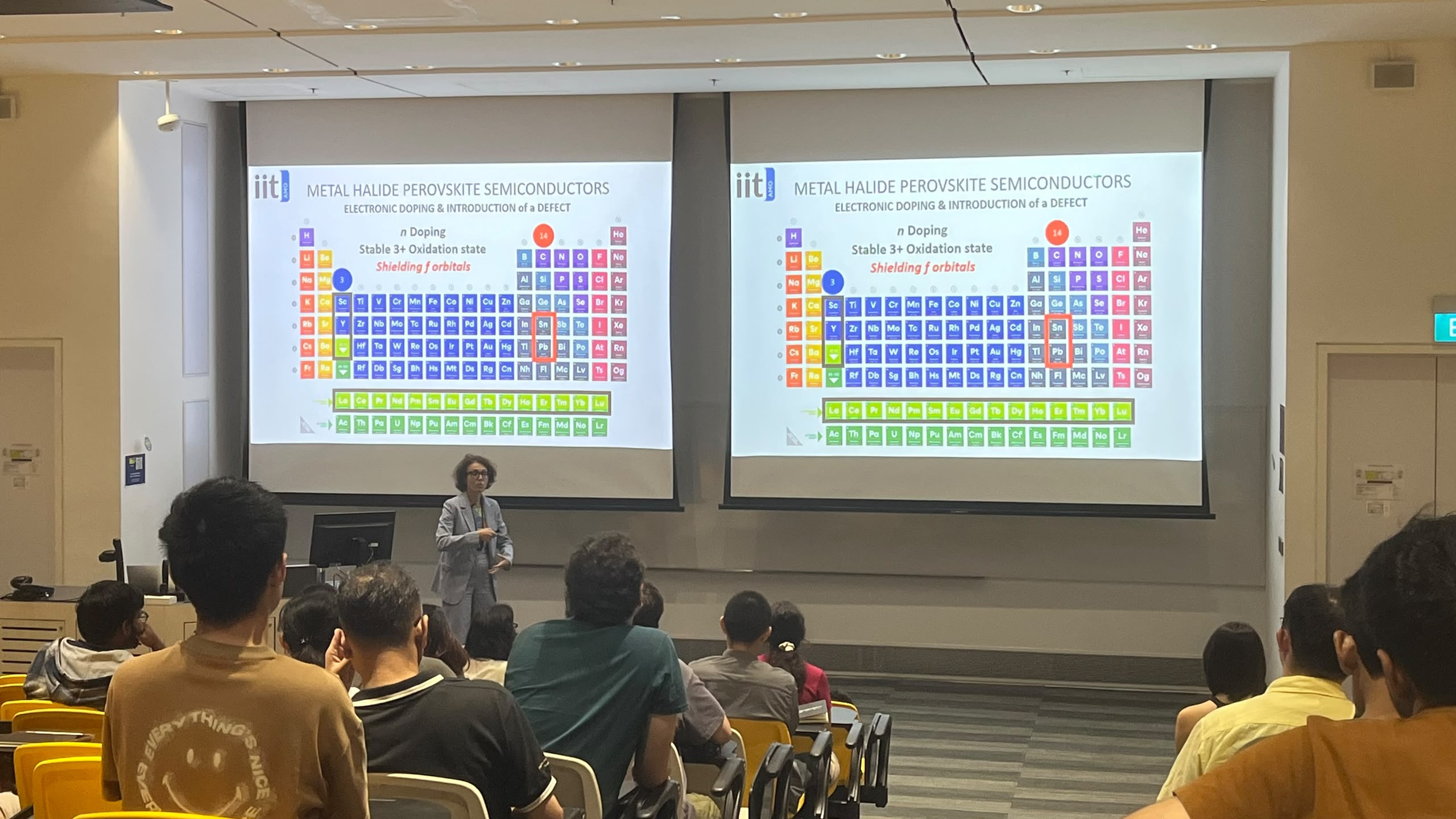 Transient absorption data and defect dynamics were explained to reveal the balance between efficiency and photostability.
Tin-Based Perovskites and NIR LEDs
The final segment moved beyond lead chemistry into tin-based perovskites, presenting FA0.9Cs0.1SnI3 dispersed in an organic matrix as an emitting layer for near-infrared LEDs. Using PL and absorbance mapping alongside a full device stack (ITO/PEDOT:PSS/emitting layer/TPBi/LiF/Al), she showed how compositional engineering pushes emission into the NIR while managing the same defect-driven trade-offs discussed earlier for lead systems, work published in ACS Energy Letters (2025, 10, 7, 3375-3382). She noted that tin-based systems present a distinct chemistry, since tin's propensity to oxidise introduces new defect pathways not seen in lead perovskites, requiring fresh strategies for passivation and encapsulation. This section underscored her broader argument that defect chemistry is not a fixed liability but a design variable, one that shifts meaningfully as researchers move across the perovskite compositional space.
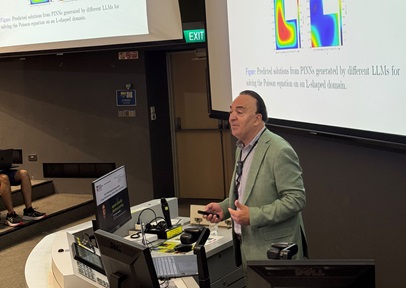
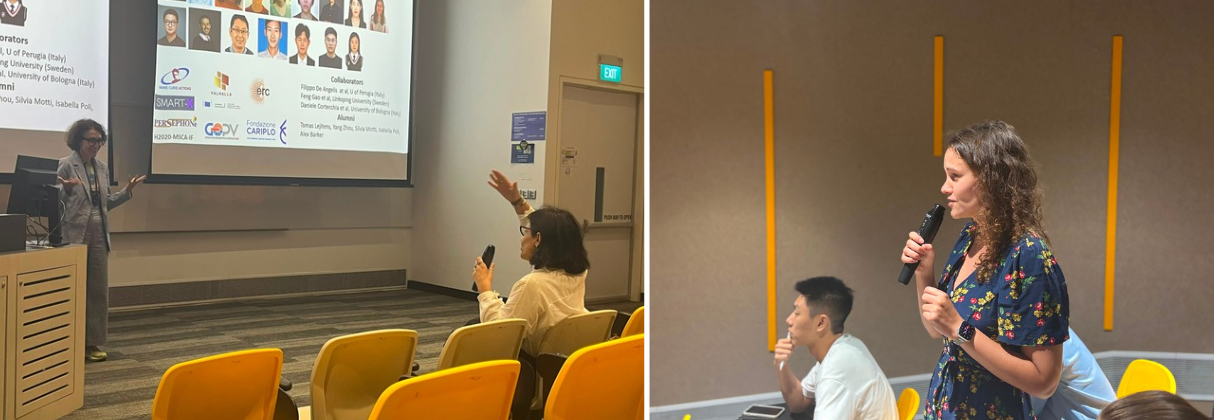 Audience members explored defect chemistry, tandem architectures, and pathways towards more stable perovskite solar cells.
Discussion and Conclusion
The colloquium closed with a lively Q&A on ion-motion, photovoltage effects across the TiO2-perovskite-Spiro-OMeTAD stack, and prospects for extending defect-tolerance strategies to tin-based systems. Audience members also probed how her group's findings might translate to tandem and multi-junction device architectures, given the ongoing interest at NTU in scalable perovskite-silicon platforms. The session ended with a group photo alongside NTU faculty, a fitting close to an afternoon that connected fundamental defect chemistry to real device performance and stability, and one that left many graduate students with fresh perspectives on how to approach defect engineering in their own research.
.jpg?sfvrsn=b11b448_1 "20260623_160831(0)")
Written by: Duvvuri Seethapathi Srinivasa Rohit | NTU School of Materials Science and Engineering Graduate Student’ Club
"This colloquium includes many interesting topics related to perovskites and defects, which is useful to various directions of research" - Zhou Dingtao (PhD student, GC-IGP)
"The topic was well explained and broadly covered the various defect mechanisms" - Yuvaraj Hemanth Kumar (PhD student, MSE)
"I enjoyed exploring defect density measurements in mixed halide perovskites" - Neha Singhal (PhD student, MSE)
Watch the recording here.