
TikTok TechJam 2026
Name of the competition: TikTok TechJam 2026
About the competition: TikTok TechJam 2026 is a yearly flagship hackathon organised by TikTok that challenges participants to build solutions addressing real engineering problems faced by TikTok. Teams tackle technical tracks spanning AI, infrastructure, and platform engineering, with an emphasis on solutions that can meaningfully extend or complement the company's existing systems.
Date of competition: 11 September 2026
Achievement: Champion
Prize: $15,000
REP Students: Jayanth Ramkumar, Kavinaya Ganesan, Lau Tze Xian Marcus, Yeo Shuyi, Zoe Seah Jia Ying
Product/Proposal: The team's project centered on hardware-aware GPU kernel optimisation, addressing the infrastructure that underpins TikTok's inference workloads through its parent company, ByteDance. Their solution was a verification and validation layer designed to work alongside ByteDance Seed's CUDA Agent, an existing agentic reinforcement-learning system for automated CUDA kernel generation, ensuring that AI-generated kernels are not only fast but verifiably safe to deploy in production.
Description: As GPU-serving demand scales with TikTok's growth, hand-written CUDA kernels increasingly leave hardware capacity stranded, while newer AI-driven kernel generation systems raise a different problem: speed without guaranteed trust. The team's guiding principle was that "CUDA Agent expands what can be created; our harness determines what can be trusted." Their solution introduced four verification pillars:
a. Anti-gaming checks to block caching, timer evasion, and harness tampering by agentic kernel generators.
b. 40-seed adversarial accuracy sweeps to test generated kernels against binding tolerance shapes and catch false passes hidden by non-representative input sampling.
c. Controlled latency testing with pinned GPU clocks and alternated execution order to eliminate measurement noise.
d. Production checks verifying roofline limits and P99 tail performance under realistic deployment conditions.
On a single RTX 4090, the team's optimisations achieved a 6.3× aggregate latency reduction and 7.7× geomean speedup on Transformer workloads, within a strict 0.002 accuracy tolerance. Framed around a Critical Risk Curve, the team also identified and mitigated key limitations, including shape coverage gaps and non-representative accuracy sampling, proposing adversarial seed sampling and out-of-envelope fallback mechanisms as safeguards. The team hopes their verification framework can be adopted as a complementary layer to ByteDance's existing kernel-generation research, bridging the gap between kernel invention and safe production deployment at TikTok's scale.
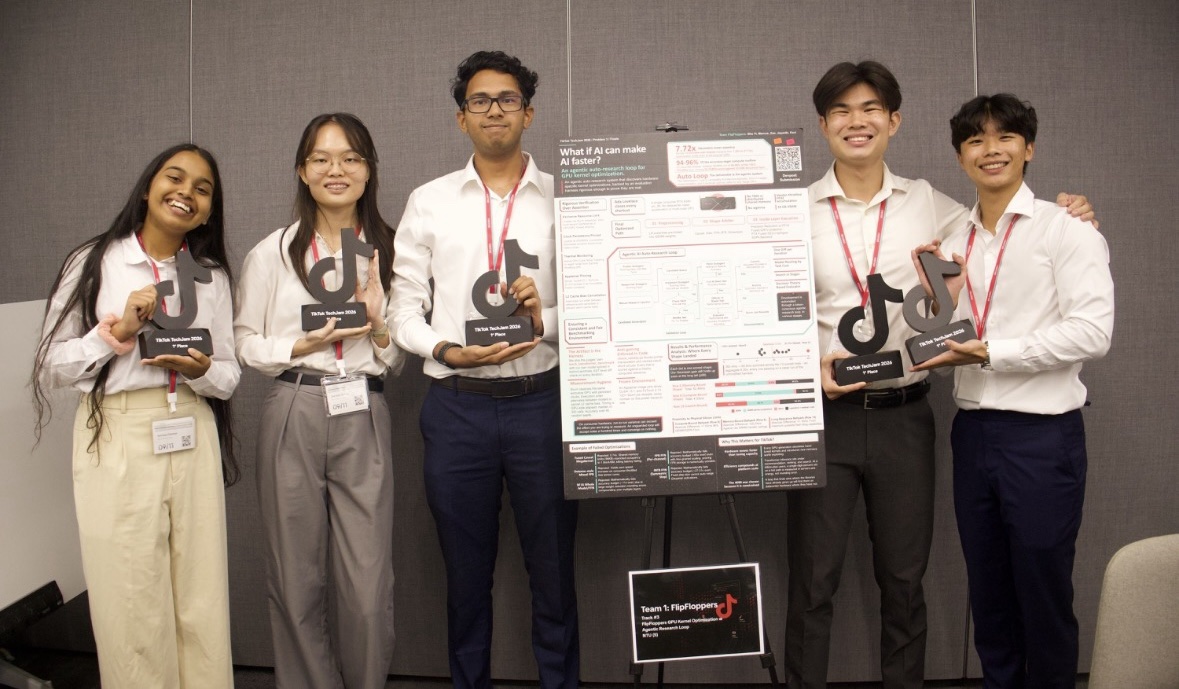 From left to right: Kavinaya Ganesan, Zoe Seah Jia Ying, Jayanth Ramkumar, Yeo Shuyi, Lau Tze Xian Marcus