
LTA Nebula X Hackathon
Name of the competition: LTA Nebula X Hackathon
About the competition: The NEBULA X Hackathon invites Singapore university and polytechnic students to take on real-world mobility challenges and develop innovative solutions that could make Singapore’s rail network smarter, more reliable and more resilient. Faced with ageing assets, a changing workforce and limited maintenance windows, LTA hopes to build a smarter network that can sense, predict, and manage itself, and to create a more reliable and resilient railway for the future. There are three tracks under this competition: Track 1: Scheduling riddle with conflicting requests where the team is required to build a tool that automates scheduling; Track 2: Moving Millions Seamlessly where the team is required to build the system that powers commuters; and Track 3: A living railway whispers secrets about our trains where the team is required to build the solution that turns hidden risks into timely interventions.
Date of competition: 18 - 20 September 2026
Achievement: Champion
Prize: $5,000
REP Students: Bersamin Justin Timothy Carmona, Gan Qing Rong, Nurdiyanah Umairah Binte Abdul Rani, Sun Sitong
Product/Proposal: Train Digital Twin by Team Bus MRT Walk, an AI-powered condition-monitoring platform for MRT trains.
Description: The team tackled Problem Statement 3 under Track 3 which is on Predictive Fault Detection where they built the solution that turned hidden risks into timely interventions.
The team built a Train Digital Twin that turned raw onboard sensor data into automatic fault detection across four train subsystems:
- Doors: finding abnormal door open/close cycles
- Air-conditioning: pinpointing the car that has a refrigerant leak
- Rail corrugation: detecting wear on either side of the track from axle-box vibration
- Bogie fatigue: estimating structural fatigue damage
The models scored highly in cross-validation, achieving a 98% accuracy score across the door, air-con and fatigue tasks. Results appeared on an interactive 3D model of the train, so engineers can see exactly which door, car or bogie needs attention, and why.
To show how this could scale to a whole fleet, the team added a fleet-scan mode. An engineer uploads a folder of train data, and the platform on Google Cloud checks every train and lists the ones with faults first. A 3D digital twin is also created for closer inspection for the engineers. Results can be exported as an inspection pack and shared, so a team of engineers can split hundreds of trains between them.
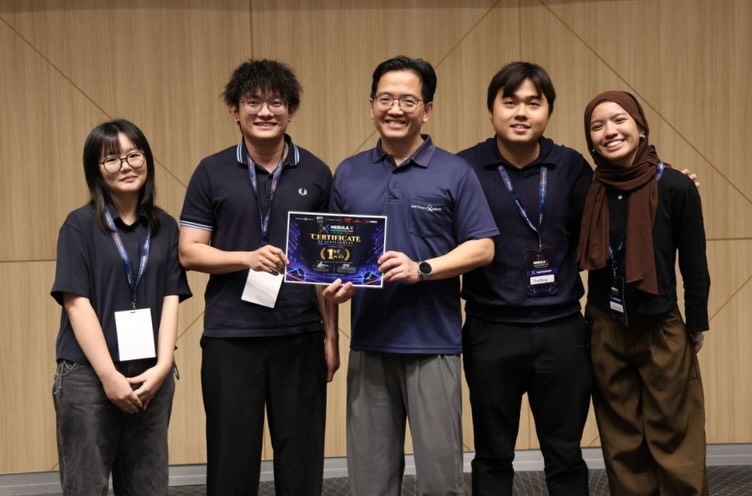 From left to right: Sun Sitong, Bersamin Justin Timothy Carmona, Gan Qing Rong and Nurdiyanah Umairah Binte Abdul Rani