S’pore scientists blazing a trail, from cancer detection to harnessing solar power
View the full article at The Straits Times
SINGAPORE - On Oct 20, a fresh batch of top scientists will be honoured with the highest accolade for researchers and engineers in the Republic – the President’s Science and Technology Awards.
The Straits Times looks at a few past recipients who have helped to advance Singapore’s science scene, from addressing unmet healthcare needs to making strides in renewable energy.
Associate Professor Nripan Mathews, 41
Young Scientist Award, 2015

Associate Professor Nripan Mathews was awarded the Young Scientist Award in 2015. PHOTO: NTU
His award-winning discovery
Since the 1950s, silicon has been used to capture and convert sunlight into electricity in solar panels. Silicon forms the heart of a solar cell.
More than a decade ago, Associate Professor Nripan Mathews and his team were exploring new materials for solar cells when they were introduced to a man-made crystal called halide perovskite. Perovskite is processed from chemical solutions and can be printed onto plastic and glass sheets, similar to a T-shirt printing process.
Perovskite-based panels are known to be more flexible, colourful, lightweight, and cheaper to produce than silicon ones.
In 2013, Prof Mathews and his collaborators at Nanyang Technological University (NTU) became the first in the world to uncover why the crystalline structure is good at harnessing the sun’s energy. When they shot high-speed lasers at the material, electrons flowed through it without being impeded by flaws in the material, unlike other material made from liquid solutions. This allowed Prof Mathews’ team to print solar cells that can absorb more light and generate more electricity.
In labs, perovskite solar cell efficiencies have improved faster than any other photovoltaic material, from 3 per cent in 2009 to over 25 per cent in 2020, comparable to the performance of silicon panels. Solar cell efficiency refers to the amount of captured energy from sunlight that can be converted into electricity.
Since perovskite can be printed on plastic, it does not have to be lined rigidly on rooftops or fields, unlike silicon solar panels. It can conform to a building’s shape and can also double as stained glass windows since it can come in different translucent colours.
“Perovskites can be printed easily on glass allowing us to target colourful power-generating windows,” noted Prof Mathews, who is a faculty member at the School of Materials Science and Engineering.
Perovskite solar cells are on the cusp of commercialisation worldwide. One promising area is in creating “hybrid” solar panels where silicon and perovskite cells are sandwiched together, increasing the overall efficiency to 30 per cent or more.
“This allows the various components of the sunlight to be absorbed by each layer resulting in very high power generation,” explained Prof Mathews.
The Young Scientist Award is given to individuals aged 35 and under who have shown potential to be world-class researchers in their fields of expertise.

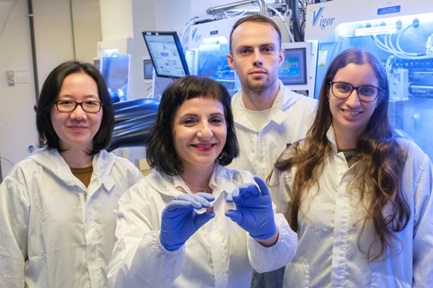
(From left) Dr Li Jia, Dr Annalisa Bruno, Associate Professor Nripan Mathews and Dr Wang Hao with the 21 sq cm perovskite solar cell modules created by their team at Nanyang Technological University. PHOTO: NTU
His ongoing projects
With the amount of e-waste from solar panels expected to rise, Prof Mathews helped develop methods to upcycle the silicon-based portions of used panels into lithium-ion batteries.
Also, he is not done with perovskite and is exploring other novel uses for it. Since the material is also good at emitting light, his team has explored making light-emitting diode devices with them.
Recently, his team has figured out how to make perovskite devices that can “remember” and “learn”, mimicking parts of the human brain.
“We are exploring how such brain-like electronic devices can be used to manage a lot of data to make quick decisions,” he added.