
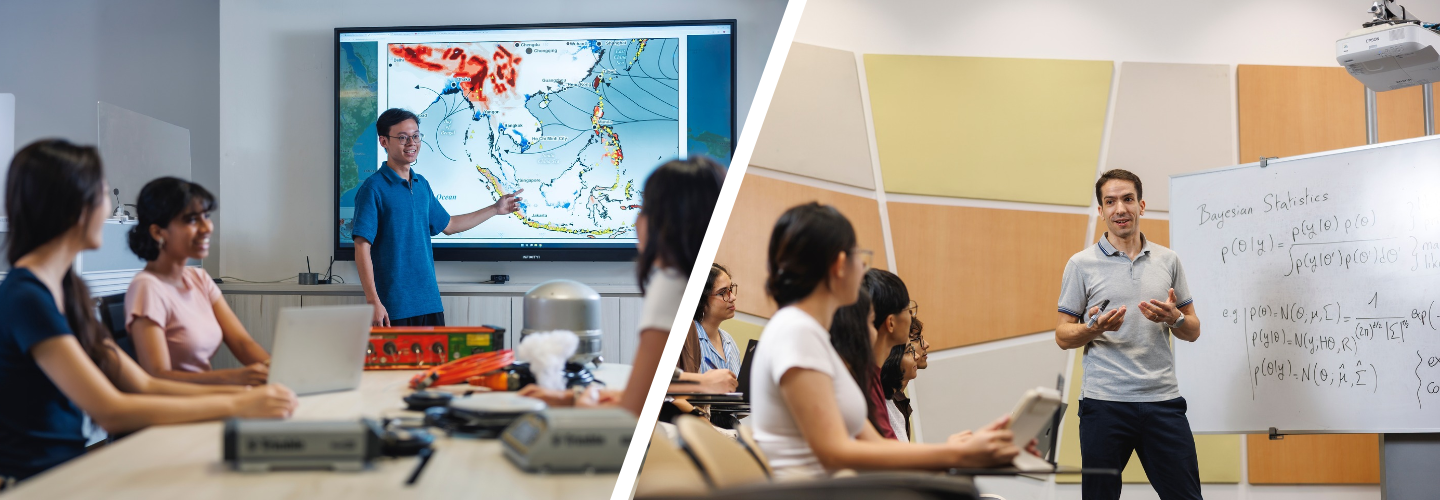
The Double Major Bachelor of Science (Honours) in Environmental Earth Systems Science and Mathematical Sciences integrates advanced statistical computations, data logic, and quantitative modelling with the physical and ecological study of our planet. Through this multi-disciplinary methodology, the curriculum trains students to decode and simulate critical real-world environmental phenomena such as climate patterns, geodynamic hazards, and ecosystem transformations.
This programme is jointly run by the Asian School of the Environment (ASE) and the School of Physical and Mathematical Sciences (SPMS).
Bridging the analytical power of mathematical systems with a comprehensive study of global environments, this programme offers an immersive, interdisciplinary scientific education.
Undergraduates will develop a stable foundation in both fields, which will prepare them for specialized roles in ecological data modelling, climate risk management, sustainability consultancy, or advanced geoscientific research.
- Parallel Dual-Major Framework: The curriculum establishes a comprehensive foundation in both Environmental Earth Systems Science and Mathematical Sciences.
- Flexible Mathematical Specializations: Students can personalize their educational profiles by fulfilling structured specializations within the Mathematical Sciences component, choosing from Computational Mathematics and Modelling, Cryptography and Cybersecurity, Data Analytics and Statistical Learning, Financial Technology with Quantitative Analysis, or Pure Mathematics.
- Merged Field and Computational Skillsets: The academic track couples direct environmental field observation and geospatial analysis with deep quantitative reasoning, programming languages, and advanced statistical modelling.
- Direct Industry Immersive Experience: A compulsory internship ties standard coursework to active industrial or administrative environments, significantly boosting professional readiness upon graduation.
- Substantial Scientific Research Project: A Final Year Project challenges students to run independent, cross-disciplinary research at the direct intersection of earth science dynamics and mathematical methodologies.
Singapore GCE 'A' Level
- H2 Level pass in Mathematics, and H2 Level pass in Physics/Chemistry/Biology/Computing/Economics
IB Diploma
- Mathematics at Higher Level, and Physics/Chemistry/Biology/Computer Science/Economics at Higher Level
International Qualification
- Mathematics at Senior High School Level, and Physics/Chemistry/Biology/Economics at Senior High School Level
NUS High School
- Major CAP of 2.0 in Mathematics, and Major CAP of 2.0 in Physics/Chemistry/Biology
This is a full-time, four-year Double Major (Honours) undergraduate degree. To satisfy graduation expectations, students must complete a minimum total of 144 Academic Units (AUs) distributed among three fundamental structural pillars:
1. Major Requirements (104 AUs):
- Environmental Earth Systems Science Major Core: 27 AUs
- Mathematical Sciences Major Core: 40 AUs
- Environmental Earth Systems Science Major Prescribed Electives: 21 AUs
- Mathematical Sciences Major Prescribed Electives: 7 AUs
- Final Year Project (FYP): 10 AUs
2. Interdisciplinary Collaborative Core (ICC) (33 AUs):
- This sector delivers global sustainability courses, ethics training, professional serial modules, data science, scientific writing, and an industry internship.
3. Broadening & Deepening Electives (BDE) (6 AUs):
- This category grants students full autonomy to study elective courses entirely outside their double major fields.
There are two variants of this Double Major programme:
- Environmental Earth Systems Science and Mathematical Sciences (home School: Asian School of the Environment). Click here for the curriculum.
- Mathematical Sciences and Environmental Earth Systems Science curriculum (home School: School of Physical and Mathematical Sciences). Click here for the curriculum.