Learning from global leaders in AI
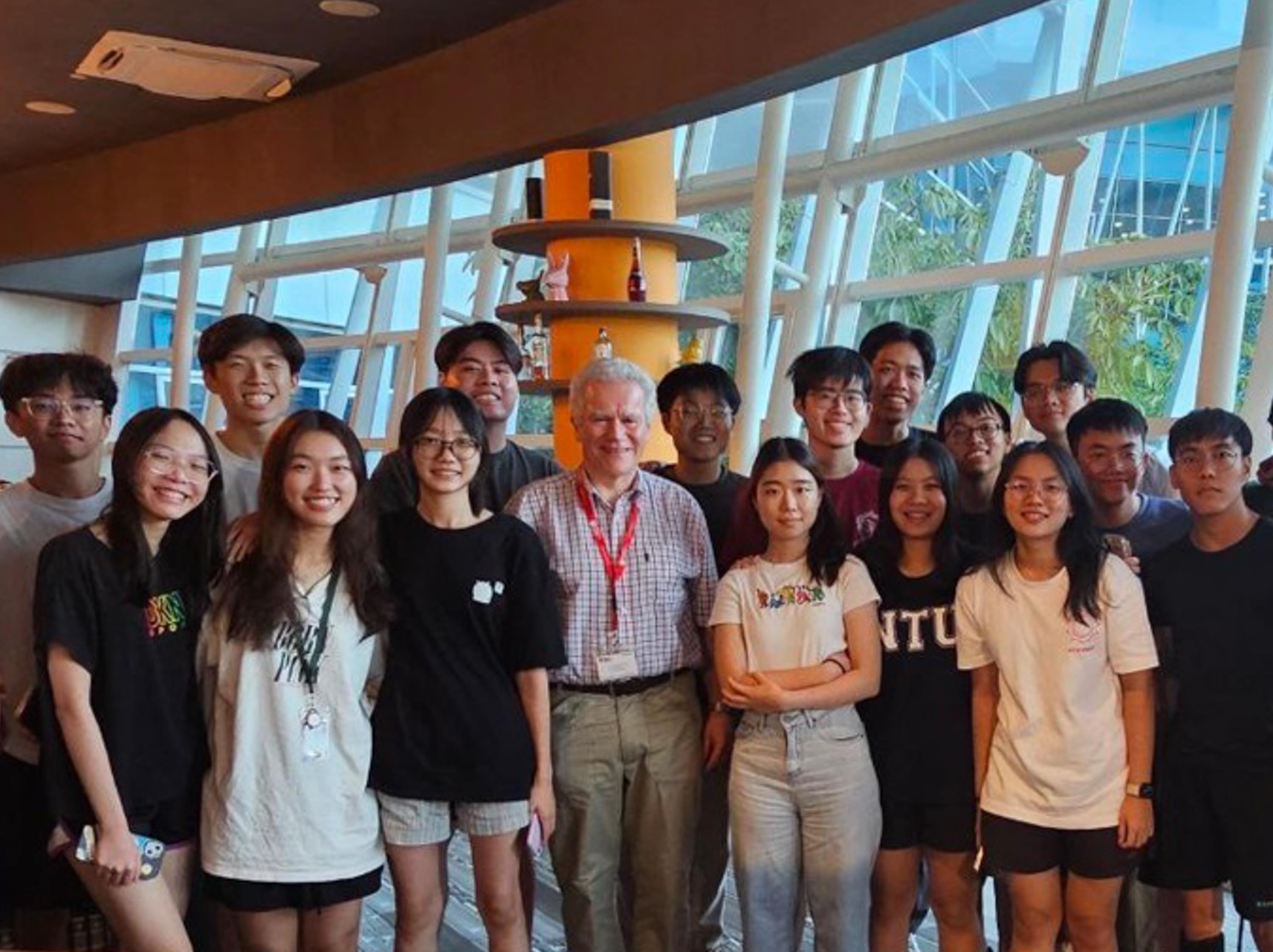
University of Oxford’s Prof Peter Millican conducted an exclusive masterclass for students of NTU’s premier Turing AI Scholars Programme. (Credit: CCDS)
It’s not every day that you can learn from and interact with pioneers and key figures in artificial intelligence (AI). But students from Nanyang Technological University, Singapore's (NTU Singapore) premier Turing AI Scholars Programme get the opportunity to do so through exclusive masterclasses.
At these interactive classes conducted by leading professors and industry veterans, students gain insights into cutting-edge AI trends.
Luminaries who have taught the masterclasses include University of Oxford’s Prof Peter Millican, who is a leading expert on philosophy in computing and the importance of ethics in AI, as well as Oxford’s Prof Michael Wooldridge, one of the pioneers who laid the foundations for how AI systems can interact with one another.

Turing AI Scholar Chong Su Ying says that the masterclasses were a major draw for her to the programme “as they provide exceptional learning opportunities and access to world-class expertise”.
“They not only strengthen my academic grounding but also better prepare me to engage in research projects with greater confidence and curiosity,” adds the second year Data Science & AI major.
These masterclasses are one of the highlights of the Turing AI Scholars Programme, which was launched in 2024 by NTU and named in honour of Alan Turing, the father of modern computer science and AI.
The programme is designed to groom potential AI leaders and nurture exceptionally talented students who want to advance AI research and develop state-of-the-art solutions to change the world for the better.
It is a four-year direct honours scholars track offered alongside NTU’s degrees in Computer Science, Data Science & AI, and AI & Society.
The programme provides a curated curriculum, combined with mentorship, research opportunities, and global exposure. The curriculum integrates core computing, advanced AI modules and interdisciplinary learning with real-world applications, giving scholars both theoretical depth and practical experience.
Global perspectives
To help students gain even more exposure to global AI research and industry practices, the Turing AI Scholars Programme also organises experiential learning trips abroad.
These international trips include visits to China to immerse students in Tsinghua University’s Yao Class and Peking University’s Turing Class, which are top computer science and AI training programmes in the country.
In their second year, Turing AI Scholars conduct research under the supervision and mentorship of a renowned AI faculty and researcher at NTU. These students also spend their third year overseas, including studying at a top university and gaining industry experience through an internship.
Students in the programme receive a comprehensive scholarship that covers full tuition fees, living and accommodation allowances, a travel grant and a computer allowance.
For Su Ying, she hopes to be based in Silicon Valley, the hub of AI, during her internship. And for her semester exchange, she has her sights on the University of California, Berkeley.
One benefit of being a Turing AI scholar is that she can be assured of a spot in top universities for her overseas study.
“The guaranteed overseas study is very appealing to me as it offers the opportunity to experience different academic environments and gain diverse perspectives that enrich my understanding of AI,” she says.