The 2025 Nobel Prize in Economics: Understanding How Innovation Drives Long-Term Economic Growth
Dr He Tai-Sen | School of Social Sciences (Division of Economics), NTU
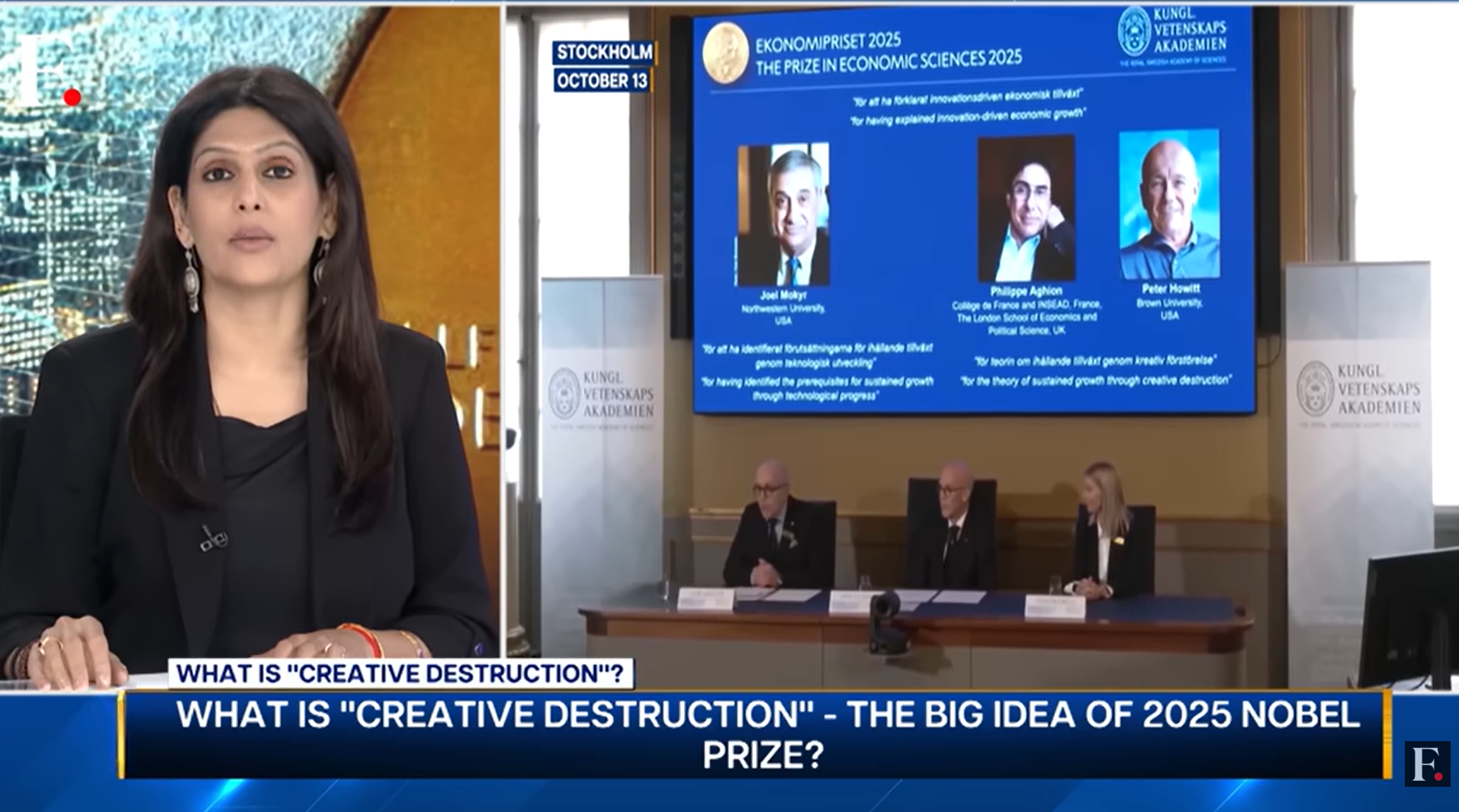
The 2025 Nobel Prize in Economic Sciences was awarded to Joel Mokyr (Northwestern University), Philippe Aghion (College de France; INSEAD; and London School of Economics and Political Science), and Peter Howitt (Brown University) for their pioneering contributions to understanding how innovation, technological change, and knowledge creation drive long-term economic growth. Their work addresses one of the central questions in economics: why do some economies continuously generate prosperity while others experience stagnation?
Traditional economic models often treated technological progress as external to the economy—that is, “exogenous” in economic terms. The laureates’ work fundamentally changed this perspective by explaining how innovation itself is shaped by institutions, incentives, education, and competition. Their research demonstrates that economic growth is not merely driven by the accumulation of capital and labour, but also by continuous processes of discovery, experimentation, and technological transformation.
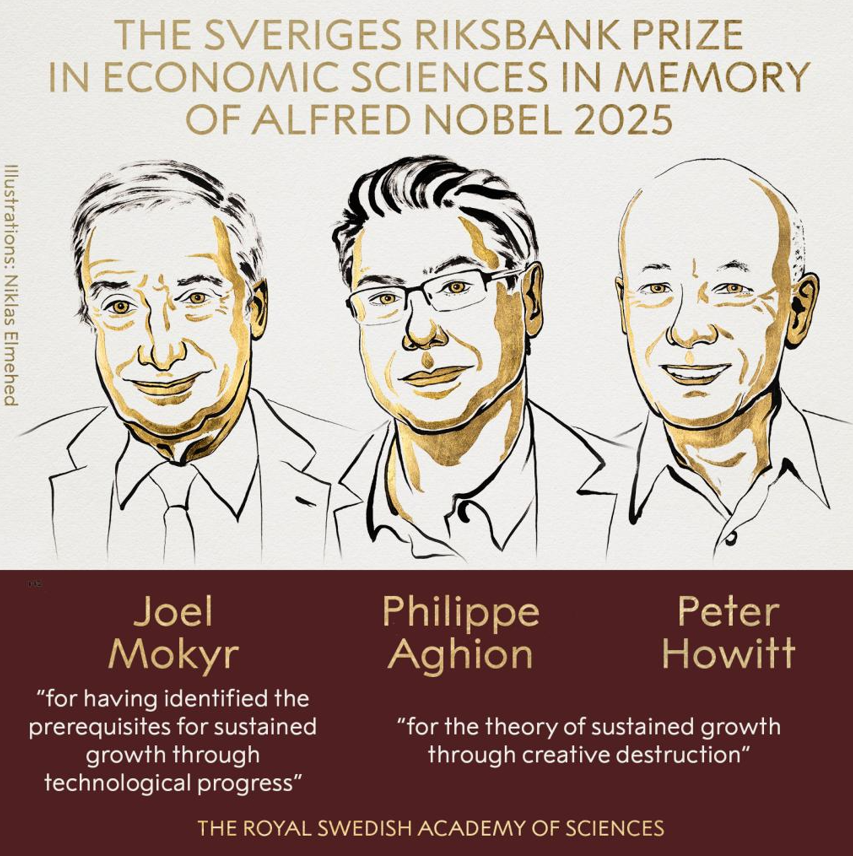 Image Credit: https://eu.36kr.com/en/p/3510392723233928
Philippe Aghion and Peter Howitt are particularly known for developing theories of endogenous growth and creative destruction, originally inspired by economist Joseph Schumpeter. Their framework explains how new innovations replace outdated technologies and business models over time. Although this process may disrupt firms and occupations in the short run, it also generates productivity gains and rising living standards in the long run. In this framework, economic growth depends on a constant cycle in which new ideas challenge existing technologies and create incentives for further innovation. Joel Mokyr’s contributions complement this perspective through economic history. His research examines how scientific culture, intellectual exchange, and the diffusion of knowledge contributed to major historical transformations such as the Industrial Revolution. Mokyr argues that technological breakthroughs alone are insufficient to sustain growth. Societies must also develop institutions and cultural environments that encourage openness, experimentation, and the spread of useful knowledge.
A central insight from the laureates’ work is that innovation depends heavily on institutions and incentives. Economies that protect property rights, encourage competition in, invest in education, and support scientific research are more likely to sustain technological progress over time. In contrast, societies that restrict knowledge diffusion or concentrate economic power too heavily may experience slower innovation and weaker long-term growth.
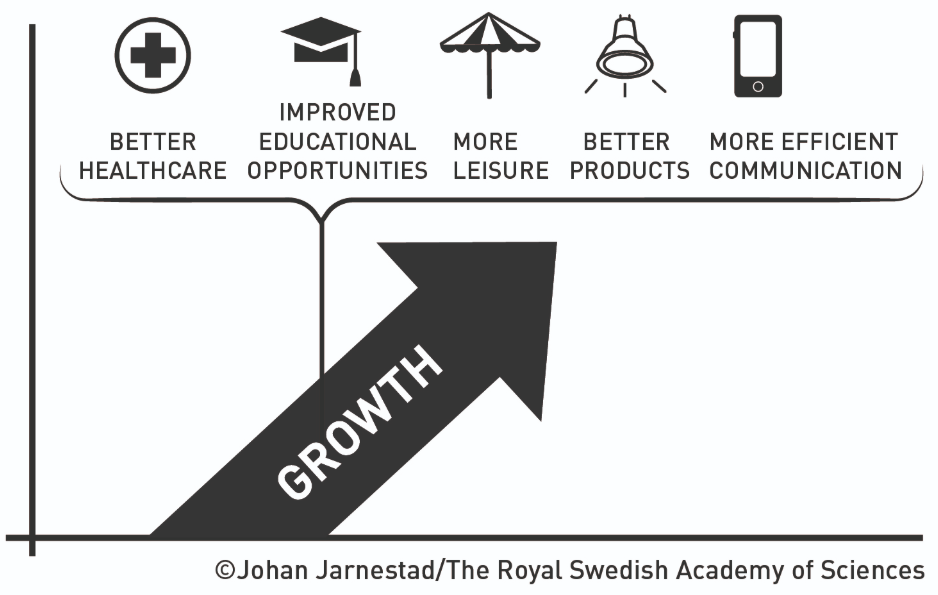
The Nobel Committee also highlighted the contemporary relevance of their research. Rapid developments in artificial intelligence, automation, and green technologies have raised important questions about inequality, labour market disruptions, and the future direction of economic development. The laureates’ work provides policymakers with a framework for understanding how economies can encourage innovation while managing the social and economic disruptions associated with technological change.
Beyond academia, their contributions have reshaped modern growth economics and influenced policymaking around the world. Their theories continue to shape debates on industrial policy, innovation systems, education, competition, and technological development. More broadly, their work demonstrates that sustained prosperity ultimately depends not only on technological invention itself, but also on the institutional and social conditions that allow innovation to flourish.
On a personal note, I had the opportunity to attend Peter Howitt’s class during my first year of PhD studies at Brown University. His teaching reflected many of the qualities that characterize his research: clarity, intellectual curiosity, and a deep interest in understanding how ideas shape long-run economic outcomes. Seeing his contributions recognized by the Nobel Committee makes this year’s award especially meaningful to me.
By illuminating the relationship between innovation, institutions, and long-term prosperity, Mokyr, Aghion, and Howitt have produced one of the most influential frameworks in modern economics. Their work has reshaped growth theory, reoriented policymaking, and offered a compelling answer to one of the discipline’s enduring questions: why do some economies keep growing while others do not?
In an era of rapid technological change, that question has never felt more urgent.
For more information, watch the video here.