Propagation of Heat in Liquid Helium-3 and Metallic Fermi Liquids by Prof Kamran Behnia
IAS Frontiers Seminars: Quantum Horizons, Seminar #8
Prof Kamran Behnia (ESPCI Paris), a distinguished expert in the field of transport experiments ranging from semimetals to superconductors, gave an engaging talk at the IAS STEM Graduate Colloquia series on 13 April 2026 titled “Propagation of Heat in Liquid Helium-3 and Metallic Fermi Liquids”, presenting his work on liquid Helium-3. He provided a plausible theoretical explanation addressing shortcomings in the current understanding of Landau’s Fermi liquid, and extended this notion to a broader class of metals. Prof Kamran’s insightful seminar was catered to a wide audience, with a healthy turnout from faculty members who were eager to learn from his sharing. The audience also included undergraduate and postgraduate students, who capitalised on this opportunity to interact with an experienced experimentalist such as Prof Kamran.
 The exciting seminar begins with a brief introduction of Prof Kamran by Prof Justin Song (SPMS).
The central experimental motivation for Prof Kamran’s work is the scaling of both thermal and electrical conductivities (and hence resistivity) with temperature in liquid helium. While it is widely accepted that the temperature dependence of resistivity follows a quadratic behaviour, deviations appear at higher temperatures. The coefficient of the quadratic term, which reflects intrinsic properties of the metal, is found to scale with the specific heat in dense metals. In recent decades, systems such as Strontium Titanate and Zirconium Pentatelluride have also been observed to display such discrepancies. These findings challenge conventional explanations based on processes such as Umklapp and Baber scattering, leaving two central questions: why is the quadratic scaling amplitude (at relatively low temperatures) linked to the Fermi energy, and why does it persist in the apparent absence of these scattering mechanisms?
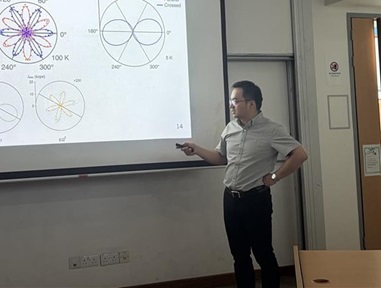
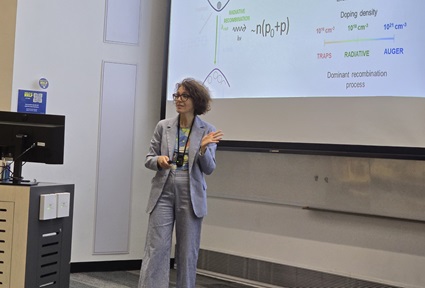
 Prof Kamran explains thermal conductivity behavior in liquid helium.
In this seminar, Prof Kamran aimed to address some of these challenges and provide reasoning for the departure from the temperature dependence predicted by Landau Fermi liquid theory. By first connecting the two conductivities through the Wiedemann–Franz (WF) law, he studied the thermal conductivity of liquid helium.
The first half of Prof Kamran’s talk focused on the qualitative behaviour of thermal diffusivity in liquid Helium-3, comparing it with supercritical fluids such as Helium-4 and classical fluids. In classical fluids, there exists a minimum in diffusivity as a function of temperature, which he attributed to a reduction in mean free path and velocity. Beyond this minimum, the diffusivity increases with temperature. This propagation is associated with collective excitations, namely sound modes. This behaviour contrasts with the quantum fluid picture, where the opposite trend is observed.
He also investigated contributions from collective sound modes, which can be modelled by recasting the proportionality constant related to specific heat via the WF law, and replacing the mean free path with the thermal de Broglie thermal length. This leads to a temperature scaling with a power of 1/2, which he referred to as the Landauer method.
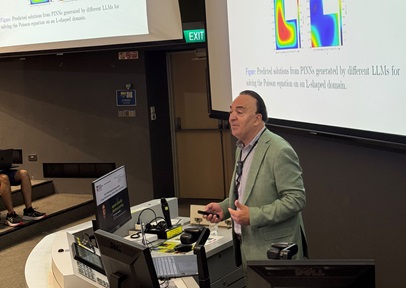
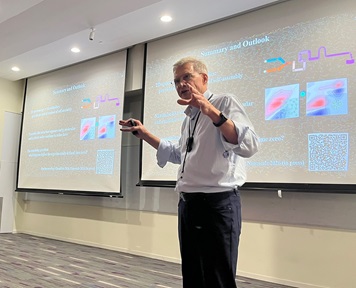
 Prof Kamran presents quantum thermal conductivity model, showing agreement with experimental resistivity data.
In the latter part of the talk, Prof Kamran presented an alternative approach using a quantum version of the Bridgman formula for the thermal conductivity of classical liquids. From this, he derived contributions from zero sound and found exact consistency between the Landauer and Bridgman approaches. Both frameworks have the advantage of not requiring additional empirical fitting parameters, suggesting that zero-sound contributions can be incorporated in a predictive manner.
In closing, Prof Kamran tested his framework on Strontium Ruthenate, where many empirical parameters are well established in literature. He compared resistivity using (1) only the quadratic temperature term and (2) a combination of quadratic and square-root temperature dependence arising from zero sound. The results showed strong agreement with experimental data, supporting the promise of this approach.
.jpg?sfvrsn=7a7a1372_1 "Media (2)") Audience engages in Q&A as Prof Kamran answers questions on theory and experiments.
Audience engages in Q&A as Prof Kamran answers questions on theory and experiments.
Many audience members, particularly faculty, engaged actively during the Q&A session, raising thoughtful questions that probed both the theoretical assumptions and experimental implications of the work. The exchange remained lively and intellectually stimulating. Prof Kamran addressed each question with clarity and precision, often elaborating beyond the scope of the talk, and demonstrating a deep command of both experimental and theoretical perspectives.
This seminar is part of the IAS Frontiers Seminars: Quantum Horizons series. Find out more about the seminars here.
Written by John Tan| NTU School of Physical and Mathematical Sciences
"I enjoyed the discussion on Fermi liquid as collisions of quasiparticles." - Teo Hau Tian (PhD Student, SPMS)
"The theory was fun and interesting as it flips our understanding of conductivity." - Ng Bing Keat (Masters Student, SPMS)
"I think the most compelling point about this seminar is the bridge between Landau’s quasi-particle description and Bridgman’s classical liquid theory, showing how collective sound modes take over heat transport as temperature rises." - Chiu Kuan-Fu (Masters Student, SPMS)
“Very in-depth and leaves you to critically think about the issue” - Tay Ya Wen (Masters Student, MSE)