Optical Microcavities: A Platform to Manipulate Strong Light-Matter Interactions by Prof Xiong Qihua
IAS@NTU STEM Graduate Colloquium Jointly Organised with the Graduate Students' Clubs
On 18 Aug, Prof Qihua Xiong (Professor of Physics, Tsinghua University) delivered a colloquium at the Gaia Auditorium, NTU. He started his talk with a sense of homecoming nostalgia, tracing his research journey from his early work at NTU, to recent breakthroughs at Tsinghua University in optical microcavities, room-temperature exciton–polaritons, and neuromorphic photonics.
The colloquium offered NTU undergraduates, PhD students, and postdoctoral fellows a rare chance to learn directly from one of the field’s leading figures. Prof Xiong highlighted how strong light–matter coupling in microcavities—notably in perovskites and transition-metal dichalcogenides (TMDs) is enabling ultrafast, low-energy optical functionalities once thought to require cryogenic temperatures.
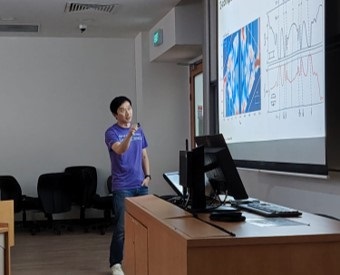
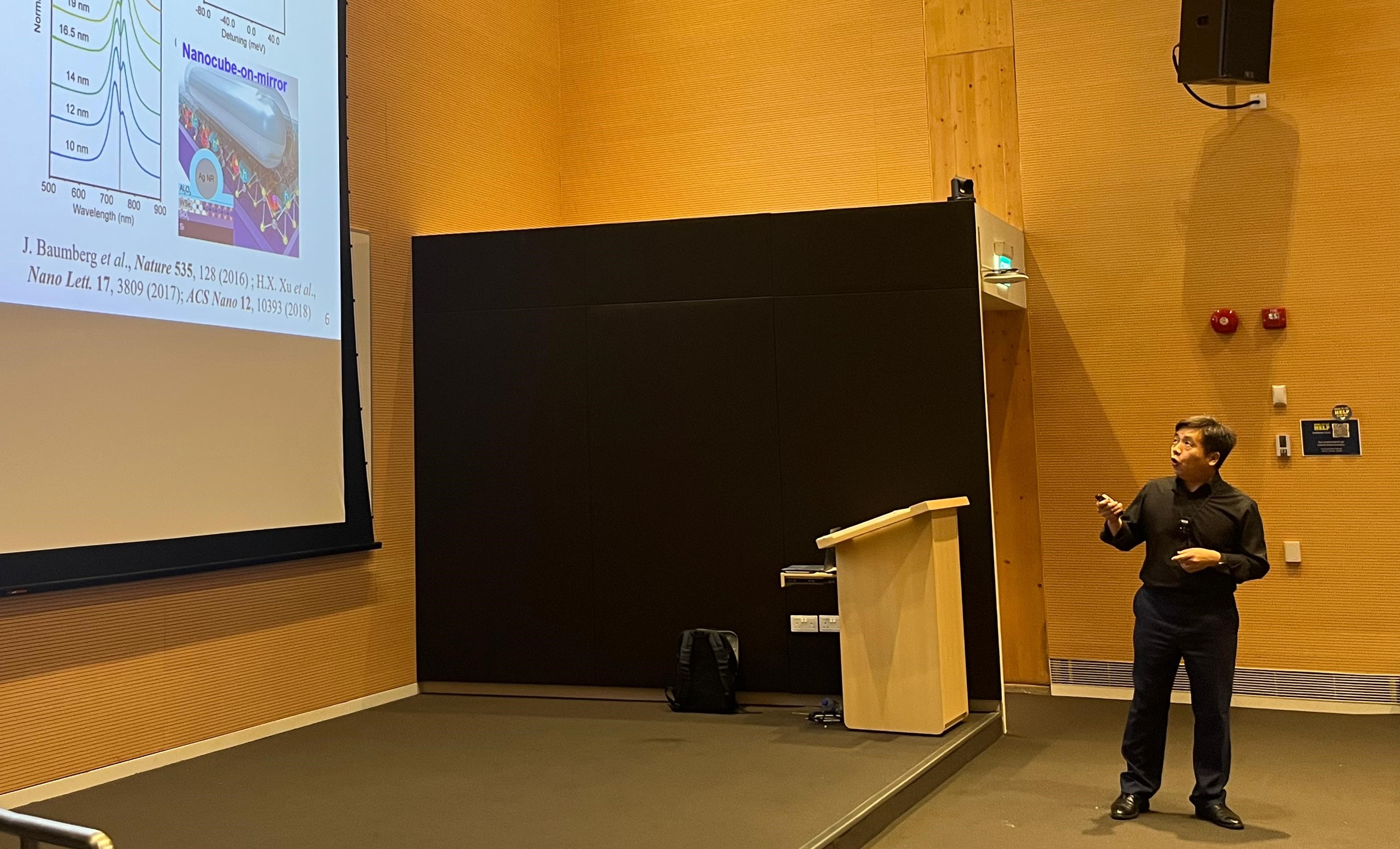 Prof Xiong explains how strong light–matter coupling unlocks ultrafast, low-energy optical functionalities.
From Weak to Strong Coupling—Foundations and Platforms
Prof Xiong began with a lucid primer: in weak coupling, microcavities modulate spontaneous emission rates (Purcell effect). In strong coupling, photons and excitons coherently exchange energy, forming exciton–polaritons with ultralight effective mass and intrinsic nonlinearity, enabling Bose–Einstein-like condensation and lasing. He surveyed platforms such as micropillars, whispering-gallery resonators, photonic crystals, and plasmonic nanogaps, and explained the trade-off between extreme confinement and increased dissipation.
Room-Temperature Breakthroughs: Perovskites & TMDs
A central theme was achieving room-temperature polariton physics. Materials with large exciton binding energies like perovskites, ZnO, organics, and TMDs, have shifted what is experimentally possible. Prof Xiong’s teams demonstrated perovskite polariton condensation/lasing, then engineered artificial potentials to realise S/P/D states and even topological edge/corner modes. In TMD microcavities, they benchmarked parametric scattering and coherence and showed how phase-space filling and Coulomb effects tune nonlinear responses.
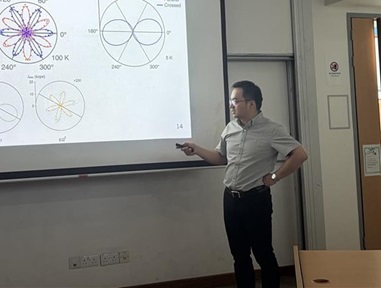
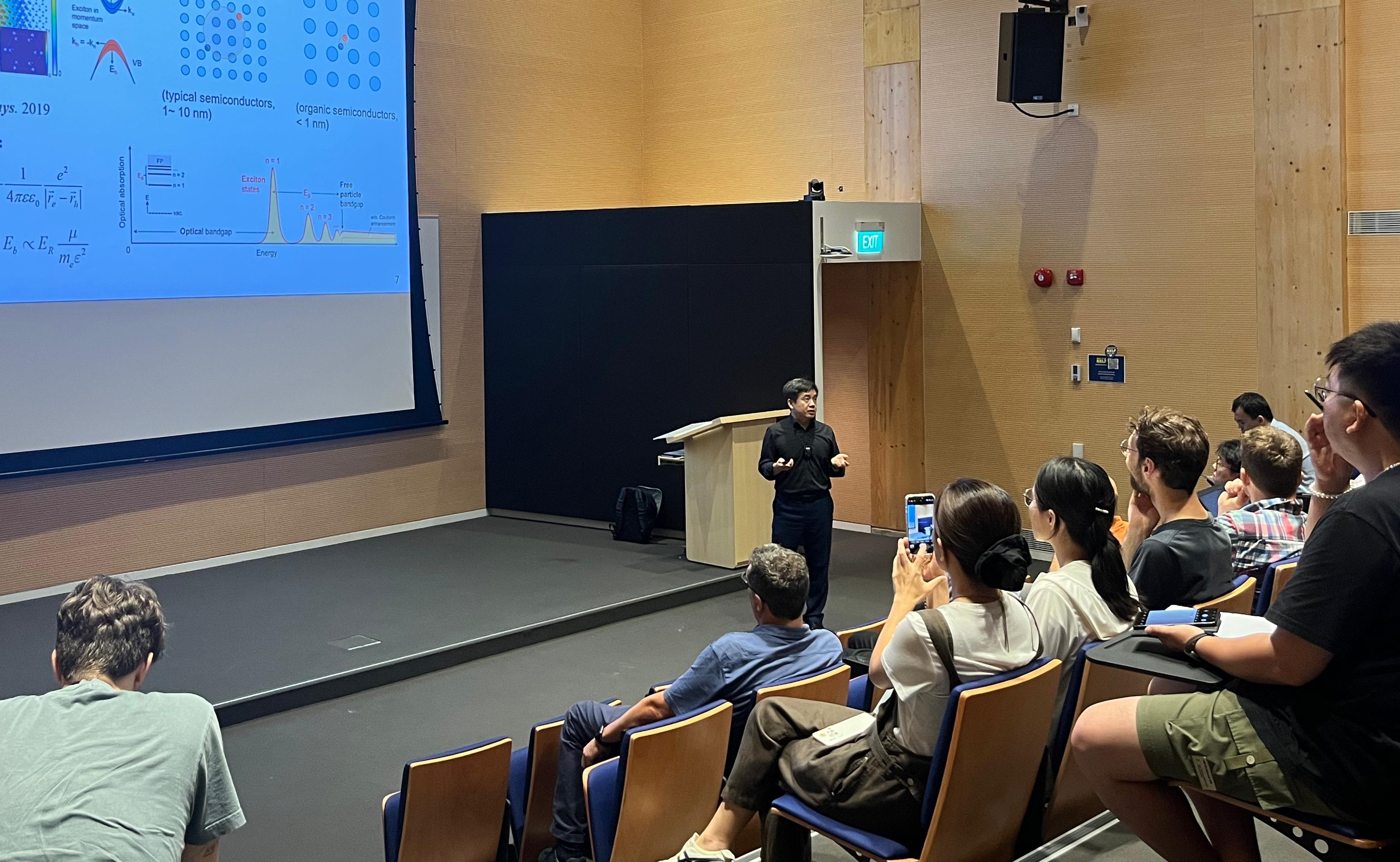 The colloquium highlights advances in polariton photonics, demonstrating ultrafast AI hardware and spin-based optical control.
Ultrafast Propagation and Neuromorphic Photonics
Using time-resolved Kerr-gating and 4f imaging, the group tracked polariton wavepackets propagating tens of microns at a few percent of c while maintaining coherence. Building on this, they implemented reservoir computing with perovskite microcavities at room temperature, achieving >92% accuracy on a digit-classification task. Thus providing evidence that polaritons can underpin ultrafast, energy-efficient hardware AI beyond purely electronic limits.
Spin Hall of Light—Now at Room Temperature
The colloquium then moved to optical spin Hall effect (OSHE) in perovskite cavities. TE–TM splitting acts as an effective magnetic field, generating momentum-dependent spin textures measured via Stokes parameters. The team observed spin-polarised beam splitting (σ⁺/σ⁻ streams) over ~60 μm with preserved coherence, which is an encouraging step toward on-chip spin-optoelectronic elements that route information by polarisation.
Open Cavities, Field Control, and the Road to Integration
To overcome the rigidity of fixed cavities, Prof Xiong’s lab is building piezo-tunable open cavities that allow fine spectral alignment and electrical/magnetic control, compatible with monolayer TMDs and 2D magnets. Early demonstrations on WS₂ and Cr-based 2D antiferromagnets hint at reconfigurable polariton platforms that blend materials science with quantum photonics.
.jpg?sfvrsn=2cb9fcc2_1)
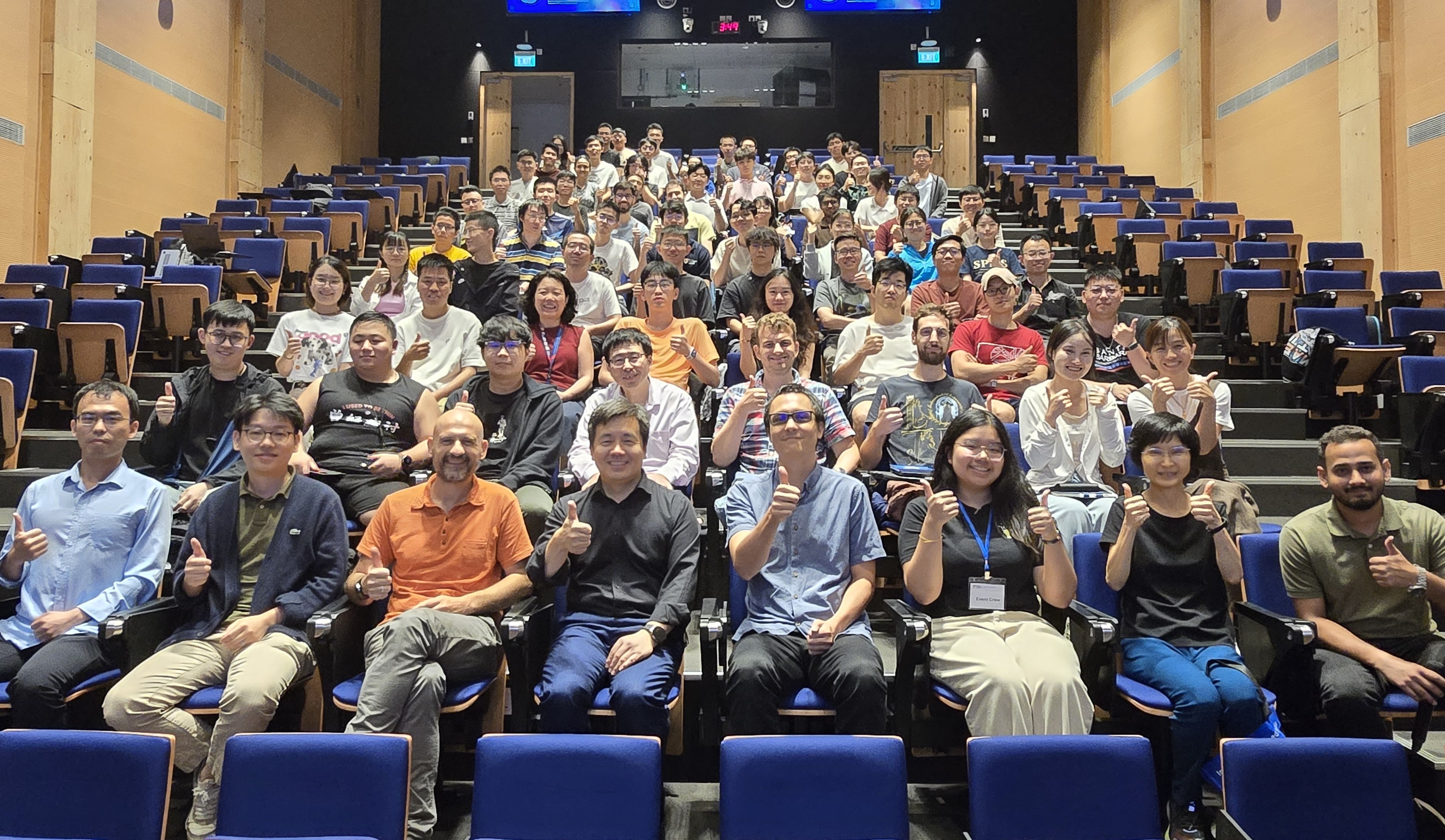
Audience members pose questions on optical devices in an engaging Q&A session following the presentation.
Closing Reflections
The colloquium ended with warm applause. What many expected to be a highly technical hour unfolded as a big-picture tour of how careful materials choices, cavity design, and nonlinear optics converge into practical room-temperature devices; from spin-controlled light to optical computing. Prof Xiong’s “homecoming” spirit and commitment to training young scientists resonated with the audience, which also underscored NTU’s role in this field’s growth.
Written by Cui Peiyuan | NTU School of Physical and Mathematical Sciences Graduate Students’ Club
“I particularly enjoyed the Spin splitter via optical spin Hall effect”- Teo Hau Tian (PhD Student, SPMS)
“Great examples given during the talk!”- Nelson Ong Kim Soon (PhD Student, CCEB)
Watch the recording here