On Landau’s Paradigm for the Classification of Phases by Prof Haruki Watanabe
IAS@NTU STEM Graduate Colloquium Jointly Organised with the Graduate Students' Clubs
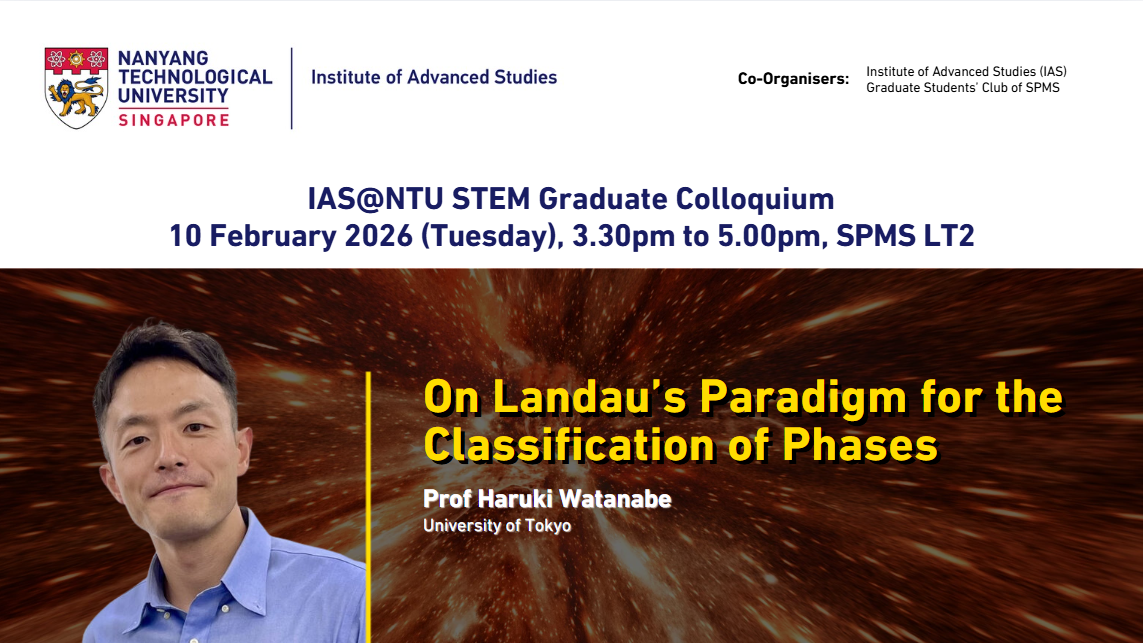
On 10 February 2026, the IAS@NTU STEM Graduate Colloquium featured an insightful presentation by Prof Haruki Watanabe from the University of Tokyo. In his colloquium, titled “On Landau’s Paradigm for the Classification of Phases,” Prof Watanabe revisited one of the most influential ideas in condensed matter physics: the classification of phases of matter through symmetry breaking. His talk explored a simple but profound question—how far the Landau paradigm can go in distinguishing phases and phase transitions, and where its limitations might appear.
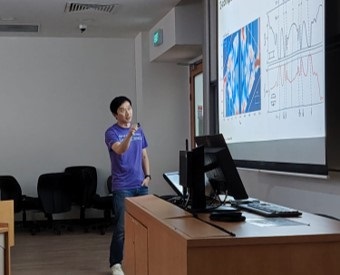
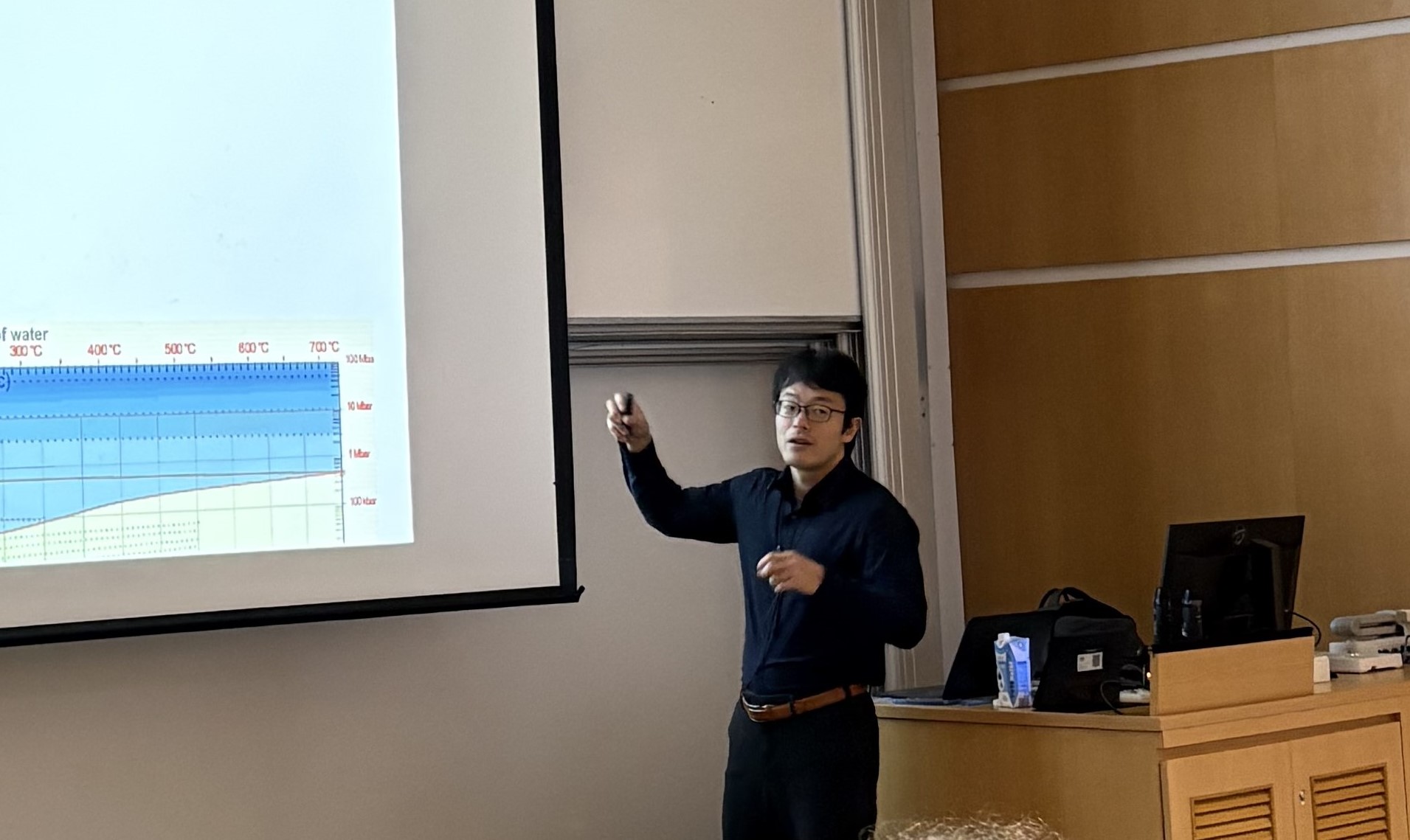 Prof Watanabe revisits symmetry breaking in condensed matter physics, examining the reach and limits of the Landau paradigm.
For decades, phases of matter have been understood through the Landau paradigm, which classifies phases according to the symmetries that their ground states spontaneously break. In this framework, a phase transition occurs when a symmetry of the system is broken or restored, and the transition is characterized by an order parameter that changes non-analytically. Familiar examples include magnetic materials, where rotational symmetry is broken when spins align, or crystalline solids, where translational symmetry is broken when atoms arrange themselves into a lattice.
However, the discovery of topological phases of matter in the late twentieth century complicated this picture. These phases cannot be described by conventional local order parameters or obvious symmetry breaking. Instead, they are distinguished by global properties of the quantum state. Prof Watanabe noted that although such phases initially appeared to lie outside Landau’s framework, modern developments show that many of them can be interpreted in terms of breaking of something referred to as “higher-form” symmetry. Yet even with these broader perspectives, certain physical systems still present puzzles that challenge how phases should be classified.
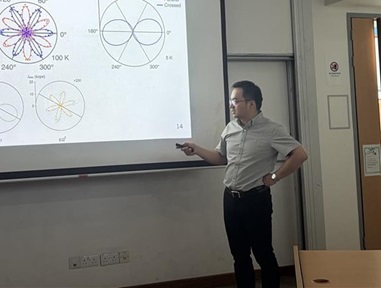
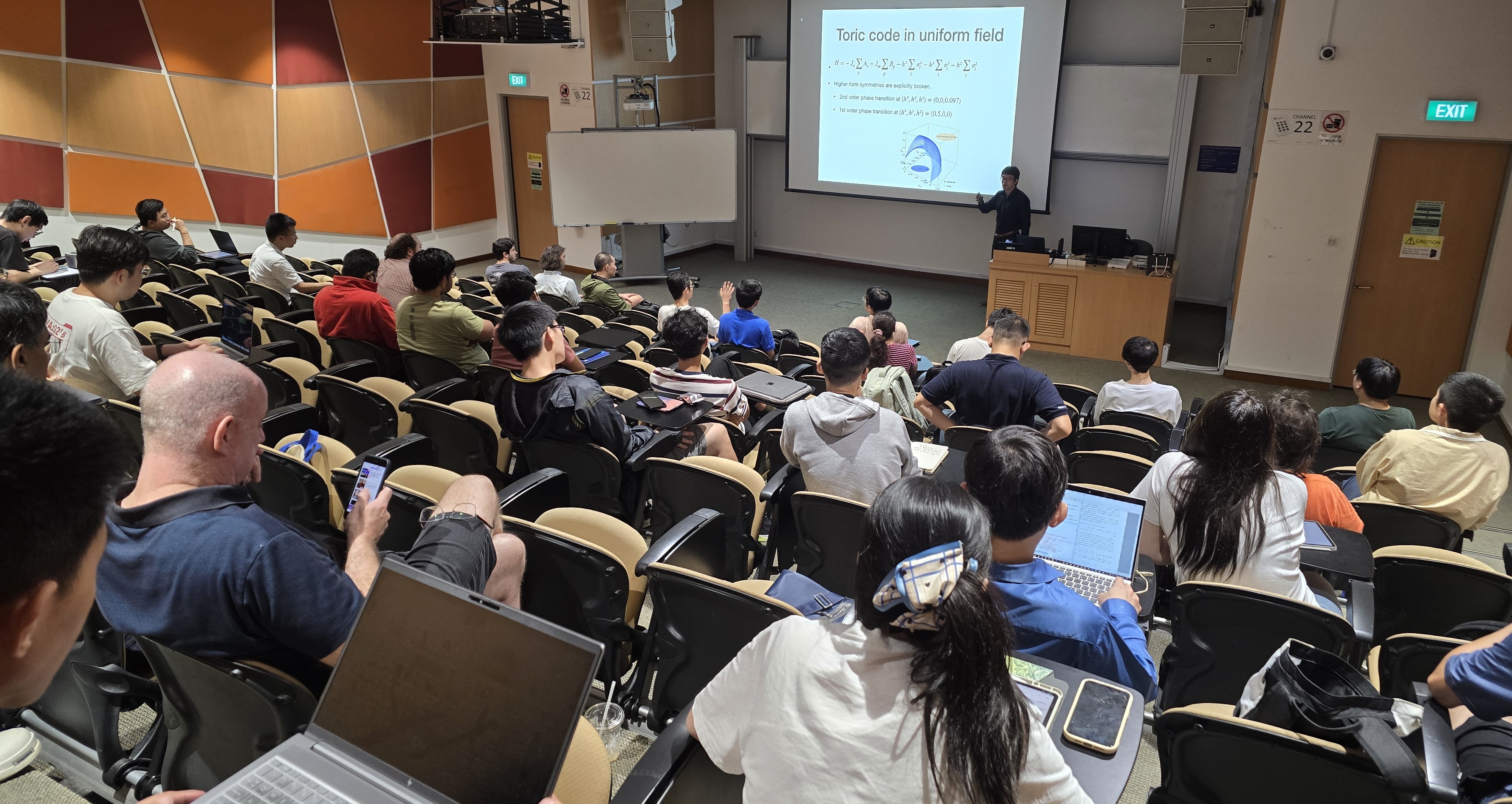 Prof Watanabe explains how topological phases challenge Landau’s theory, highlighting higher-form symmetries and unresolved puzzles in classifying quantum matter.
To illustrate this, Prof Watanabe discussed an example from an unexpected setting: the crystalline forms of water. Under high pressures and low temperatures, H2O crystallizes into numerous solid structures known as ice polymorphs. Two such phases are Ice VII and Ice X. In Ice VII, oxygen atoms form a cubic lattice while protons occupy asymmetric positions along the hydrogen bonds, producing O–H···O bonds in which the proton sits closer to one oxygen atom. In Ice X, by contrast, the proton lies midway between the two oxygen atoms, forming a symmetric O–H–O bond in which it is effectively shared. As Prof Watanabe pointed out, despite this significant microscopic change in the proton configuration, the symmetry of the oxygen lattice remains the same (cubic) in both structures.
This raises a natural question: are Ice VII and Ice X genuinely different phases of matter? Experimental studies over the past several decades have not given a clear answer. Early measurements suggested the possibility of a sharp first-order phase transition, while later high-pressure spectroscopic experiments indicated that the change might occur continuously. From the viewpoint of the Landau paradigm, the puzzle is evident. Since the oxygen lattice symmetry does not change, there is no obvious symmetry breaking distinguishing the two states. The only difference lies in the microscopic position of the proton along the hydrogen bond. As Prof Watanabe emphasized, this leads to a deeper conceptual question: to what extent should microscopic degrees of freedom be considered when defining phases? In this sense, the Ice VII ↔ Ice X problem goes beyond crystallography and invites a reconsideration of how rigid the usual criteria for phase transitions should be.
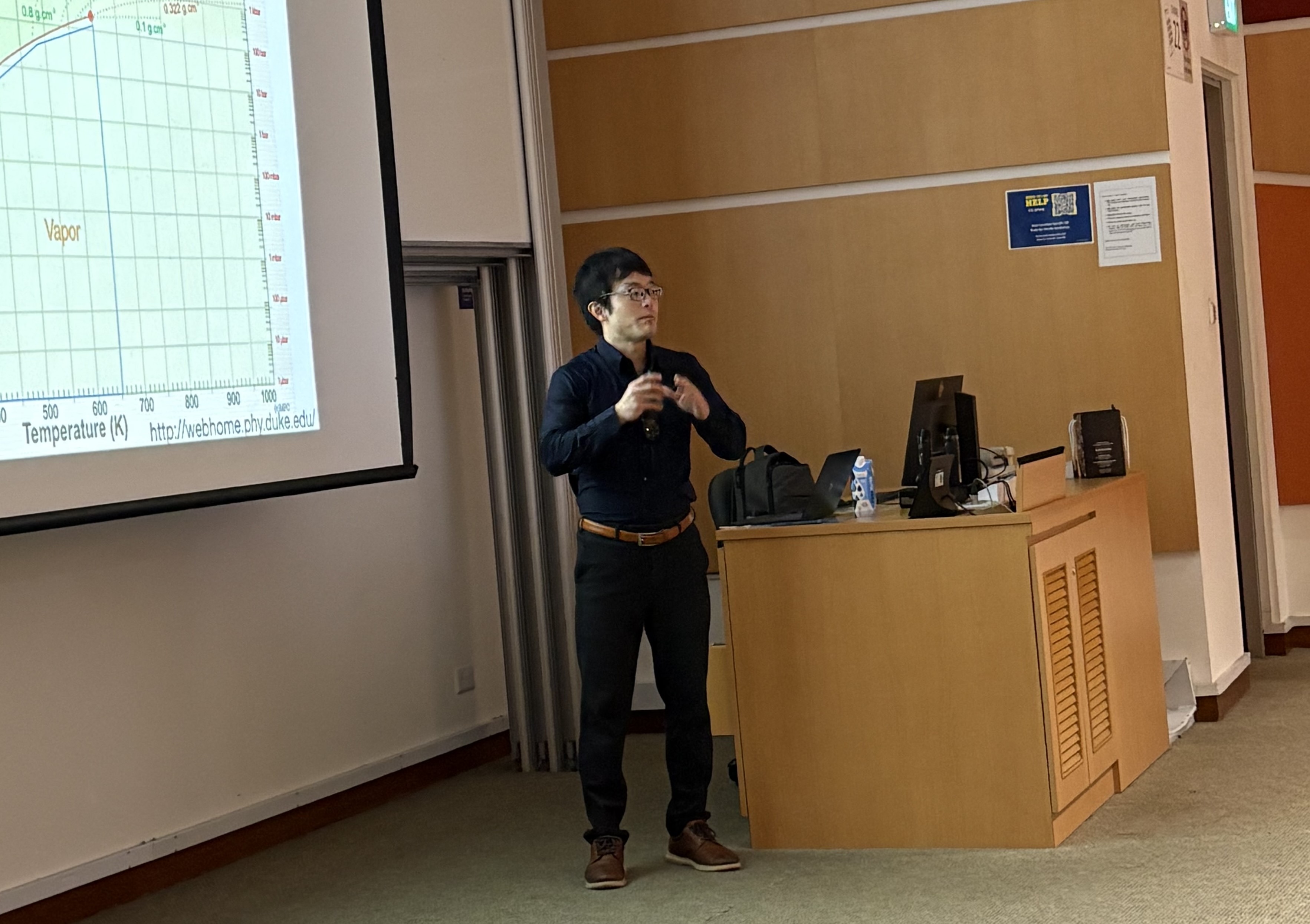 Prof Watanabe explores how boundaries between different states can blur, showing how nature sometimes shifts gradually rather than abruptly.
While navigating this puzzle, Prof Watanabe drew connections to several theoretical models in condensed matter physics where phase distinctions become subtle. One example he mentioned was the 3D Toric Code, which exhibits phases distinguished not by breaking symmetry but by topological order. In this system, a sharp transition exists at zero temperature, yet at finite temperature the distinction can blur into a crossover. The absence of a conventional order parameter makes the classification less straightforward, echoing the ambiguity seen in the Ice VII ↔ Ice X transformation.
Another analogy he highlighted involved the N-state clock Model, which interpolates between the Ising Model and the XY Model depending on how many states the spin can take. By drawing an analogy between the Ice VII ↔ Ice X problem to double well problem, Prof Watanabe noted that the behavior of protons along the O–H–O bond in dense ice can be viewed in a similar way: when tunnelling between two positions is weak, the proton effectively occupies one of two discrete states, whereas increasing pressure allows stronger tunnelling and gradual delocalization. Whether this evolution corresponds to a sharp restoration of symmetry or a smooth crossover remains an open question.
 Local constraints in ice-like systems shape how particles organise, revealing complex behavior and blurred boundaries between distinct states of matter.
He also briefly mentioned models of spin-1 on the Pyrochlore Lattice, where local “ice-rule” constraints lead to emergent gauge symmetry. The analogy with water ice is striking. Proton displacements along hydrogen bonds resemble spin directions, and the constraints governing these positions mirror the rules that organize spins in such lattices. These examples highlight how local constraints and internal degrees of freedom can complicate the usual symmetry-based classification of phases.
Returning to the Ice VII ↔ Ice X problem, Prof Watanabe explained that one way to clarify the situation is to study simplified theoretical models and search for thermodynamic signatures of a genuine phase transition. Numerical approaches such as Monte Carlo simulations can reveal whether order parameters or quantities like the specific heat display non-analytic behavior. Current results from such studies suggest that the transformation between Ice VII and Ice X may correspond to a smooth crossover rather than a true phase transition, implying that the two structures could belong to the same thermodynamic phase.
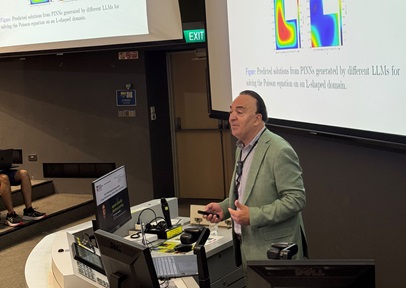
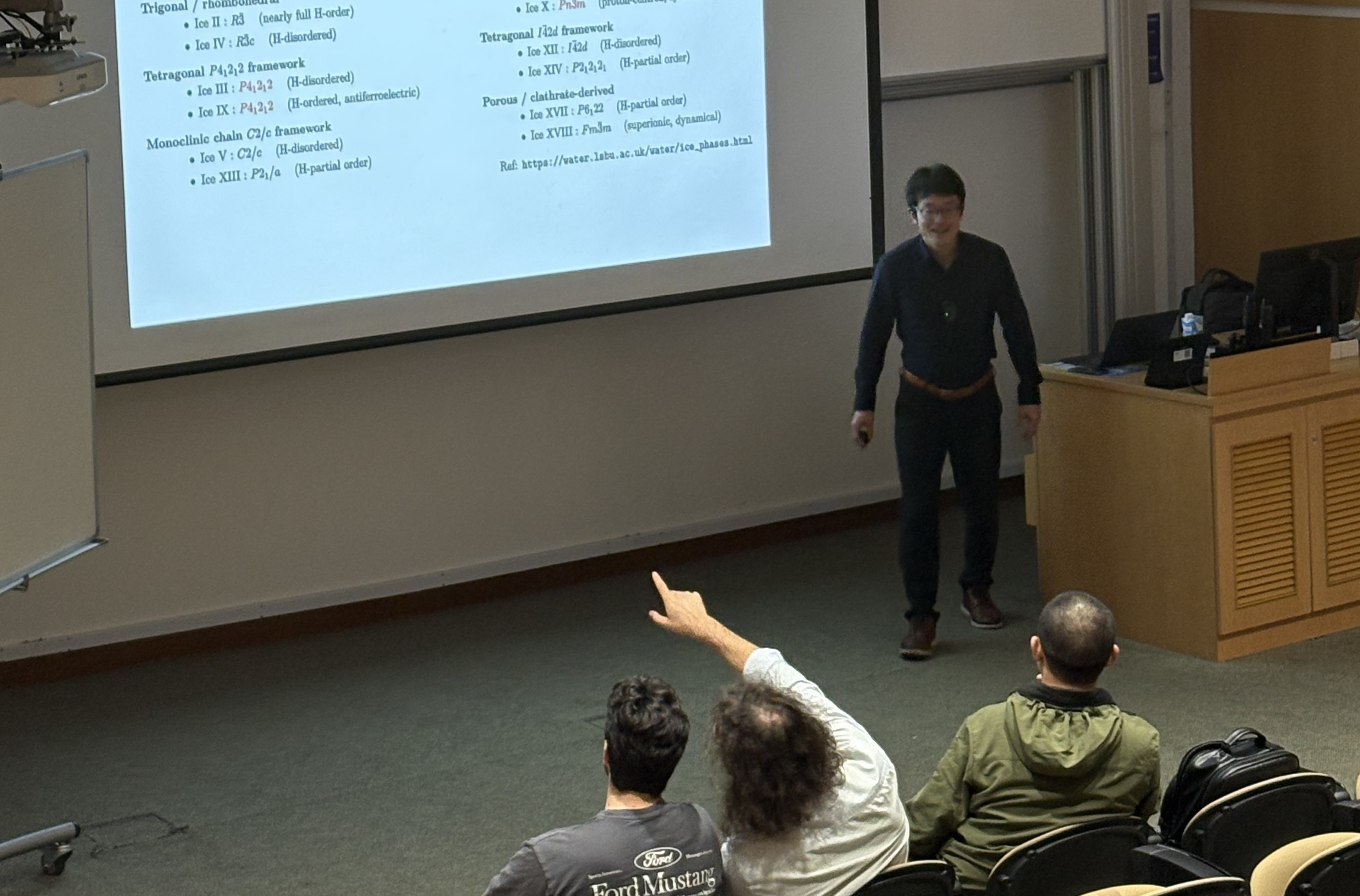 The colloquium concludes with engaging questions from the audience on challenging existing theories and inspiring new ways to understand nature.
As Prof Watanabe concluded, establishing this result more rigorously remains an important open challenge. More broadly, the Ice VII ↔ Ice X puzzle illustrates how systems with subtle internal degrees of freedom can test the limits of the Landau paradigm. Understanding when symmetry breaking is sufficient, and when additional concepts are required, continues to shape modern efforts to classify the rich variety of phases found in condensed matter systems.
This colloquium is held in conjunction with the ongoing IAS Frontiers Seminars: Quantum Horizons series. Find out more about the upcoming seminars and register here.
Written by: Adira Mohitha | NTU School of Physical and Mathematical Sciences Graduate Students' Club
“I enjoyed the presentation on the ice space group examples .” – Huang Wenyue (Masters student, EEE)
"It was fascinating to know about finite temperature phase transitions without SSB" - Adira Mohitha (PhD student, SPMS)
Watch the recording here: