General Properties of Frustration-Free Many-Body Systems by Prof Haruki Watanabe
IAS Frontiers Seminars: Quantum Horizons, Seminar #6
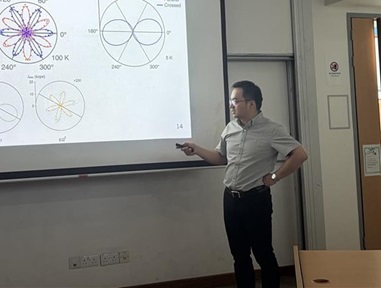
On 9 February 2026, the Institute of Advanced Studies (IAS@NTU), in collaboration with the Graduate Students’ Club of the School of Physical and Mathematical Sciences (SPMS) hosted the IAS Frontiers Seminars: Quantum Horizons by Prof Haruki Watanabe on “General Properties of Frustration-Free Many Body System”. To begin with, Prof Watanabe defined what a frustrated system is, the simplest of them being a triangle of spin with antiferromagnetic coupling, where any two spins could align antiparallel to satisfy this coupling, but no configuration including the third spin cannot simultaneously minimise the energy of each bond. The system then remains frustrated.
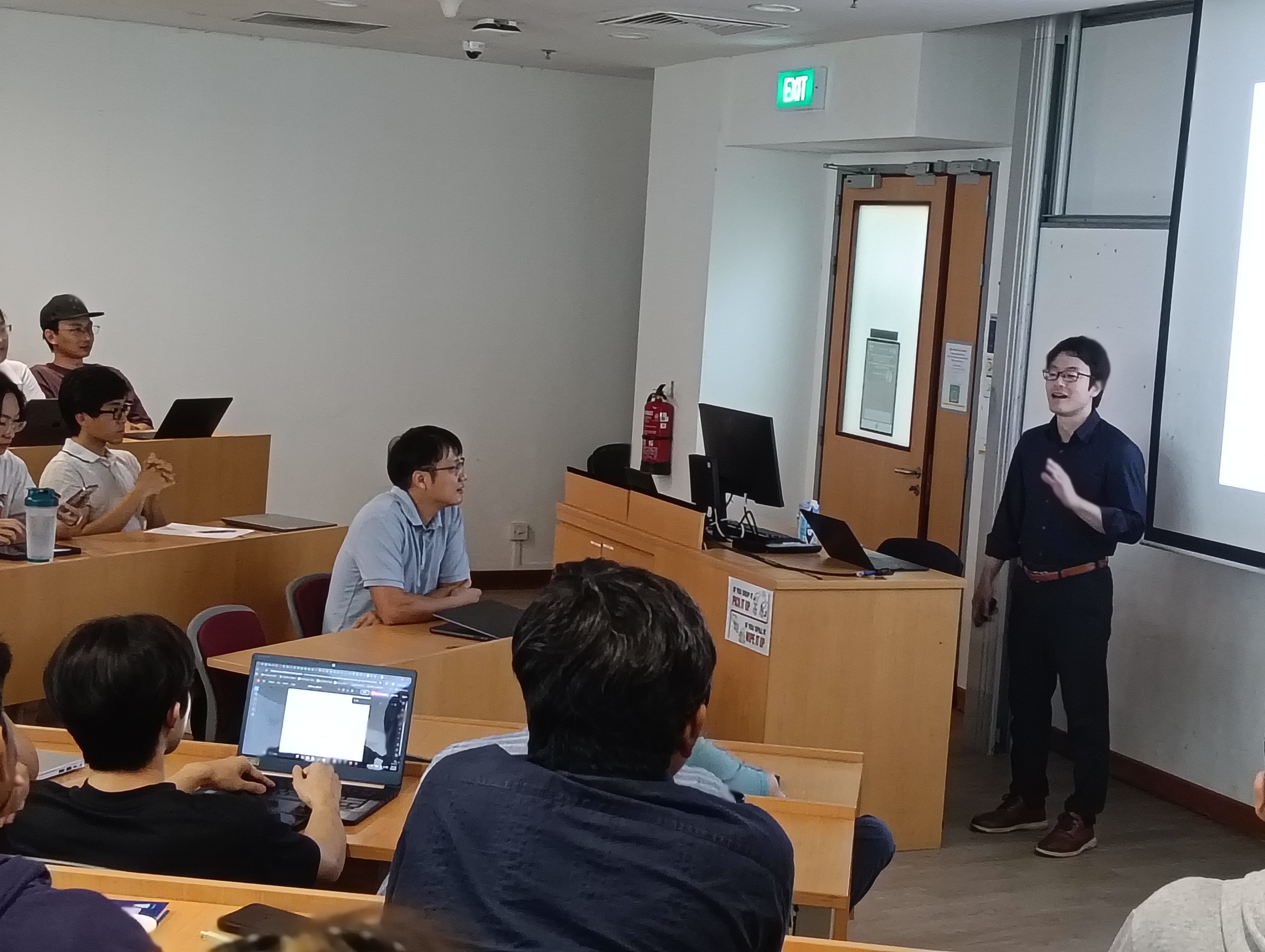 Prof Watanabe explains frustrated systems, showing how competing interactions prevent simultaneous energy minimisation and create persistent physical frustration.
This, a frustration-free system is one where each bond, represented by local terms in the global Hamiltonian is finite-ranged and simultaneously minimised by the ground state. Many of the famous solvable models are frustration-free (FF), such as AKLT and Majumdar-Ghosh spin chain, as well as Toric code. A frustration-free system could be gapped, meaning there is a finite energy gap from the ground state to the first lowest energy level, or gapless, where this energy goes to zero in the thermodynamic limit. A gapped system such as the standard N-dimensional Toric code can sustain ground state degeneracy, but research by Prof Watanabe and his colleagues in modified N-dimensional Toric code shows that there can be topological order with degeneracy of 1. Prof Watanabe also mentioned that U(1) continuous symmetry cannot be broken at finite temperature for system of dimension 2 or lower, as per Hohenberg-Mermin-Wagner theorem, of which he gave proof by contradiction and via Bogoliubov inequality. However, in gapped FF system, this restriction can be bypassed, even in one-dimensional system. This is possible because FF condition allows an exact two-fold (or higher) ground-state degeneracy on a finite chain. The degenerate ground states can each transform nontrivially under U(1), so the symmetry is effectively broken in each one.
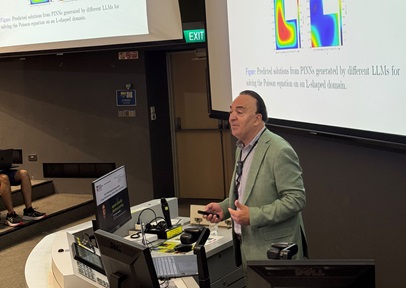
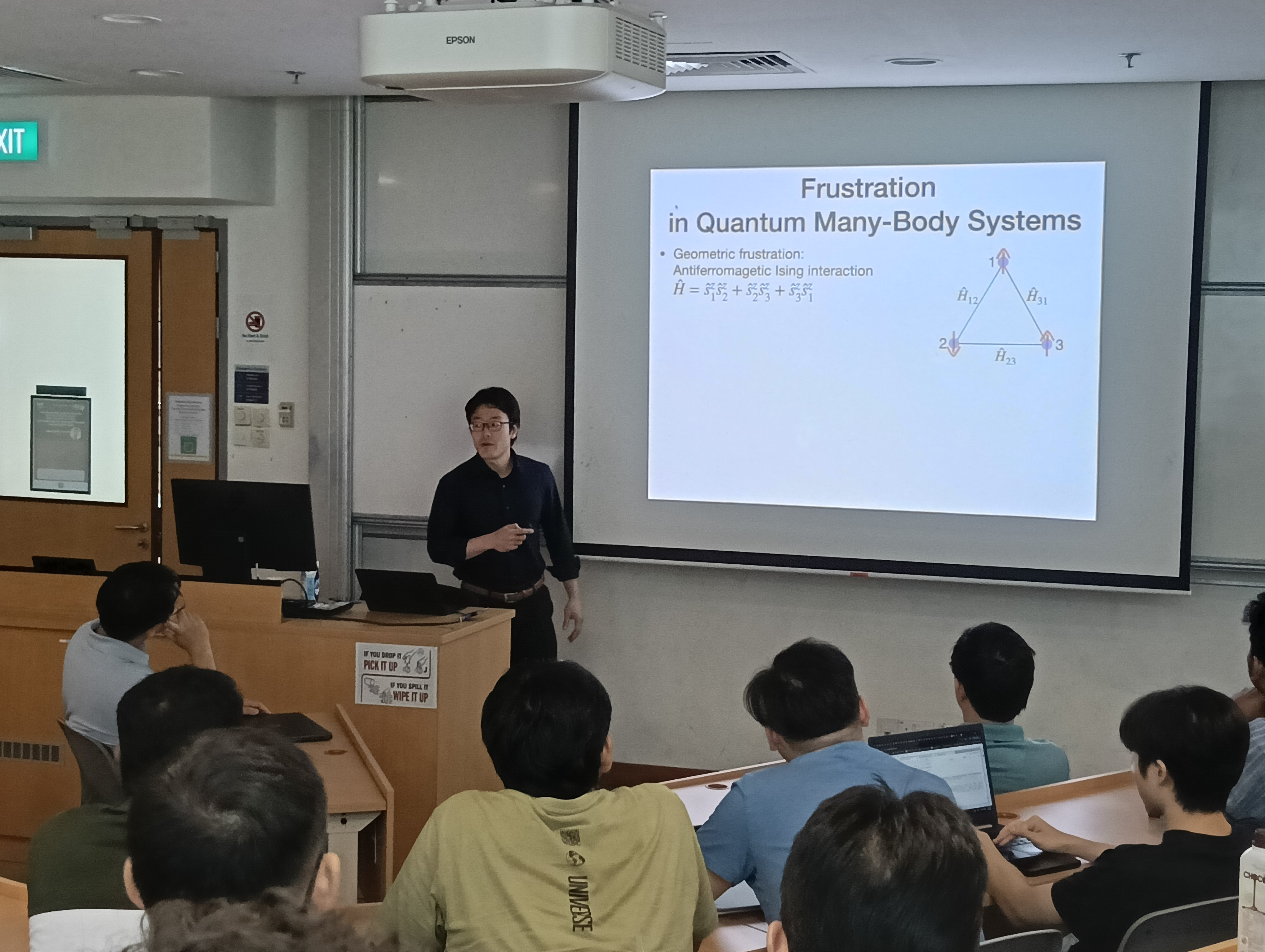 Prof Watanabe explains how system size and interactions shape energy behaviour and reveal unexpected properties in complex materials.
With the foundations in place, Prof Watanabe laid out the conjectures relating to FF systems, starting with the scaling of finite-size gap. That is, if the Hamiltonian if frustration-free and gapless, then there is a finite energy gap that scales as inverse power of the system size, where the power here is the dynamic critical exponent in 2D Ising model. Secondly, he explained that finite-size splitting, where degenerate energy levels that slightly differs to each other in finite system, is absent in gapped FF system. Conversely, if the system is frustrated, then the ground state becomes slightly non-degenerate, showing finite-size splitting. Thirdly, Prof Watanabe stated that gapped FF system cannot host a Chern insulator - a special phase of matter that gives rise to insulating bulk yet chiral edge current, quantified by Hall conductance. In this case, the Hall conductance of gapped FF system is zero.
Then, Prof Watanabe presented a new result on the spin-1/2 model with nearest neighbour interaction and translational symmetry, which only hosts two gapless FF class with quadratic dispersion, as well as a new theorem for the audience to think about. He supposed that if the Hamiltonian is frustration-free, and the equal-time correlation function shows power law decay, which is only possible in gapless system, then the finite size energy gap scales as inverse power of the system size. Prof Watanabe then concluded with some unexpected application of the frustration-free frameworks: relaxation to equilibrium state in Markov chain, mapping of Markov chain with detailed balance and locality to frustration-free Hamiltonian, and the extension of frustration-free model to fermionic systems.
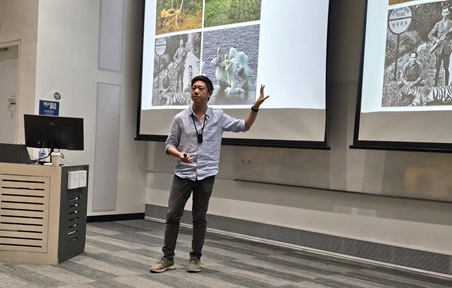
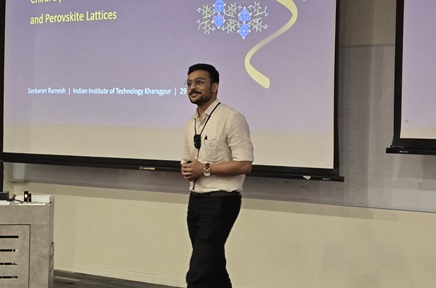
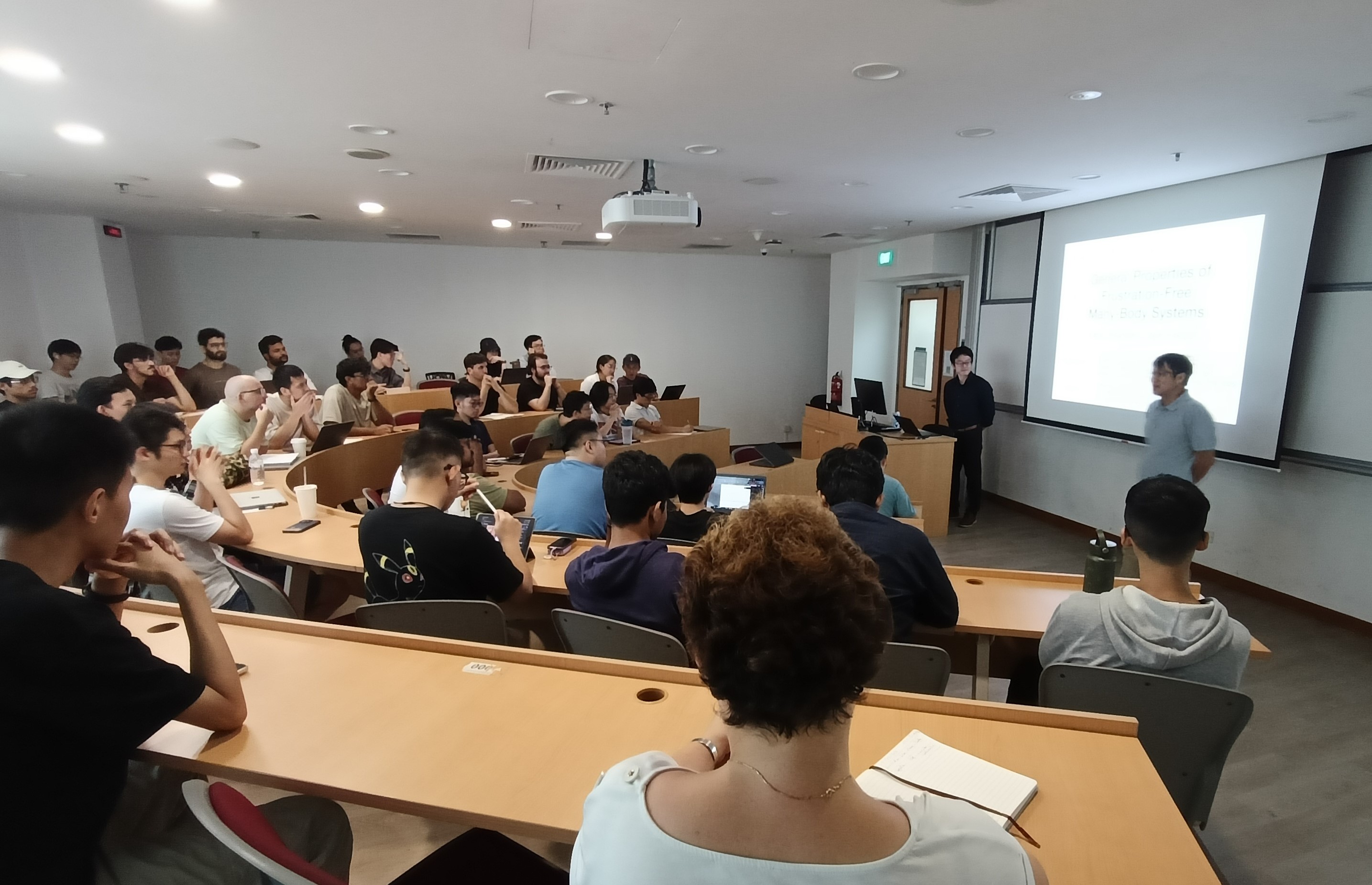 Audience engages in lively discussion, exploring complex ideas together and gaining deeper understanding through shared curiosity.
Throughout the seminar, many in the audience, ranging from PhD students to faculty members, went on a lively back-and-forth questions to clarify and explore a more unified understanding of quantum many-body systems based on symmetry and frustration. In the end, even though the topic was a theoretical challenge, it was an enriching experience for all the attendees.
This seminar is part of the ongoing IAS Frontiers Seminars: Quantum Horizons series. Find out more about the upcoming seminars and register here.
Written by Dustin Erhard Theofilus| NTU School of Physical and Mathematical Sciences
“The professor was open to questions and he took every question seriously and spent time on it." - John Tan (PhD Student, SPMS)
"Prof Watanabe showed comprehensive details of the quantum many-body systems based on symmetry and frustration, further explored to the goal of general properties of FF Hamiltonians." - Qhiu Kuan-Fu (Masters Student, SPMS)
“I enjoyed the various examples of FF Hamiltonians, and implications on band separation” - Tang Yue (PhD Student, IGP-ERI@N)