Charge Density Wave Orders in Rhombohedral Graphene by Prof Leo Jia Li
IAS Frontiers Seminars: Quantum Horizons, Seminar #2 (AY26/27)
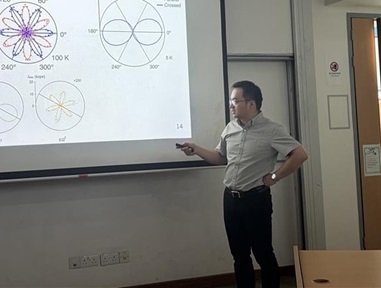
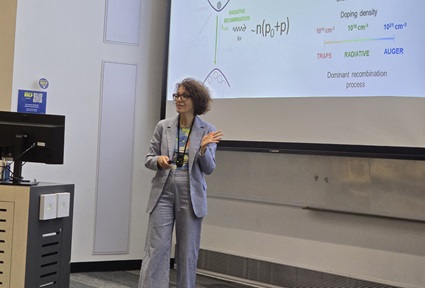
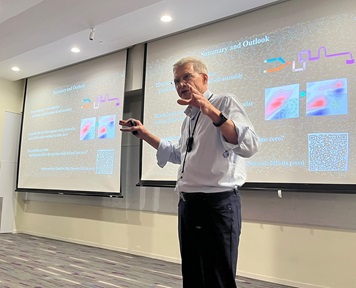
The IAS Frontiers Seminar on Quantum Horizons on 5th October 2026, featured Prof Leo Jia Li (University of Texas at Austin). Prof Leo is an experimentalist who primary works on the transport measurement of layered materials. In this seminar, he introduced his recent finding on the coexistence of charge order and Fractional Quantum Hall (FQH) effect as well as superconductors in Rhombohedral Multilayer Graphene (RMG).
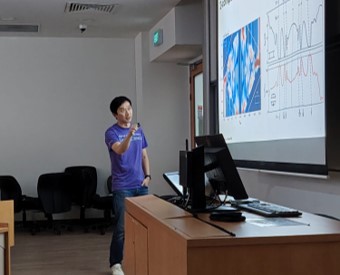 Prof Leo began his seminar with concepts on Fractional Quantum Hall Effect and particle transport.
Prof Leo began with an introduction on Fractional Quantum Hall (FQH) effect: bulk insulating states with nontrivial edge transport of particles carrying fractional charge. Specifically, he mentioned the Jain sequence which predicts FQHE could only be measured on separated filling levels and forms a gapless fermi liquid with half filling. Similar Jain sequence has been found in systems (RMG) with zero magnetic field. In multilayer structure, FQHE states are described by 2 component Jain sequences that require both the effective fillings of two composite fermions to be integer. This idea of electrons occupying difference states at the top and bottom layer of the RMG is the key for understanding the coexistence of charge order and FQHE.
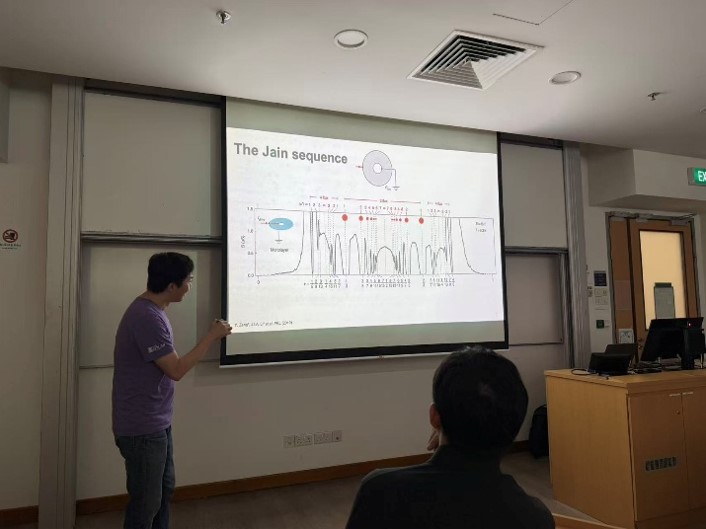 Prof Leo dove into the Jain sequence, the emergence of fractional Quantum Hall plateau and its significance on charge ordering and fractionalisation.
Next, Prof Leo showed the phase diagram of a Quantum Hall system formulated by Fogler, where charge order with a various number of electrons per unit cell could appear as a “bubble” phase occupying a range of filling factors. This charge order formation is facilitated by the inverted dispersion of RMG bands that lead to filling of higher Landau levels. Using a Carbino disk R8G device, Prof Leo measured the bulk resistance with varying magnetic field and charge density. The existence of charge ordering is demonstrated by a boarded incompressible region from a Reentrant Integer Quantum Hall (RIQH) state since the charge density wave (CDW) reduces itinerant electrons taking part in edge transport. To further study this phenomenon, Prof Leo applied a different displacement field to control the filling on the top and bottom layer and observes a “checkboard” distribution of Quantum Hall states with two striking boundaries of high conductance. When increasing the B-field, the extended Quantum Hall states signaling the RIQH effect appears, separated by the same boundary where a first-order transition between different FQH quantisations on top and bottom layers take place. This breaking down of Jain sequence and emergence of FQH plateau at integer filling is strong evidence of the co-existence between charge ordering and fractionalisation.
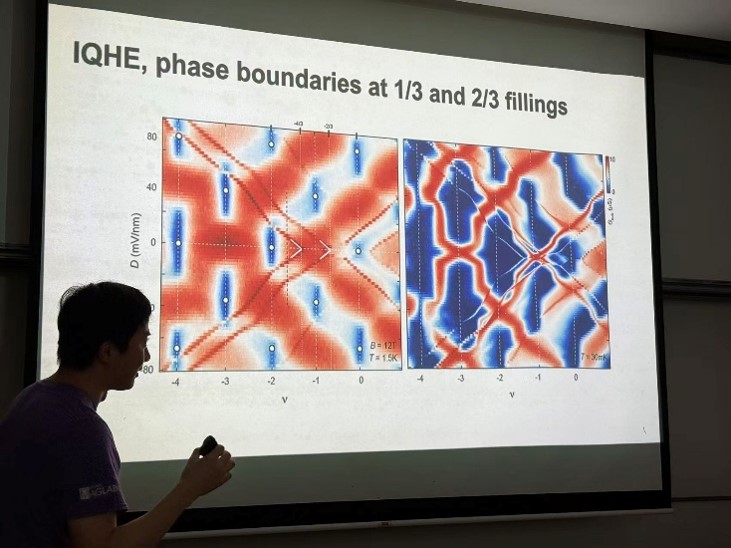 Prof Leo shared his latest findings on the complex electronic states observed in the system.
Finally, Prof Leo reported his results on the state inside the metallic “region II” when we turn on a magnetic field. Again, he found Quantum Hall physics together with charge ordering. At a higher displacement field, however, a superconducting (SC) state appears. This SC state is highly tolerant to magnetic fields, and the phase diagram shows its critical temperature is closely related to the critical temperature of CDW. This suggests new possibilities on the origin of pairing of unconventional SC states.
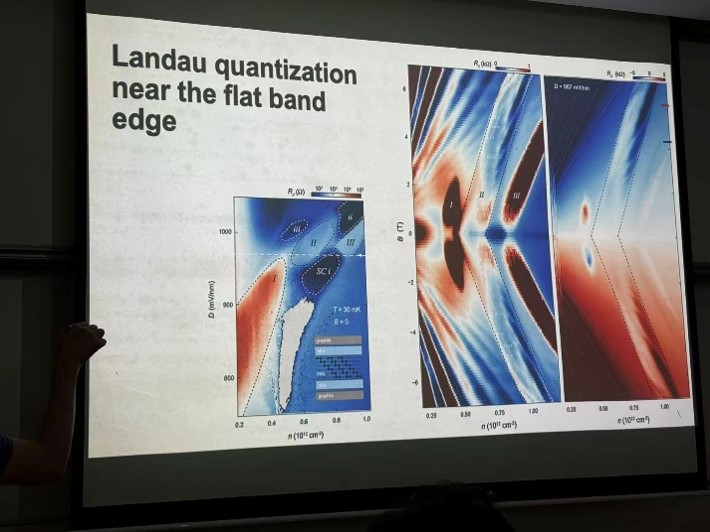 Prof Leo engaged with the audience and addressed questions following his seminar.
After the seminar, Prof Leo answered the question from audience, including detailed techniques in resistance measurements as well as the theoretical origins of band inversion and charge order formation. From the seminar, people learned about Rhombohedral Multilayer Graphene as an ideal playground of strong correlated physics, and the non-trivial phases that incorporate charge order and fractionalisation.
This seminar is part of the IAS Frontiers Seminars: Quantum Horizons series. Find out more about the AY26/27 seminars here.
Written by Wang Shicong| NTU School of Physical and Mathematical Sciences
"Motivation for the work was explained very well by Prof Leo. This made it easy to follow even for someone who's new to this field. " - Adira Mohitha (PhD Student, SPMS)
"Prof Leo's presentation was systematic and comprehensive " - Zu Shuyu (PhD Student, IGP-NEWRI)