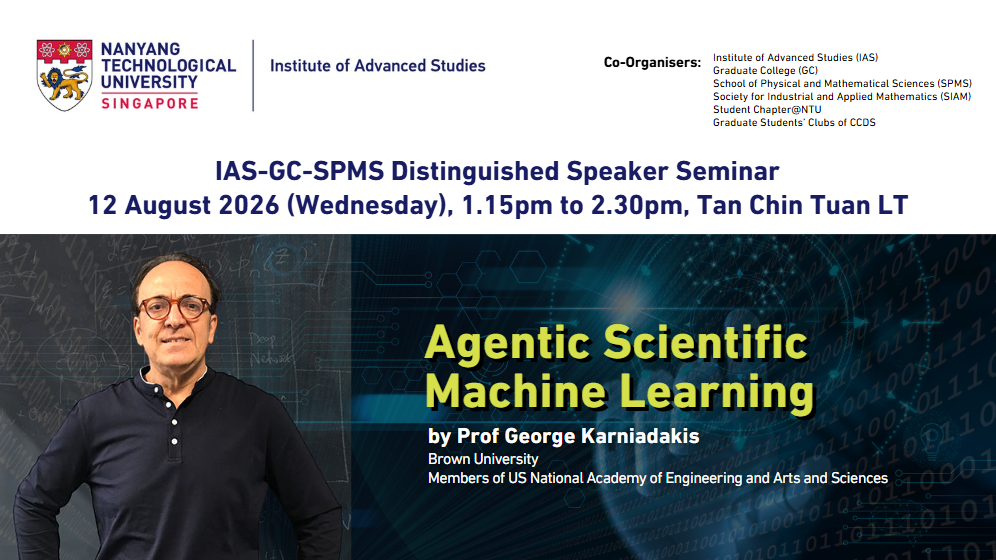
Agentic Scientific Machine Learning by Prof George Karniadakis
IAS-SPMS Distinguished Speaker Seminar Jointly Organised with the Graduate Students' Clubs
On 12 August 2026 the IAS@NTU STEM Graduate Colloquium Series, jointly organised with the Graduate Students' Clubs and the Graduate College, hosted Prof George Karniadakis from Brown University for a distinguished lecture titled “Agentic Scientific Machine Learning”. The presentation detailed the rapid advancement of agentic scientific machine learning systems, exemplified by the ATHENA framework. Prof Karniadakis mapped out the technological trajectory from Physics-Informed Neural Networks (PINNs) to neural operators, followed by the multi-agent architecture of ATHENA and its evolution into Graph ATHENA. The colloquium provided an engaging, broad-overview synthesis for an audience of graduate students, faculty, and computational researchers.
Foundations of Scientific ML and PINNs
Prof Karniadakis began by reviewing the underlying principles of Physics-Informed Neural Networks (PINNs). By embedding physical conservation laws directly into neural network loss functions through automatic differentiation, PINNs eliminate the need for computational meshes and significantly reduce code complexity compared to traditional numerical solvers. Although standard PINNs require retraining whenever initial or boundary conditions change, his research group introduced neural operators, specifically DeepONets, to address this constraint. These allows to produce a family of solutions, the full function that contains “distributions of solutions, not just one solution. So, this allows you to do is to not retrain every time you have new parameters”. Consequently, researchers can evaluate new parameters and boundary conditions in real time without retraining the model for every iteration.
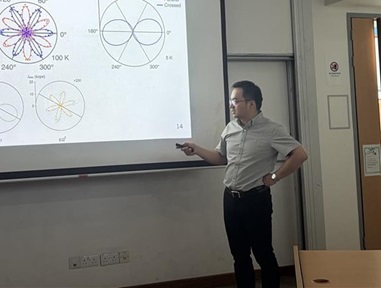
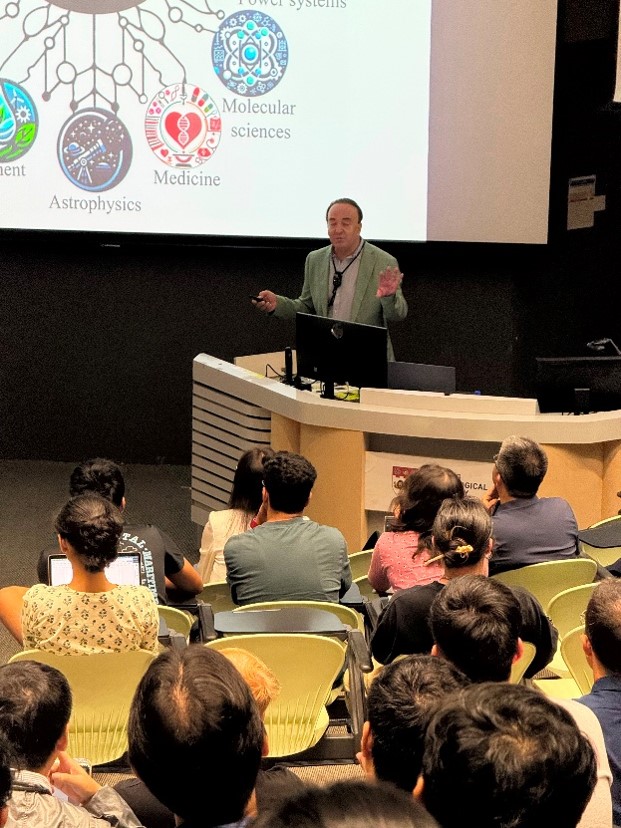 Prof Karniadakis discussed the variety of applications of PINNs
ATHENA: Collaboration via Specialised LLMs
Building on the foundation of PINNs and neural operators, Prof Karniadakis introduced ATHENA, an agentic framework designed to autonomously determine the optimal numerical and machine learning methods for complex physical problems. While individual large language models (LLMs) such as ChatGPT, Claude, or DeepSeek frequently struggle with intricate scientific prompts, assigning specialised operational roles across a multi-agent team overcomes these single-model limitations. In ATHENA, diverse agents assume distinct responsibilities, acting as proposers, critics, coders, and librarians, among others.
The multi-agent workflow begins with a user prompt, such as solving the Burgers' equation in PyTorch with specified boundary conditions. If validation data is absent, the system autonomously searches for necessary data. The proposer agent generates an initial candidate solution, while the critic agent evaluates it to identify gaps or missing implementations, such as unhandled boundary conditions. The coder agent then converts the refined solution into executable PyTorch code, while the librarian agent scans, condenses, and distributes relevant literature across the team. Each agent operates on distinct LLMs with tailored temperature settings. Higher temperatures (e.g., 0.8 for the proposer) foster exploratory search, whereas lower temperatures ensure conservative, deterministic evaluation by the critic, e.g.
ATHENA then subsequently evolves candidates solutionsu using a genetic algorithm, advancing and mutating promising approaches. This hybrid framework pairs classical numerical methods—which excel at eliminating high-frequency errors—with neural networks that handle low-frequency components due to their spectral bias. As a result, ATHENA allows to solve non-linear partial differential equations (PDEs) with 1,000x to 10,000x improvements over root solutions.
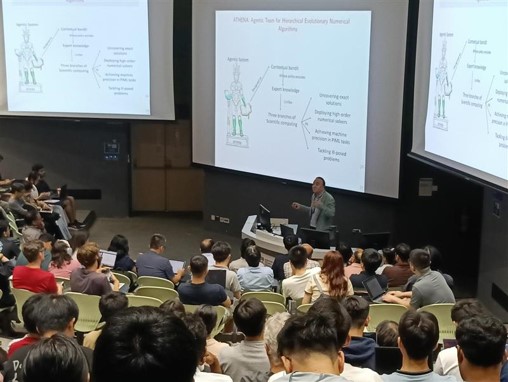 Prof Karniadakis provided an overview of the ATHENA framework.
Graph ATHENA: Geometric Fingerprints for Continual Learning
Prof Karnidakis last introduced Graph ATHENA to address the challenge of continual learning, i.e., “ Can we become smarter and smarter as we solve problems?”. The core innovation lies in encoding both problem domains and solution methods into unique geometric fingerprints. By organising knowledge within a structured metric space using the Jaccard distance, Graph ATHENA measures concept similarity rather than raw text matching.
When presented with a new problem, the system performs probabilistic interpolation across existing fingerprints in the method space to synthesise and select optimal solvers. This geometric memory structure provides an efficient mechanism to manipulate, store, and build upon prior successes and failures without triggering memory explosion.
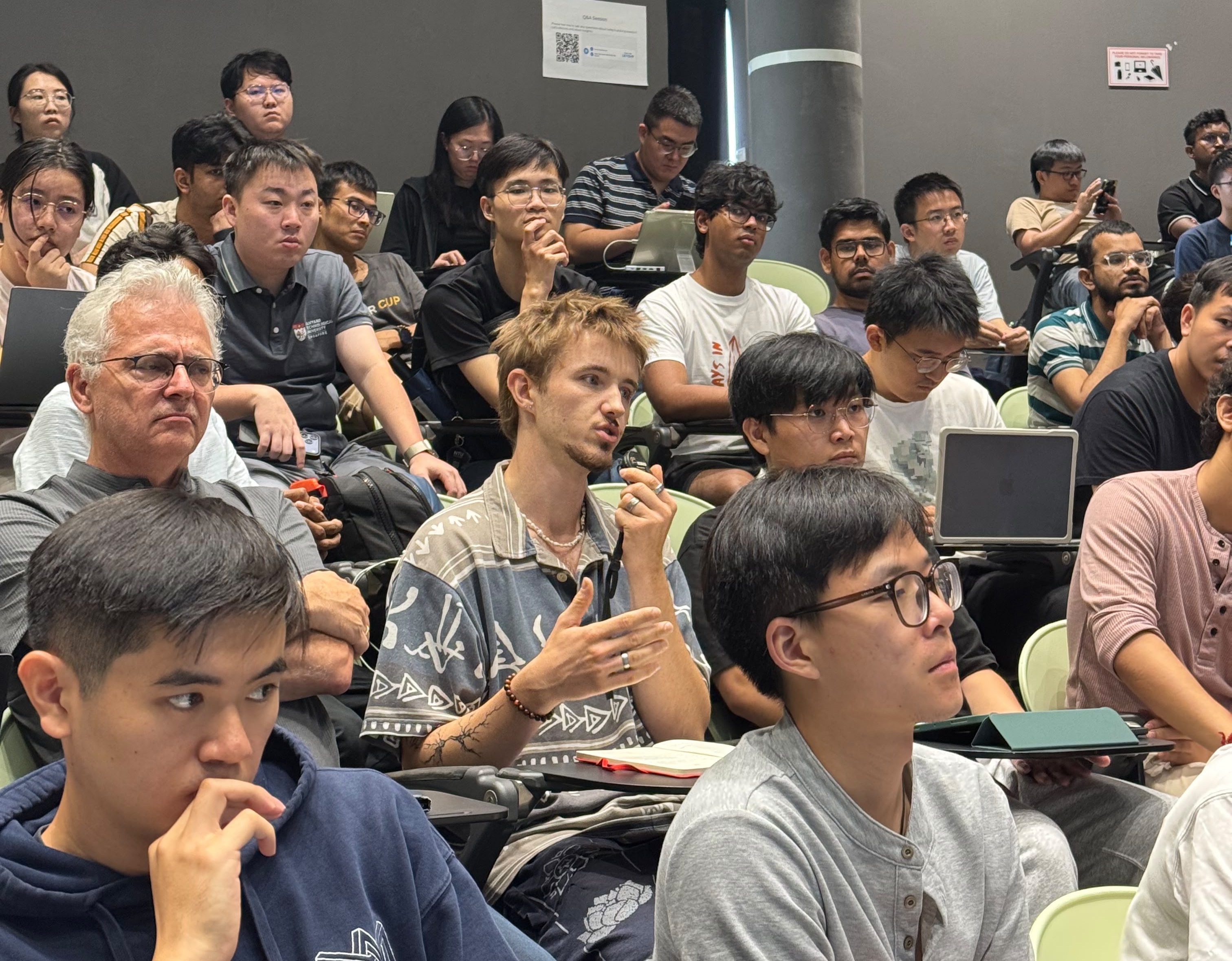 Attendees engaged with Prof Karniadakis in an active Q&A session addressing technical and operational questions.
The presentation concluded with an interactive Q&A session addressing key technical and operational questions:
Guardrails and Alignment: When questioned about trusting autonomous multi-agent solutions in critical applications, Prof Karniadakis explained that geometric fingerprints combined with validation against physical experimental data establish reliable guardrails.
Ill-posed and Open Problems: Regarding unsolvable or ill-posed boundary problems, he noted that agents leverage regularisation techniques and geometric mesh refinements to achieve stable convergence where standard approaches stall.
Unified vs Domain-Specific Knowledge Graphs: Responding to inquiries about future scientific AI architectures, Prof Karniadakis indicated that major AI research labs are actively building specialised models (such as dedicated math, physics, or biology agents) rather than a single monolithic knowledge graph.
Error Propagation in Multi-Agent Workflows: To prevent the propagation of false confidence, he highlighted the critical role of proposer-critic dynamics, systematic forensic analysis, and transitioning from empirical multi-agent design toward formal mathematical rigor.
Overall, the lecture illustrated how scientific machine learning is evolving from single-model PINNs toward autonomous, agentic discovery frameworks. Systems such as ATHENA and Graph ATHENA combine multi-agent reasoning, genetic algorithms, and geometric memory graphs to systematically determine optimal combinations of first-principles and data-driven models for handling complex scientific problems.
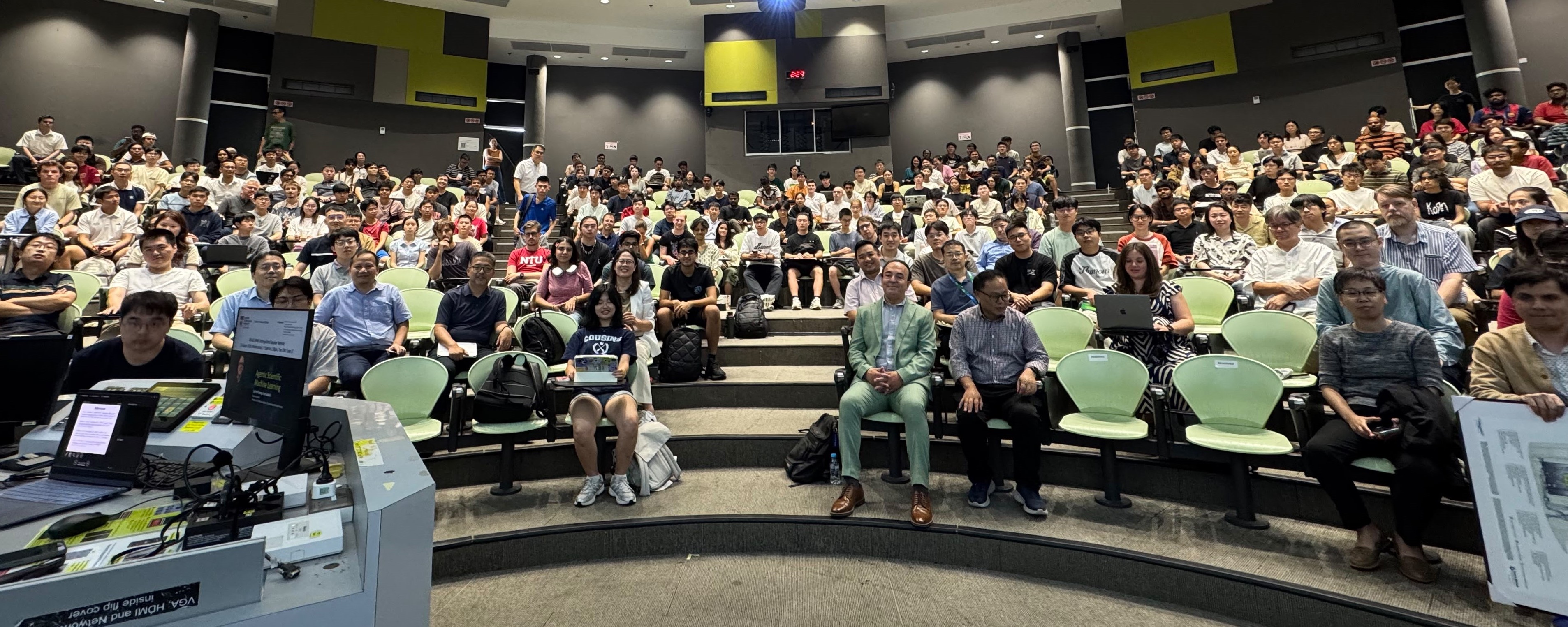
Written by: Fernandes De Conto Eduard | NTU College of Computing and Data Science Graduate Student’ Club
- "This seminar provided an excellent overview of the technological development path from PINNs to its integration with [AI] agents.” — Wenxuan Yuan (PhD student, CCDS)
- “One slide in the presentation particularly caught my attention. It presented ATHENA, a multi-agent system where specialised agents collaborate as a scientific research team. I found this idea of organising and coordinating different agents for scientific problem-solving especially interesting.” — Feng Peilin (PhD student, EEE)
- “The clarity in the presentation that allowed even a fresher like to get key concepts clearly.” — Anantharaam R (PhD student, CEE)
"I enjoyed how the professor provided an assessment of different GenAIs and how they solve scientific problems." - Bani Hakim Mohamed bin Bani Farook Mohamed (MSc student, CCEB)
"One slide in the presentation particularly caught my attention. It presented ATHENA, a multi-agent system where specialised agents collaborate as a scientific research team. I found this idea of organising and coordinating different agents for scientific problem-solving especially interesting." - Feng Peilin (PhD student, EEE)
"This presentation provided an excellent overview of the technological development path from PINN to its integration with agents. " - Wenxuan Yuan (PhD student, CCDS)
Watch the recording here.