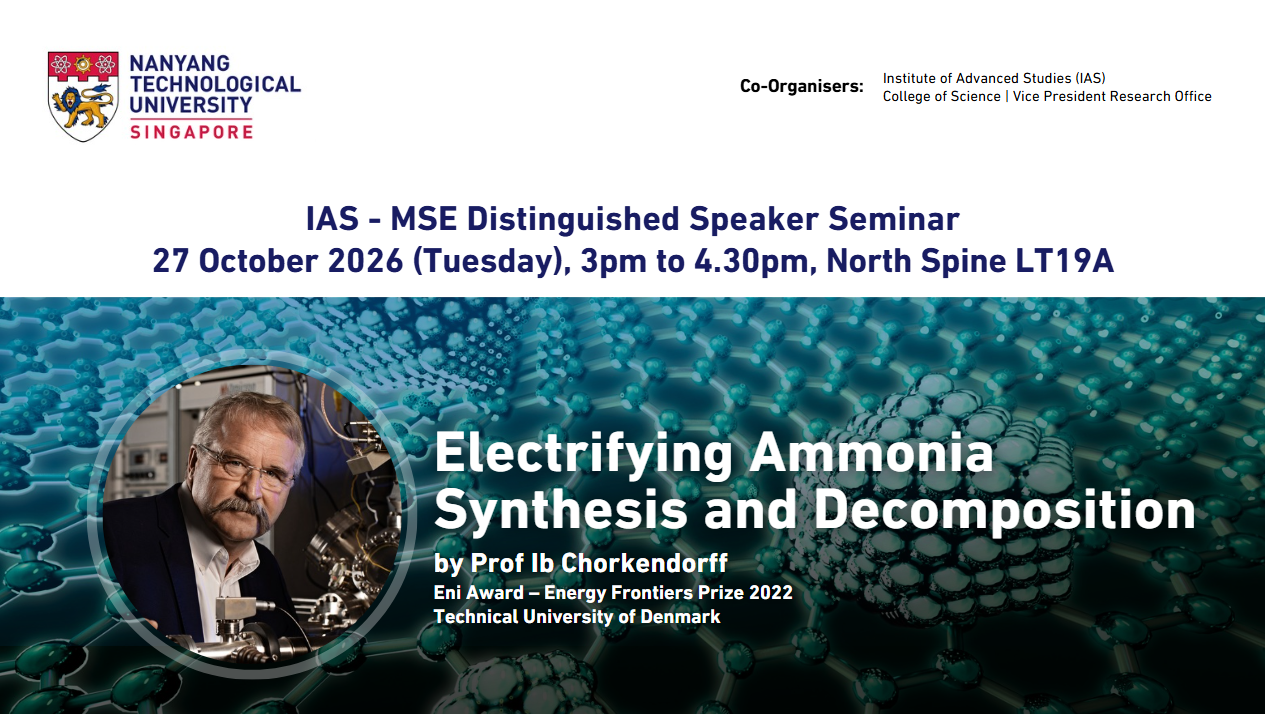
Electrifying Ammonia Synthesis & Decomposition by Prof Ib Chorkendorff
Harshita Samaur | PhD Student, NTU School of Materials Science and Engineering
On 27 October 2026, the IAS-MSE Distinguished Speaker Seminar hosted Prof Ib Chorkendorff from the Technical University of Denmark (DTU) and the Director of the VILLUM Centre for the Science of Sustainable Fuels and Chemicals. In his seminar, he outlined how ammonia can be decarbonised. He showed electrified reformers that shrink reactor volume a hundredfold, and lithium-mediated electrochemical synthesis improved Faradaic efficiency from 7% to 69%; spin-mediated promotion of cobalt catalysts and Ba-promoted cobalt for ammonia cracking offer new design routes. Since batteries cannot power ships, ammonia is a promising shipping fuel, though cracking inefficiency and water tolerance remain challenges.
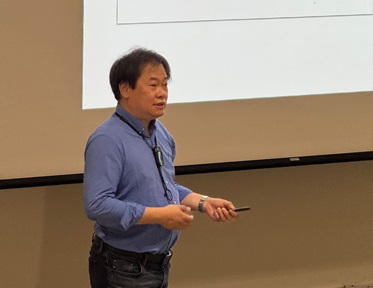
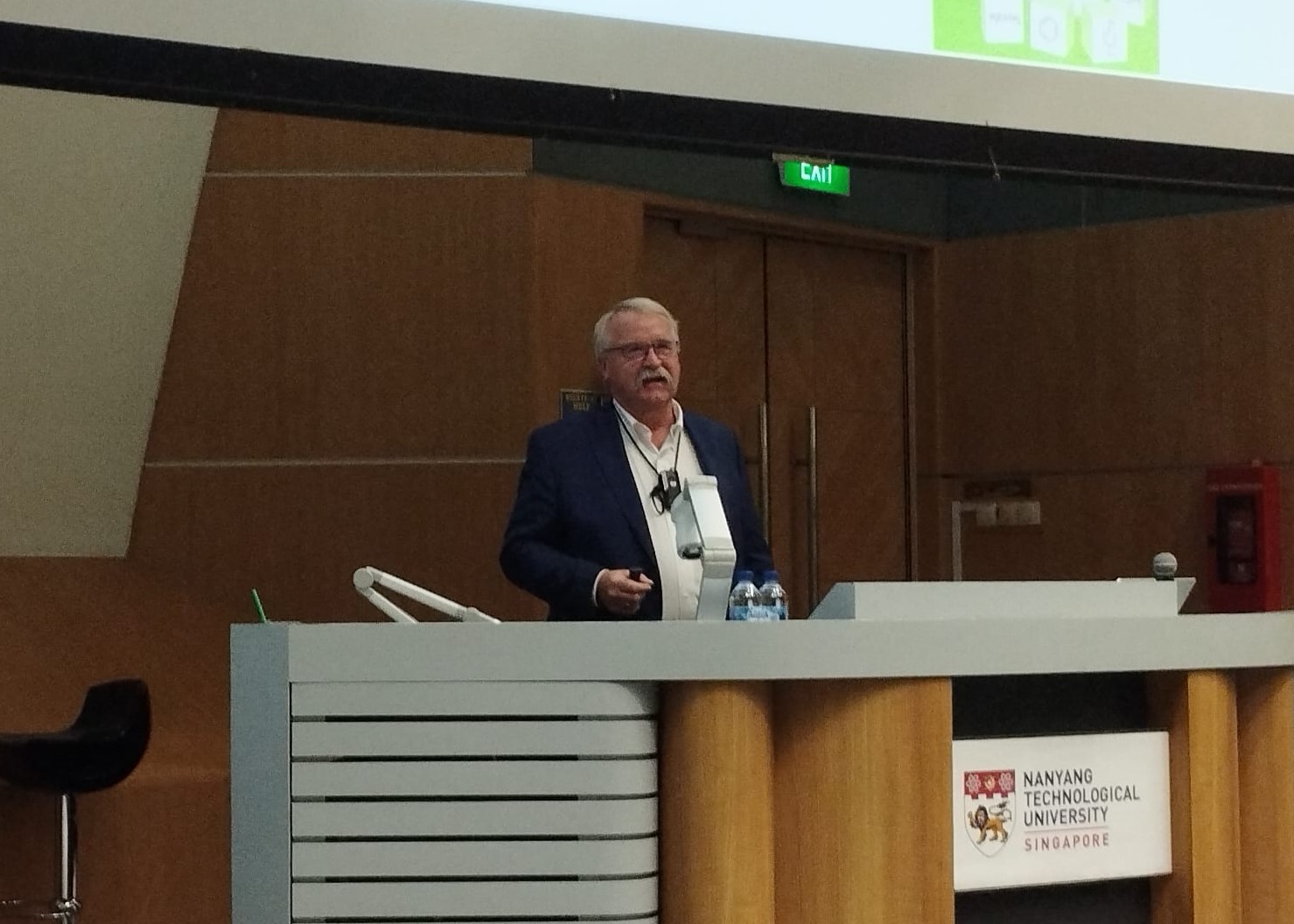 Prof Chorkendorff began his seminar with an overview of how ammonia can be decarbonised, and exciting new design routes ahead.
The Problem and Proposed Solutions
Ammonia fertilisers help feed about half the world’s population, but conventional Haber-Bosch production is carbon-intensive and can damage catalysts and reactor tubing. Burners heat catalyst tubes to about 1000°C, causing carbon buildup that blocks pores and may force shutdowns; metal dusting also corrodes the tubes. One proposed improvement is to heat the reformer directly with electricity rather than burning gas around it. This provides more even heating, and modelling suggests an electric reformer could achieve 95% conversion in about 15 m³, compared with 1,140 m³ for a conventional unit. Prof Chorkendorff said the approach could reduce global CO₂ emissions by about 1% and is being tested in a pilot plant. The talk also explored decentralised, solar-powered ammonia production using only air and water. However, direct nitrogen-to-ammonia conversion on metal surfaces remains difficult: the competing reaction that produces hydrogen is roughly ten orders of magnitude faster.
The Method
The group revisited an old approach that uses lithium as a helper. Because ammonia contamination is everywhere, they used nitrogen labeled with a heavier isotope and showed that the ammonia produced really came from the nitrogen gas. This work, published in Nature in 2019, gave a trustworthy starting point of about 7% efficiency. Prof Chorkendorff and the group made several improvements to further refine the method. One such improvement was swapping the solvent THF for diglyme, for which the group reached 69% efficiency and produced 4.5 g of ammonia over 300 hours in a small cell (Nature, 2024).
A Surprising Catalyst Effect
The group also studied cobalt catalysts supported on lanthanum nitride. During the reaction, lanthanum crept up onto the cobalt surface, and labelled nitrogen showed that nitrogen from the support took part in the reaction. Computer calculations then explained why the “promoter” atoms help. The old idea was that they push electrons onto the metal, but calculations showed this has almost no effect. Instead, the promoter creates a strong local electric field and changes the magnetic (spin) behavior of cobalt and nickel. This is a new way of thinking about how to design catalysts, and it explains why barium helps cobalt.
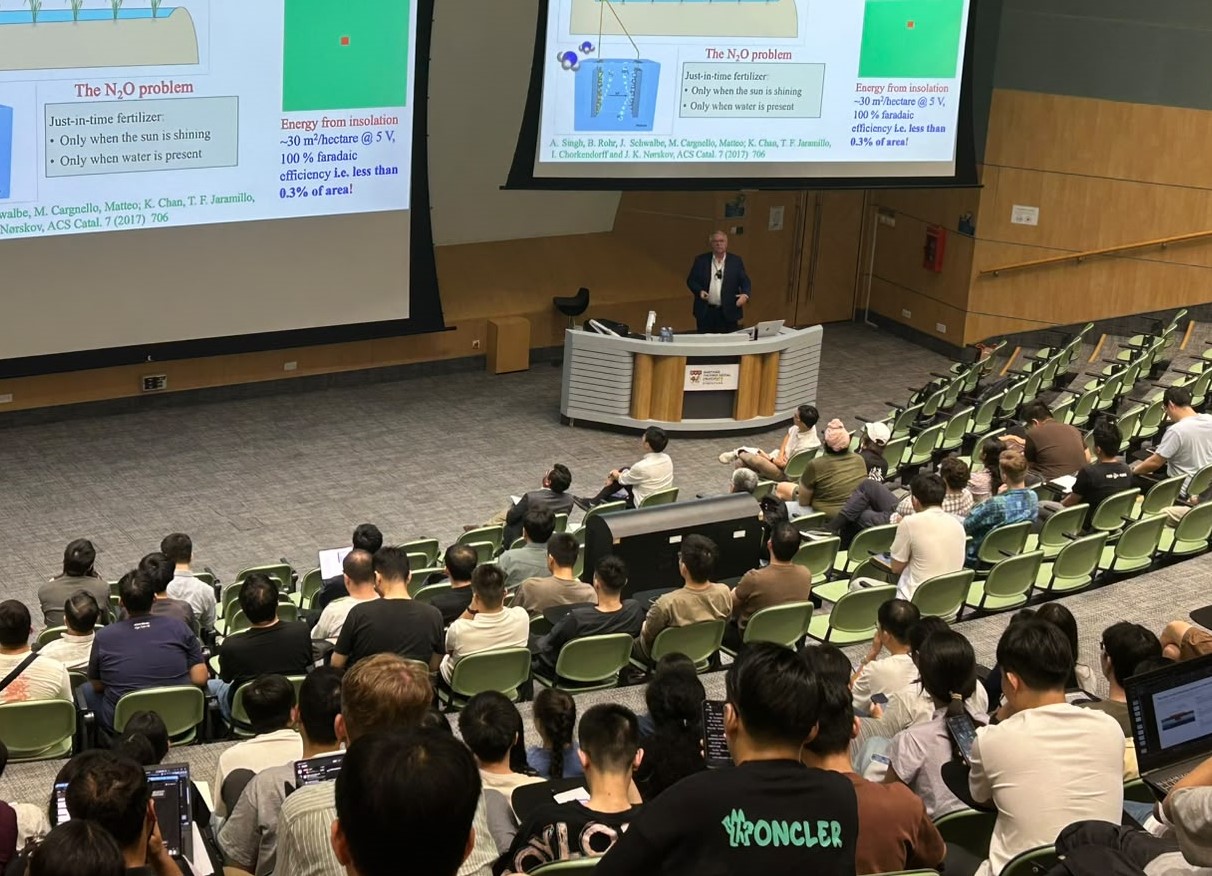 Prof Chorkendorff took the audience through an insightful journey of ammonia's applications to innovative catalyst design.
Ammonia as Ship Fuel
Global shipping includes about 100,000 vessels, burns around 300 million tons of fuel per year, and causes about 3% of greenhouse gas emissions. He explained that batteries take up about 600 container slots and weigh about 34% of the ship’s mass. Ammonia is a promising alternative; however, an engine cannot burn pure ammonia well, so about 10% must be split back into hydrogen to help it burn. Using theory to guide the search, the group found that barium-promoted cobalt worked very well, outperforming cobalt, nickel, and ruthenium on their own.
The Most Exciting Parts
- A reformer about 100 times smaller, already heading to pilot scale.
- Careful science in a messy field. Isotope labeling turned an often-unreliable reaction into one the community can trust.
- From 7% to 69% efficiency. Several smart changes added up to hundreds of hours of steady ammonia production.
- A new explanation for promoters, based on electric fields and spin, not electron transfer.
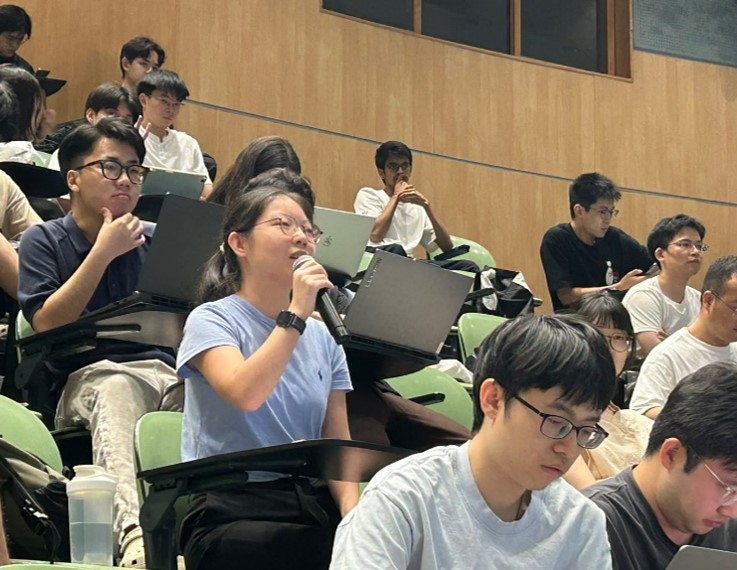 Attendees engaged with Prof Chorkendorff in an active Q&A session addressing technical and operational questions.
Looking Ahead
Prof Chorkendorff's main message was that electricity-driven ammonia still has room to improve, especially for local fertiliser production. He believes the best results will come from combining electrochemistry with the best thermal catalysts at slightly higher temperatures and low pressure. The same families of catalysts can be used both to make ammonia and to split it. He also pointed to Singapore. Sunny regions such as northern Australia could make ammonia from solar power and ship it here. Singapore, with limited land, could act as a hub where ammonia is cracked into hydrogen on demand for industry and fuel.
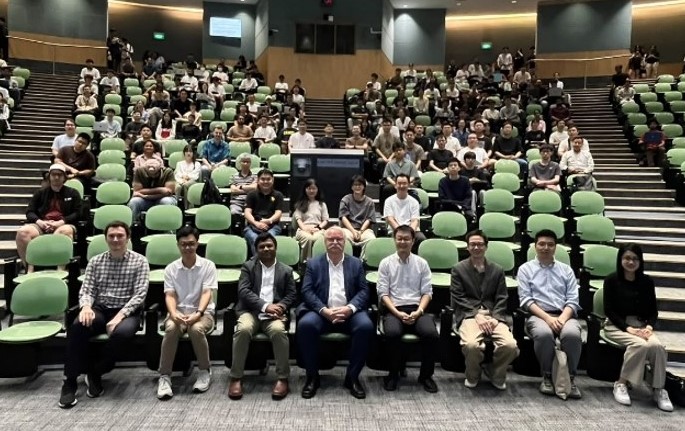
Highlights from the Q&A
1. Contamination: Ammonia can come from many unexpected sources, so clean gas and isotope checks are essential.2. Challenging earlier results: He admitted that correcting published claims meets resistance and takes time. His advice was to always ask for proof.
3. AI in research: AI helps with hard calculations and literature searches, but results must be checked by someone who knows roughly what the answer should look like. He compared it to pocket calculators: "We adapt and become more capable."
4. Advice to students: Both fundamental science and applied technology offer meaningful problems. “Choose work with lasting impact."
Watch the recording here.